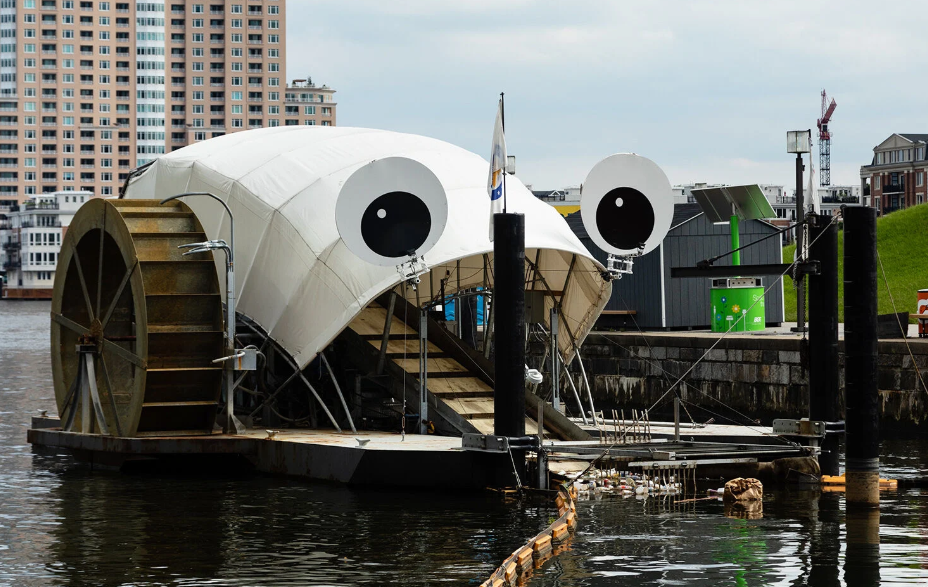
The family of googly-eyed trash wheels keeping Baltimore’s harbor tidy is about to get a new relative next door—on Back River in Baltimore County.
That litter interceptor stood out among 21 environmental restoration projects announced recently to honor settlement of a lawsuit over a string of pollution problems at Baltimore city’s two wastewater treatment plants, one on Back River and one on the Patapsco River.
Officials with the Maryland Department of the Environment, the city and county joined community activists at a riverfront park in Essex in April to mark the awarding of $1.7 million for the projects and to report major progress in the treatment plants’ performance.
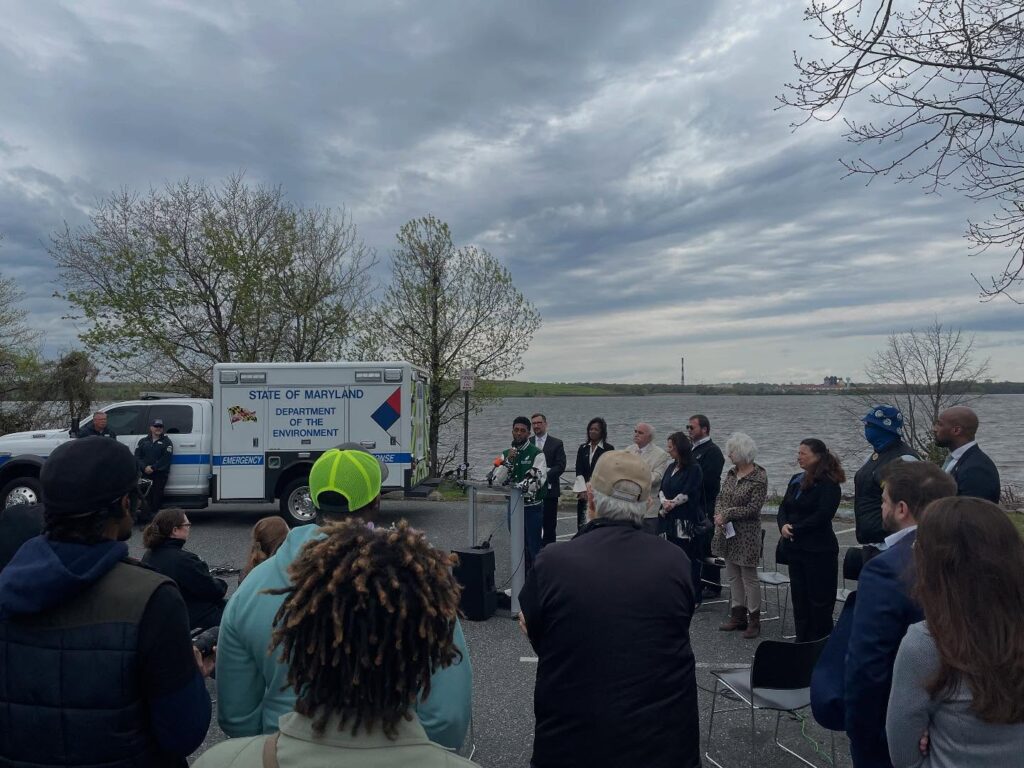
As part of a 2023 consent decree, Baltimore agreed to pay $4.75 million to settle lawsuits brought by MDE and the nonprofit Blue Water Baltimore over repeated violations at the two plants. Blue Water had alerted state regulators to problems with the Patapsco plant, which prompted an investigation and ultimately a temporary state takeover of the Back River facility.
Under the decree, 40% of that sum was to go to environmental restoration projects, while MDE was slated to collect $1.4 million in penalties. The city would be able to avoid paying another $1.4 million if it complied with the terms of the settlement.
According to MDE, nitrogen and phosphorus discharges from the two plants have declined by 60% to 80% since 2022.
The biggest recipient of the funds was the Back River Restoration Committee, which joined Blue Water Baltimore to press for state action to fix the plants’ maintenance and treatment problems. It is to receive $655,363 to design and build the wheel, which will replace a floating trash boom that must be constantly cleared manually of litter.
The remainder of the funds went to 20 other civic, neighborhood and religious groups around Baltimore for a variety of projects, including stream cleanups, rain barrels, permeable pavement, youth education, workforce development programs and native plantings. The Chesapeake Bay Trust is handling disbursement of the grants.
This story first appeared at bayjournal.com on May 5, 2025.