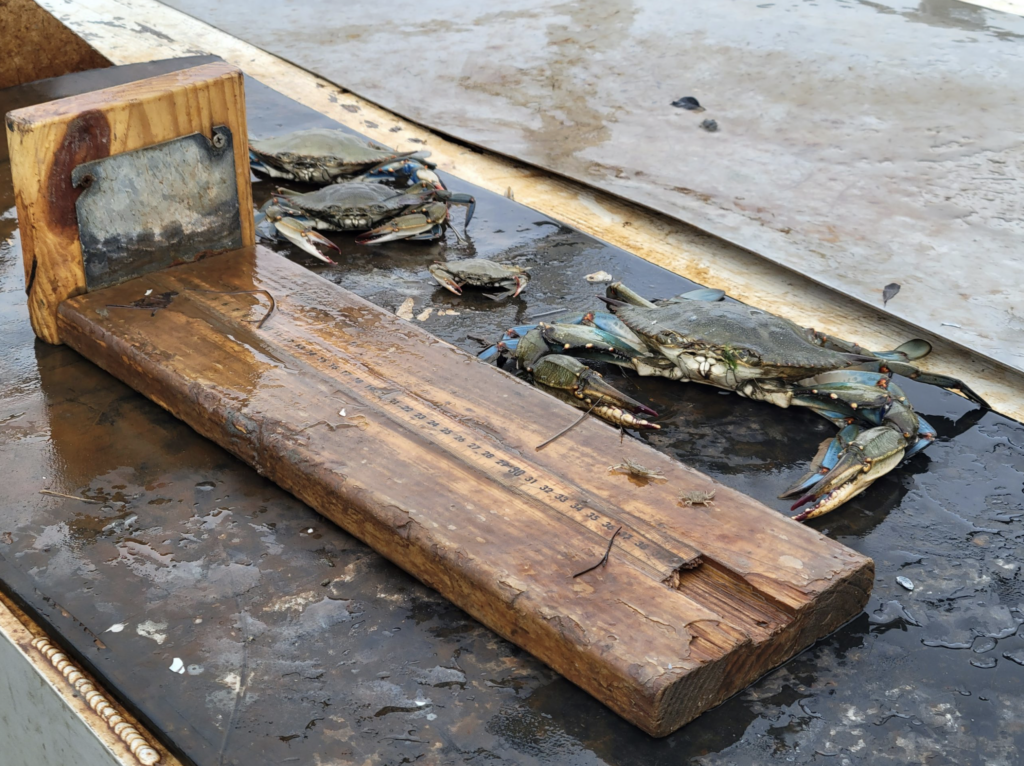
For once, there’s some good news about the Chesapeake Bay’s blue crab stock.
This year’s winter dredge survey conducted by the Maryland Department of
Natural Resources (DNR) and Virginia Institute of Marine Science, found sharp
increases in the numbers of male and juvenile blue crabs after years of declining
numbers and an especially harsh winter.
Mandy Bromilow, Maryland DNR’s blue crab program manager, was reluctant to
call it a comeback just yet, but she did say it was “encouraging.”
“We are hearing good things, especially about juvenile crabs,” she said. “We’re seeing
what could be a sustainable increase in the numbers.”
The only drawback was the drop in the number of females, she added. “But it’s nothing
we haven’t seen before.”
Zach Widgeon, spokesman for the Virginia Marine Resources Commission, one of the
agencies involved in the survey, said the decline in females could be at least partly
related to the harsh winter.
“It’s similar to what we saw back in 2014,” he explained.
The survey, conducted annually since 1990, samples 1,500 sites in the Bay and its
tributaries from December to March. This year, it estimated there are 349 million blue
crabs in the Bay, a 46% increase over the estimate of 238 million crabs last year.
Two-thirds of that total, about 228 million, were juvenile crabs, a 121% increase over
last year’s tally. That comes after six years of declining juvenile numbers and the 2025
survey recorded the second-lowest abundance of young ever found.
In addition, the survey estimated 37 million adult male crabs, a 42% increase from last
year’s record low near 20 million males.
Those are the highest numbers of male and juveniles since 2019.
Bromilow and Widgeon agreed that the increase in juveniles could be due to a number
of things, including changes in ocean currents in the areas where they spawn pushing
them back into the bay.
But while those numbers went up, the number of adult females decreased by 25%, to
81 million crabs. That’s lower than the numbers fisheries managers would like to see,
but not so low as to trigger new management action, such as harvest limits.
Even more encouraging, fisheries managers say, is that those numbers come after a
winter so harsh that it led to the deaths of about 20% of adult male crabs and 12% of
adult females, compared to an average of 9% and 7% male and female winter deaths
from 1996 to 2026.
Those numbers come just two weeks after a study released by Maryland, Virginia and
Potomac River fisheries managers showed that the Bay’s blue crab population has
declined by about 50% since 2010.
Bromilow said that finding “wasn’t anything new.”
“We’ve been talking about that for some time. The stock assessment report talks about
surveys up to 2023, so it’s difficult to connect the two.”
But don’t think those encouraging numbers are going to lead to managers easing
harvest restrictions, she added. “At least not this year.”
The dredge survey results and the long-term report come as Bay scientists are finalizing
a large-scale analysis of blue crabs and factors affecting their population. The draft
assessment found that there are more blue crabs than previously estimated in the Bay,
but that the crabs face an overall population decrease without a clear cause.
Over the next year, fisheries scientists and watermen from the affected jurisdictions will
discuss how to turn those results into a management framework designed to increase
crab stocks.
A similar study in 2011 led to management decisions that helped to bring the
Chesapeake’s blue crab population back from more than a decade of low abundance
and harvest levels.