Like ‘em or not, blue catfish are here to stay in the Chesapeake. Long adapted to our country’s big Midwestern rivers, they were stocked in Virginia’s large tidal rivers in the 1970s for recreational anglers, at a time when other fisheries were depressed. Unfortunately, the blue cats have “succeeded” too well in the Bay system in the ensuing fifty years, becoming the dominant species in multiple rivers and crowding desirable natives such as rockfish, white perch, and American shad.
Today, the blue catfish is considered an invader, and fishery managers in Virginia and Maryland are rightly developing commercial markets to reduce the population. More power to them; the 15-30-inch “eaters” are versatile and nutritious. According to NOAA’s Chesapeake Bay Office, a 4-ounce blue cat fillet includes 19 grams of protein, with only 90 calories and 1.5 grams of fat, plus healthy Omega-3 fatty acids. For an in-depth look, read this report from Virginia Cooperative Extension. At a time when other finfish stocks, especially rockfish, sit at low levels with tight restrictions, blue cats are local, fresh, abundant, and inexpensive. They provide economic opportunities, including jobs for an increasing number of watermen and workers in processing facilities.
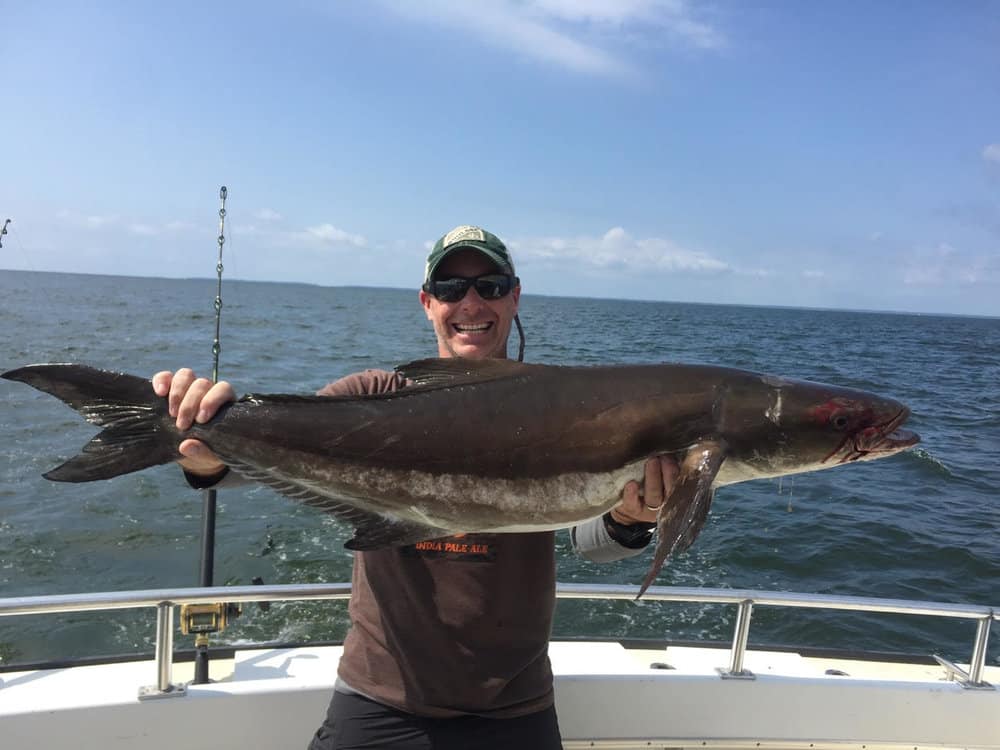
Even so, it’s valuable for us to remember the original reason for their introduction: they are recreational angling assets. Large blue catfish are powerful fighters, readily accessible trophies that drive tackle, bait, guide, boat, tournament, and tourism businesses worth several tens of millions of dollars to the region each year. Like bass anglers, trophy cat fishers carefully release their big fish, believing they are too valuable to be caught only once.
Another reason to release them is that as blue catfish (and many other fish species) grow, they eat increasing quantities of forage creatures whose diets include minute quantities of PCBs and mercury from sediment. The toxins collect in the cats’ body chemistry (bioaccumulate). Older, larger fish carry high levels. Thus, Virginia, Maryland, the District of Columbia, and the Potomac River Fisheries Commission all issue health advisories that warn against eating blue catfish larger than 30” long.
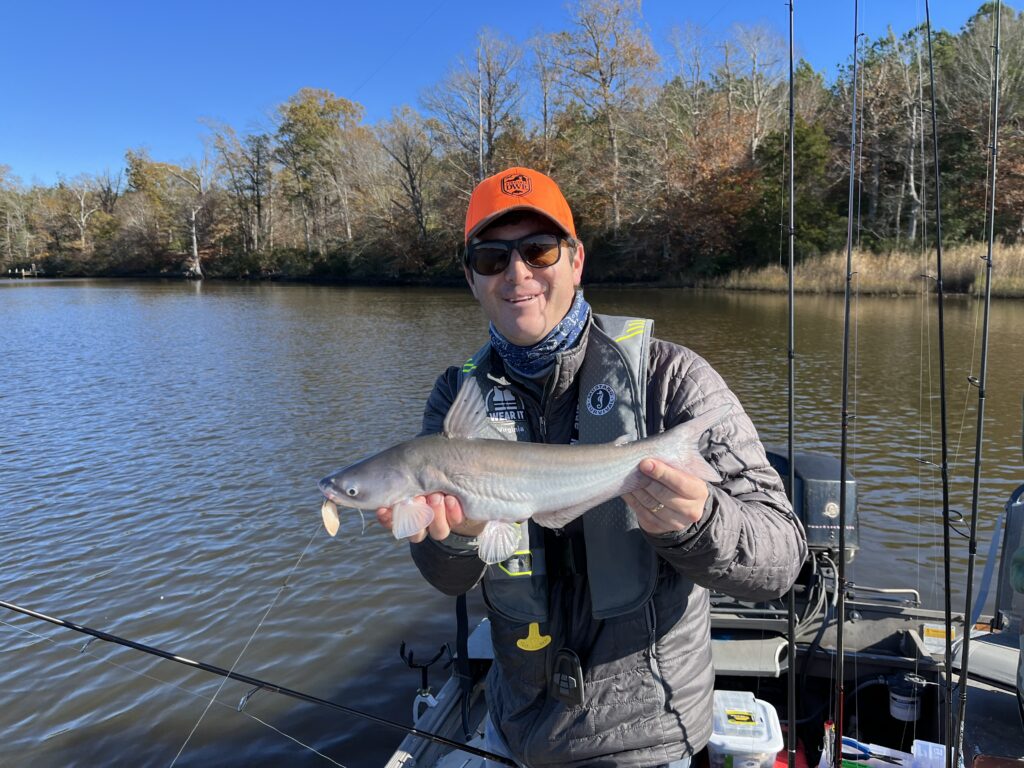
On their native rivers, however, anglers revere the smaller, 15-30” “eater” cats as panfish the way we do white perch, spot, and croakers on the Chesapeake. We need to recognize that value here. Like those established Bay favorites, the cats are fun to catch and good to take home for supper (see here for blue cat recipes from Maryland’s Best).
Here are some personal notes on those two attributes. First, as to bait, these fish are opportunists, ready to eat whatever is available wherever they are, including vegetation and shellfish as well as finfish. The “eaters” are adolescent predators that gather in schools along channel edges. In summer, some will forage in adjacent shallows early and late in the day, feeding on minnows, crayfish, insect larvae, worms, and anything else they encounter. Their barbels (“chin whiskers”) hold thousands of sensors that can taste, smell, and feel. Each fish’s lateral lines form a highly developed mechanoreception system, detecting physical disturbances in the water that help the animal sense prey and even navigate around obstacles or along channel edges.
Thus, in fishing for blue catfish, think fresh bait with combinations of taste, smell, and vibration. They will sometimes strike lures, especially spoons, spinners, and chatterbaits whose vibrations speak to those lateral lines, but live minnows and freshly cut bait (e.g., from gizzard shad) are more consistent. Other baits that work for me include whole nightcrawlers and strips or chunks of cheap, boneless chicken thighs. Marinate the chicken pieces in strawberry or cherry Jello (I’m not kidding), made up with only half the water in the recipe on the box. If you like, add a little garlic powder. Put them up in quart-size freezer bags and refrigerate till fishing time.
Lots of cat anglers fish baits like these on conventional bottom rigs such as the two-hook “high-low” or single-hook Carolina rig with a 1-2-oz. sinker, which work well from a pier, shoreline, or anchored boat. These rigs are naturals for family fishing trips. Any spinning or baitcaster rig rated for ¼-3/4-oz. lures with 10-20-lb. test line will work for this job (basically the sort of tackle anglers use for largemouth bass, redfish, and speckled trout). Watch the video How to Catch Blue Catfish in Virginia’s Tidal Rivers from Alex McCrickard, of Virginia’s Department of Wildlife Resources (DWR).
On a river like the upper tidal James or Nanticoke, I like to drift channel edges in my skiff with a baitcaster, using 10-lb. test braided line (and a similar rig in the hands of whoever is fishing with me). Like Alex, my rig includes some form of sliding sinker on the main line (the lightest I can get away with and still keep the rig bouncing on the bottom). I slip a fluorescent plastic bead onto the line below the sinker, then tie in a two-eyed swivel. To that, I tie a two-foot section of 15-lb. test monofilament leader with a small inline bobber pegged about six inches above a 3/0-5/0 circle hook (size it to fit your bait, larger if you combine chicken with nightcrawler).
The trick then is to look for fish on the sonar, especially where they congregate along a channel edge. There, I gauge wind and current to drift the skiff’s lines through them. There’s an art to that task, as winds can be fluky in the upper tidal reaches of the Chesapeake’s rivers, so keep at it, trying to visualize where the fish are in relation to the boat by looking at landmarks along the banks. Put a rod or two in holders, but keep one in your hands. Either way, let any fish that bites have the bait for several seconds and tighten up gently, so the circle hook slides into the corner of its mouth.
Blue cats of this “slot size” (15-30”) are strong and will pull drag for a few minutes before coming to net. To be humane and also optimize meat quality, dispatch a cat with a couple of blows to the skull (I use a 15” piece of a limb from a red cedar) and bleed it by cutting the “throat” at the base of the gills with a pair of sharp shears. Also make a vertical cut on each side at the base of the tail. I gut each fish completely, stuff its belly with ice, and place it carefully in a cooler with a slurry of ice and water. To get ready for filleting, please watch this video as DWR Biologist Scott Hermann or this one from Maryland’s Keith Lockwood.
Eater blue catfish: abundant, fun to catch, and good to eat while helping the Chesapeake. What’s not to like?