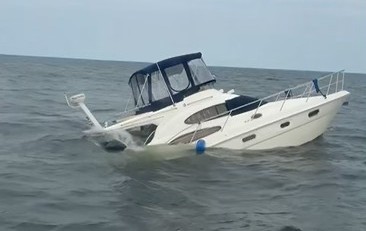
The video is enough to put the pit in any boater’s stomach: a 37-foot cabin cruiser in the lower Bay, slowly being swallowed up by the water as its stern and cockpit disappear under the surface.
The powerboat had two people on board when it began taking on water. The boaters made a distress call on Channel 16 from their VHS radio about 4 nautical miles east of Point Lookout in Southern Maryland.
The boat owner told the Coast Guard Sector Maryland-National Capital Region that the bilge pumps had kicked in and were initially keeping up with the flooding. However, when one pump failed, the situation quickly got worse and the boat’s stern began to submerge.
A charter captain who was in the area, David Rowe of Bay Quest Charters, responded and stayed with the boat until the Coast Guard arrived. A Coast Guard response boat from Station St. Inigoes reached the boaters just in time. The Coast Guard said, “Upon arrival, the Coast Guard crew safely rescued both persons on board seconds before the boat capsized and sank.”
The Coast Guard shared video of the boat sinking under the surface after the boaters were safely aboard the emergency response boat.
Thankfully, both of the boaters were safely brought to shore with no injuries or medical response required.
The Coast Guard praised the boat owner for being well-prepared for an unexpected emergency situation. Having a functioning VHF radio and always wearing a life jacket are vitally important, Sector Maryland-National Capital Region points out.
The Coast Guard also reminds boaters to perform regular equipment checks before heading out on the water. In some cases, bilge pumps can mean the difference between life and death or can keep your boat from sinking to the bottom of the Bay.
There are many reasons a bilge pump can fail, and our partners at the Annapolis School of Seamanship (ASOS) say this is the time of year it when it often happens. Often, systems that were working fine last season suddenly don’t work anymore due to corrosion or frayed electrical wires.
You can test your bilge pump at the dock by turning on the manual switch to confirm it’s running, or simply by spraying some hose water into the bilge to see that it automatically kicks in.
You should also do a visual inspection of the bilge regularly, says ASOS Vice President Capt. Matt Benhoff. “You’d be surprised what ends up in there,” he tells us. Screws and other small bits from your boat could damage the bilge pump without you even realizing it.
Another factor to consider is your boat’s battery. Because the bilge pump runs on battery power, if you haven’t had your engine running in awhile, and the bilge pump is forced to working overtime because you’re taking on water, you may run out of battery power.
If you have water in the bilge due to a hole or leak in the hull, water can come in surprisingly quickly. Benhoff says a one-inch-diameter hole in the hull that sits one foot below the water line can allow over 1100 gallons per hour to enter the boat. If the hole is two inches in diameter, the flooding rate increases to 4700 gallons per hour—a challenge for any bilge pump to keep up with.
ASOS President and CEO John Martino also points out that it can take awhile before a boat operator notices the boat is taking on water. An indicator light on the instrument panel isn’t always easy to notice right away. He recommends installing a bilge alarm with a float switch that sits just a few inches above your bilge pump’s float switch. That way, you’ll be alerted quickly that your pump isn’t keeping up with the water coming in.