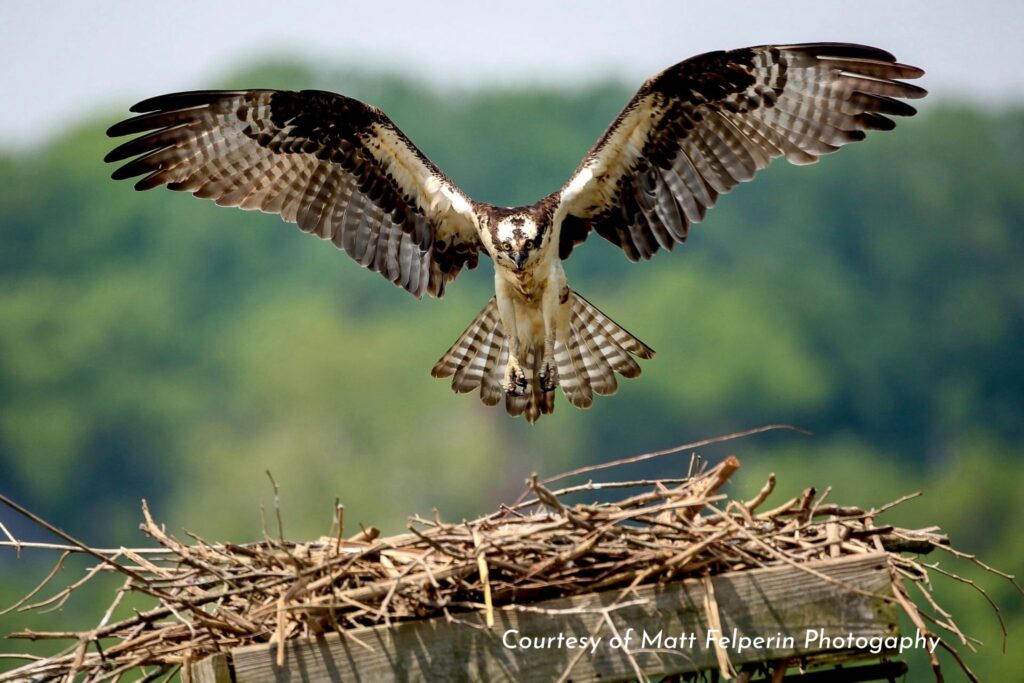
Recently, much has been written—and debated—about the decline of successful osprey breeding in the Chesapeake Bay. An eye-opening study of the osprey population in Virginia’s Mobjack Bay back in 2023 first sounded the alarm on osprey nest failures and the possible shortage of available prey (primarily menhaden) for the raptors to feed their chicks. The study area focused on one part of the Bay, so some criticized that it wasn’t representative of the entire Chesapeake.
Since then, the Center for Conservation Biology at William & Mary (CCB) has been expanding its tracking of osprey nests around the Bay, relying on partner groups to observe the nests in far reaches of the watershed. In 2024, the results were grim. CCB found that in several high-salinity areas of the lower Chesapeake—Mobjack Bay (Ware River, North River, and East River), the lower York River, and the Lynnhaven River—only 17 out of 167 nests were successful. A total of 21 osprey chicks survived that year. Osprey pairs in relatively fresh water (where osprey feed on mostly gizzard shad and catfish, versus menhaden in the saltier tributaries) fared better.
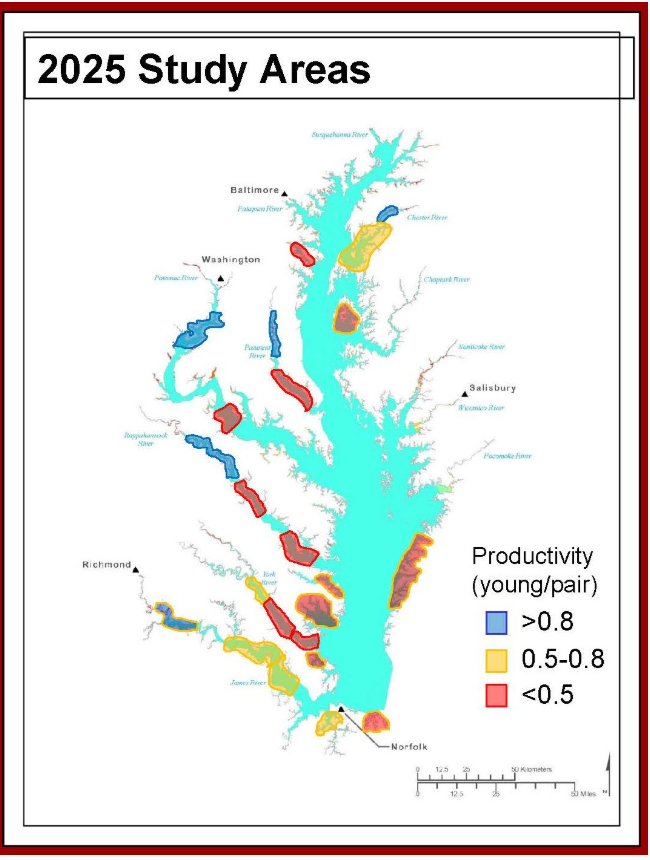
CCB’s 2025 breeding study includes 1,025 osprey pairs in 23 different study areas around the Chesapeake Bay, nearly double the number they studied last year. The areas range from tidal-fresh waters to salty ocean-strength waters at the mouth of the Bay. The osprey pairs were tracked throughout nesting season (March through August) to see how many chicks they produced, and whether they survived. While the freshwater osprey pairs continue to have healthier breeding results than the high-salinity pairs, all areas saw less nest productivity than last year.
In the saltiest waters, those above 18 parts per thousand, productivity averaged out to only 0.25 chicks per osprey pair. To keep a population stable, the breeding performance needs to be at least an average of 0.8 young per pair. 18 study areas fell below this stable-population threshold. Many pairs failed to produce any young at all in 2025.
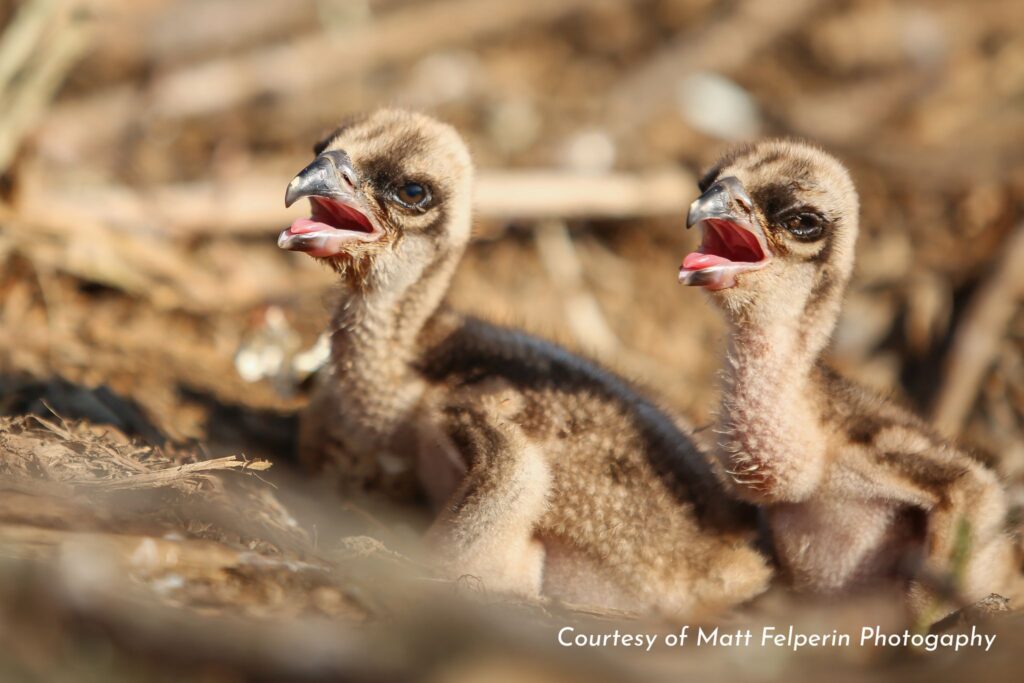
CCB says that researchers visiting the nests observed the largest contributing factor appeared to be the loss of young likely due to starvation. Broods with only one chick, loss of young, and nest failure are all indicators of food stress, the scientists say.
CCB notes in its study results, “The osprey breeding performance documented in higher salinity waters in 2025 is not high enough to sustain the osprey population in the Bay.” The most concerning detail is that a larger section of the Bay is being affected than the previous research showed. The area of the osprey chick deficit includes more than 80% of the surface waters of the tidal Chesapeake.
Is the overall osprey population about to plummet, based on these reproduction numbers? Do the signs of starvation indicate there is a menhaden shortage? These are questions that will be posed at an upcoming panel discussion put on by Eastern Shore-based lifelong learning organization Chesapeake Forum. The event, titled Our Disappearing Osprey, brings together experts on the issue, including osprey scientist Greg Kearns, who gathered some of the data in the 2025 survey; Chesapeake Legal Alliance Executive Director David Reed, who advocates to protect the Bay’s forage fish population; and Will Poston from the Chesapeake Bay Foundation (CBF), which has been calling for further study on the menhaden fishery inside the Bay.
Poston says in response to the CCB study, “Alarm bells are still ringing up and down the Chesapeake Bay. Unfortunately, 2025 was another year during which scientists saw osprey chicks starving in nests along the saltier waters where they traditionally depend on menhaden for food… The Chesapeake Bay is changing, and the science remains woefully inadequate.”
The Bay Foundation goes a step further, calling for a pause to menhaden fishing in the Bay until science shows whether the forage fishery is sustainable. They ask Atlantic Coast fishery managers to “heed the results” of recent stock assessments as they manage catch limits.
The menhaden fishing industry disputes CBF’s interpretation of the CCB study findings. In a statement, purse-seine fishing operators Ocean Harvesters write, “As Virginians, we share the public concern about the poor 2025 osprey breeding results reported by the Center for Conservation Biology (CCB).”
Their primary argument is that the nesting failures and starvation happen soon after hatching begins in April or early May, before Ocean Harvesters begins fishing in the Bay. They point to a CCB observation that reads, “Most young that starve in the nest die within the first two weeks after hatching.” Ocean Harvesters point out, “CCB records pairs arriving late February and early March; many never laid eggs at all, events that obviously precede any fishing and indicate that birds may not return to the area in good health.”
CCB acknowledges that food availability in the Bay is not the only factor causing osprey breeding to struggle. The study finds that weather events, like high winds and extended rains damaging nests, also played a role. They cite an example in the upper James River study area, where osprey pairs make their nests on floating buoy markers. Winds there were unusually high, tilting the buoys enough to pitch active nests into the water.
The lecture Our Disappearing Osprey will be held Tuesday, Nov. 4, 4:30-6:30 p.m. at the Avalon Theater in Easton, Maryland. Chesapeake Forum is holding the event to give the public a bigger-picture look at where ospreys stand in the Bay, rather than just an anecdotal look at what they may see from the dock.
They also hope to give people an opportunity to take action, rather than just walking away from the lecture shaking their heads.
You can read more details of the 2025 Center for Conservation Biology Study here. Editor’s note: this link does include images of failed nests and deceased birds.