When we think of American history filmmaking, we think of Ken Burns. His films The Civil War, Baseball, Jazz, The Vietnam War, and others, have shaped how the public sees our history and culture. Now, in time for America’s 250th birthday, Burns turns his attention to the start of our nation with the upcoming release of his co-directed film The American Revolution.
Well before the documentary’s release date of Nov. 16, Yorktown, Virginia, will get its own special screening. This Saturday, Sept. 20, a 56-minute sneak peek film will be shown on the grounds of Yorktown Battlefield. It includes scenes from the entire six-part documentary. Saturday’s event, called We the People: A Yorktown Battlefield Event, will begin at 3 p.m. and culminate with the screening at 7 p.m.
In the afternoon, visitors can enjoy a Revolutionary Festival that includes artillery demonstrations, Colonial music, living history encampments, tours, and food trucks. Kids can immerse themselves in history by “enlisting” in the Continental Army and learning to march at a militia drill station. Revolutionary Spy Games allow kids to solve secret codes about fun historical facts, and there will be period clothing to dress up in.
The We the People event is put on by Colonial National Historical Park, in partnership with WHRO Public Media, York County, the Jamestown-Yorktown Foundation, and the VA250 Commission. David Schmidt, who co-directed the film with Burns and colleague Sarah Botstein, is a Virginia native and will introduce the film at the We the People event.
Schmidt, who began as an apprentice with Burns’s film company Florentine Films, grew up in Williamsburg and even worked in Colonial Williamsburg with the Fifes and Drums. “I played the fife, I wore the tri-corner hat… I like to say I grew up in 1774,” he quips. Living in Williamsburg and watching Burns’ earlier films as a kid lit a fire in Schmidt: a passion for telling the story of history.
Though Schmidt has worked on four preview Burns documentaries, this one is “like coming home”, he says.
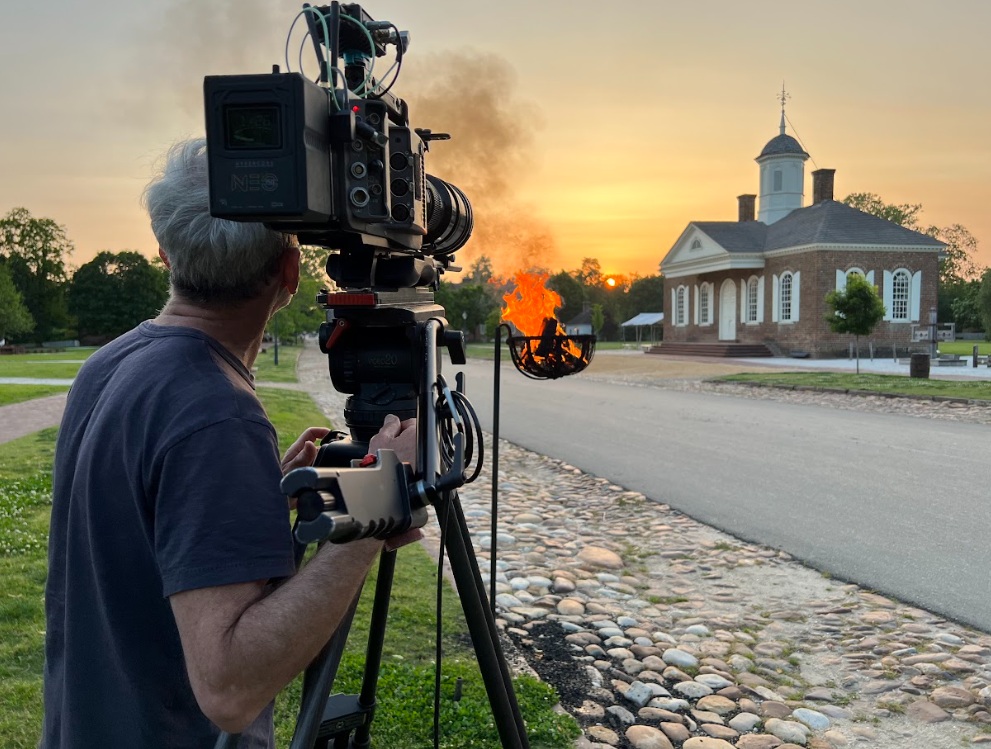
One big challenge in making The American Revolution is that there are no photographs, moving footage, or living witnesses left behind from Colonial America. It has taken the team 10 years to bring the story to life. The filmmakers shot scenes at historical sites with the help of reenactors. They commissioned some new artwork and used some from artists who lived through the war. They relied on maps from the Colonial period, but also brought in newer technology like CGI recreations of places like Yorktown and drone shots of marching soldiers.
Schmidt tells us the film partly focuses on showing the difficulty of wartime logistics before there were railroads, tanks, or planes. “You have to see people marching, the hands at the loom making the clothes that clothed the Army, and the animals moving to carry their supplies. You want to see what it actually takes. It’s kind of a handmade struggle,” he explains.
The Chesapeake Bay region played a key role in the Revolutionary War, not just in the “Historic Triangle” of Yorktown, Jamestown, and Williamsburg, but at other sites, too. Schmidt lists a battle in Chesapeake, Virginia, the Battle of the Capes (between Cape Charles and Cape Henry at the mouth of the Bay), the important site of Mt. Vernon, and the soldiers’ route through Elkton, Maryland, at the top of the Bay.

The Chesapeake Bay itself was used as a war strategy, because its shape and its tributaries allowed for extensive travel by water and more effective shipped throughout the region than other parts of the country.
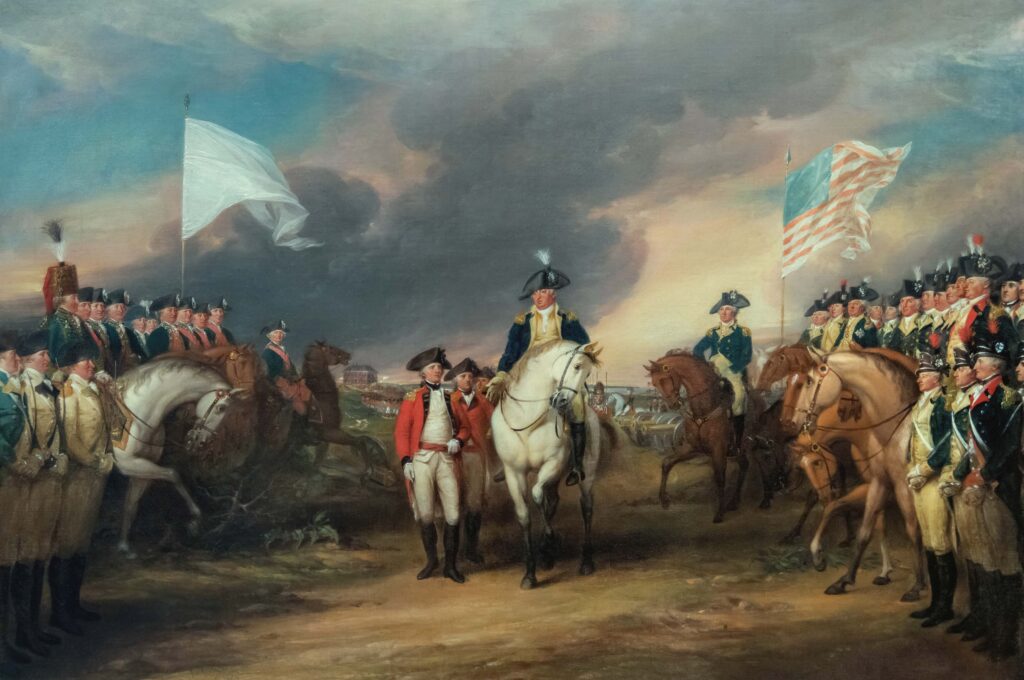
The screening at Yorktown is unique because people will be able to take in the film at the exact spot where the war ended. “To be present at the place where one of the most important moments in human history happened, I think is going to be really special,” Schmidt says. The film premiers on PBS on Nov. 16, and Schmidt says Yorktown has a presence in virtually every episode.
While the event and screening are free and open to the public, registration is required. You can sign up here. Visitors are encouraged to bring lawn chairs, water, and to prepare for the weather since the event is rain or shine. For more information, call (757) 898-2410. The screening begins at 7 p.m.
If you can’t make it to Yorktown this weekend but would like to see the film in person, another screening will be held Oct. 29 at Mt. Vernon, introduced by Burns and Botstein. Maryland Public Television will also hold a preview screening at the Maryland Center for History and Culture in Baltimore on Nov. 14. Learn more here.
Schmidt and his co-directors aim to show The American Revolution far and wide. “We’re trying to get people talking about this because this story belongs to everyone,” Schmidt says.