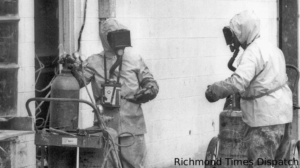
Today, the James is arguably the healthiest river in the Chesapeake system. Fifty years ago, though, it was arguably the most polluted. Its future looked dark. Just the year before, in 1975, Virginia’s Department of Health had closed the entire tidal portion of the river, from Richmond to Hampton Roads, to all fishing, both commercial and recreational, because of a year-long, criminally negligent spill of the insecticide Kepone. A small chemical business in Hopewell had been dumping some into the river in the process of supplying the compound to nearby Allied Chemical.
The disaster was the most obvious cloud for the river’ waters, wildlife, and people, but the James was already suffering from several hundred years of day-after-day silty agricultural runoff flowing out of its 10,432-square-mile watershed, plus industrial pollution from Covington and Richmond upriver to Hopewell and Smithfield downriver (remember that the federal Clean Water Act had passed in 1972, only four years before), and sewage combined with polluted urban stormwater coming out of Lynchburg and Richmond. Body-contact watersports had been a No-No on the river below Richmond for at least a century.
So, what happened? What magic made this worst-to-first miracle come about? In hindsight, the James’s resurgence came with long, sustained, often low-profile hard work. The lesson is that environmental progress is often incremental, cumulative, and measured over decades.
It started small. In the late summer of 1976, 140 landowners on the lower James across Charles City, James City, Prince George and Surry Counties came together to form the Lower James River Association (LJRA). Their aim was to provide an organized voice for the James in the General Assembly and before regulatory bodies, especially the State Water Control Board, as the provisions of the Clean Water Act began to take hold. For example, in 1981, LJRA appealed to the State Water Control Board, the EPA, the U.S. Army Corps of Engineers, and the Governor’s Office to monitor dredging on the James River and prevent Kepone recontamination.
By 1983, it had become apparent that the Association needed a professional staffer. Thus, its first Executive Director, Patti Jackson, came onboard to attend the signing of the first Chesapeake Bay Agreement by the governors of Virginia, Maryland, and Pennsylvania, along with the mayor of Washington, D.C. The goals and structure of that long-term effort have helped shape much of the work happening throughout the James River watershed, while also illustrating how sustained commitment, partnerships, advocacy, restoration, and public investment are necessary to achieve lasting progress. In an example of the latter, Richmond and Lynchburg made great strides in the eighties in improving sewage treatment (which continues).
Five years later, Patti Jackson and several helpers completed the Lower James River Corridor Study, which detailed the relationship of natural, historic and man-made features of the river and its shore. It provided a roadmap for river advocacy. In a most encouraging sign of renewal that year, the Virginia Board of Health lifted the ban on lower James River fishing due to Kepone contamination. Amazingly, both water quality and recreational fishing for largemouth bass in the upper tidal river had by then improved so much that the James began to attract major tournaments, a potent sign that cleaner water could foster economic development.
The year 1991 brought LJRA’s first Watershed Management Plan, a comprehensive look at how partnerships, advocacy, and public investment could lead to river restoration. The following year, Governor Douglas Wilder awarded LJRA the Governor’s Environmental Excellence Award. Then, in 1995, LJRA and the upper river’s Friends of the James merged to form the James River Association (JRA), allowing the new organization to focus on the entire watershed. Examples of that focus in succeeding years were the Riparian Buffer Planting program (“boots on the ground”) and the Virginia Water Quality Improvement Act, which JRA helped to pass in partnership with the Chesapeake Bay Foundation’s Virginia Office.
JRA launched its James RIVERKEEPER program in 2001to be the eyes, ears and voice of the river (“boats on the water”) as part of the international WATERKEEPER Alliance. It includes not only a professional staff but also the James RiverRat Volunteer Program. Realizing that education of young people is an essential investment in the river’s future, JRA partnered in 2003 with Virginia Commonwealth University’s Rice Rivers Center to develop hands-on education programs for school students.
In 2005, Patti Jackson retired after firmly establishing JRA as a valuable player in the broader Chesapeake cleanup effort. Richmond native Bill Street succeed her, bringing a broad set of environmental, management, and on-the-water skills to the organization. Under his tenure, the Association has continued to grow in size and reach as a powerhouse throughout the James River’s huge watershed, with offices, boats, and active programs now based not only in Richmond but also in Lynchburg, Williamsburg, and Hampton.
Building beyond its long-term strengths in policy and advocacy (“ensuring a healthy, resilient waterway for all communities across Virginia”), JRA staff and volunteers now provide diverse programs in Community Conservation (“empowering residents of the 10,000 square-mile James River watershed to implement river-friendly conservation practices at home.”), on-the-water Students of the James (“bringing watershed science to life for students across Virginia”), and Watershed Restoration (“building riparian buffers in the Middle and Upper James, living shorelines in the Lower James, and green infrastructure solutions in our urban and suburban areas”).
In 2019, the James River Association received the prestigious Thiess International River Prize, considered the most coveted award of river and watershed restoration. The Thiess River Prize “inspires innovative initiatives that promote river resilience, encouraging winners to develop ‘bankable’ projects that provide effective solutions to the most pressing issues faced by our waterways.” When Bill Street asked the Chair of the International River Foundation what common factors he saw in previous River Prize winners, he replied, “Persistent, sustained effort.” Here’s to another fifty years, JRA!
There’s a lot more to see and learn about America’s Founding River on JRA’s website, including Our Mission in Motion videos about the Association’s 50th Anniversary and its on-the-water education programs for school students and adults (that’s everybody!). Also visit the remarkable story of The Great Return of the Atlantic Sturgeon. For a detailed, scientific look at the actual conditions in and on the water, take a look at JRA’s State of the James reports, published every two years since 2007.