We share the bacteria levels in Bay waters on our social media pages each week. ShoreRivers provides CBM with the weekly bacteria results from the Choptank, Sassafras and Chester Rivers and other bodies of water every Friday and we post them for our readers.
While we cover our local rivers, you may be wondering how to check the water quality if you are heading to Virginia or other parts of Maryland.
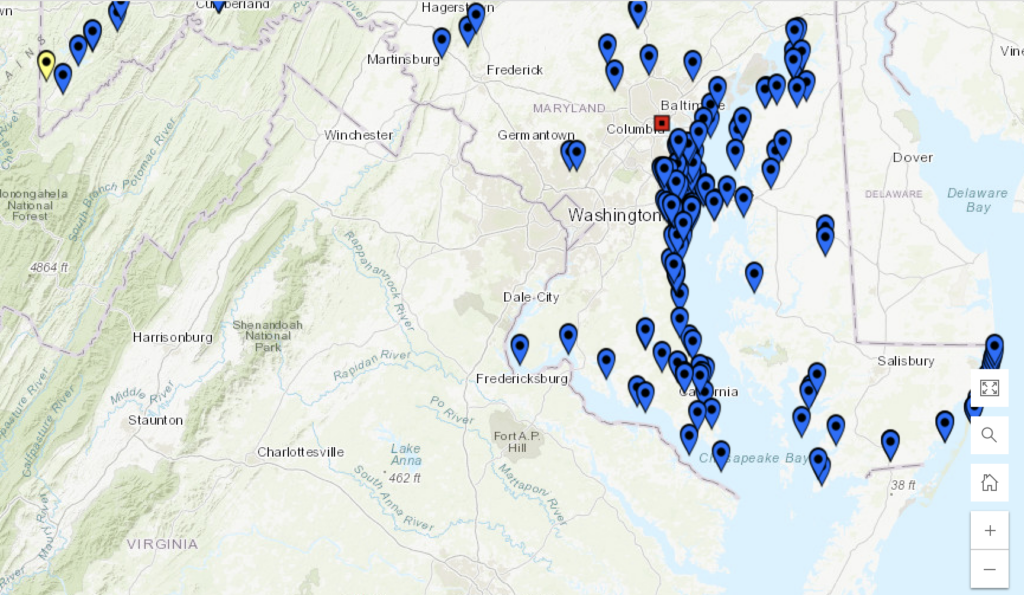
In Virginia, the Virginia Department of Health (VDH) has created a map that shows beach sampling and monitoring from May – September. Go to https://www.vdh.virginia.gov/waterborne-hazards-control/swimming-advisories-and-monitored-beaches-map/ and zoom in to see if your area has a blue flag (indicates bacteria sample results are within a safe range); red triangle (indicates bacteria levels exceed the established safety criteria; yellow triangle (lets you know sampling was not conducted in that area) or grey circle (tells you the beach season has ended and sampling and monitoring will not occur).
VDH monitors for bacteria called enterococci. When high levels are detected, it could cause recreational water illnesses. Recreational water illness symptoms include vomiting, diarrhea, abdominal pain, skin rashes and wound infections.
There’s also a harmful algal bloom map from May – October, which can be found here https://www.vdh.virginia.gov/waterborne-hazards-control/algal-bloom-surveillance-map/. It includes a form to report an algae bloom.
In Maryland, if you visit https://mde.maryland.gov/programs/water/MHB/Pages/Maryland-Healthy-Beaches-Home.aspx and click on “Check My Beach,” you can find out if its okay to enter the water. The Maryland Department of the Environment monitors for indicator organisms, such as enterococci and E. coli. Alerts posted on the Maryland map include “Closed,” “Not Recommended,” “Algae Bloom” and more.
“A heavy downpour essentially flushes everything on land—from garbage and pet waste to agricultural fertilizer—straight into our local rivers and beaches,” says Dr. Ben Espinosa, an infectious disease expert focusing on outbreaks in both the US and Africa. “This sudden influx causes a rapid surge in harmful bacteria. Giving the water 24 to 48 hours to naturally dilute and clear out after a major storm is your best shield against waterborne pathogens.”
VDH has tips to protect yourself while enjoying the water:
- Avoid swimming in water that has an unusual odor, appears stagnant, or is visibly muddy.
- Obey posted warning signs near swimming areas.
- Avoid swimming near pipes, fishing piers, or water flowing from storm drains onto the beach.
- Prevent children and pets from swallowing water while swimming.
- Stay out of the water if you are ill or have a weakened immune system.
- Wait a few days after a heavy rainfall before swimming.
- Use appropriate toilet facilities and properly discard trash, pet waste, and dirty diapers.
- Avoid swimming if dead fish are present.
- Shower with soap and water after swimming.
- Protect cuts and open wounds with waterproof bandages to prevent direct contact with water.
- Contact your local health department if you suspect water contamination.