Editor’s Note: As the city of Baltimore grapples with sewage overflows, urban runoff, and other clean-water challenges, Mr. Trash Wheel’s cultlike following is still finding fun, positive ways to advocate for Inner Harbor health—like this unconventional “dumpster dive” event we experienced over the weekend.
“Mr. Traaaaash Wheel, Mr. Traaaaash Wheel, Mr. Traaaaash Wheel, he’s the hero of the harbor!” The refrain echoed through the warehouse of the Baltimore Community Toolbank as a band of blue-jumpsuited staff led the sing-along with ukuleles and tambourines. Wacky jellyfish-umbrellas, decorated with streamers and plastic bottles, hung from the ceiling. Outside, a dumpster of trash pulled from Baltimore’s Inner Harbor awaited sorting. Tarp-covered tables filled the warehouse, soon to be covered with litter as volunteers picked through the garbage to count bottles, cans, shoes, and the occasional disco ball.
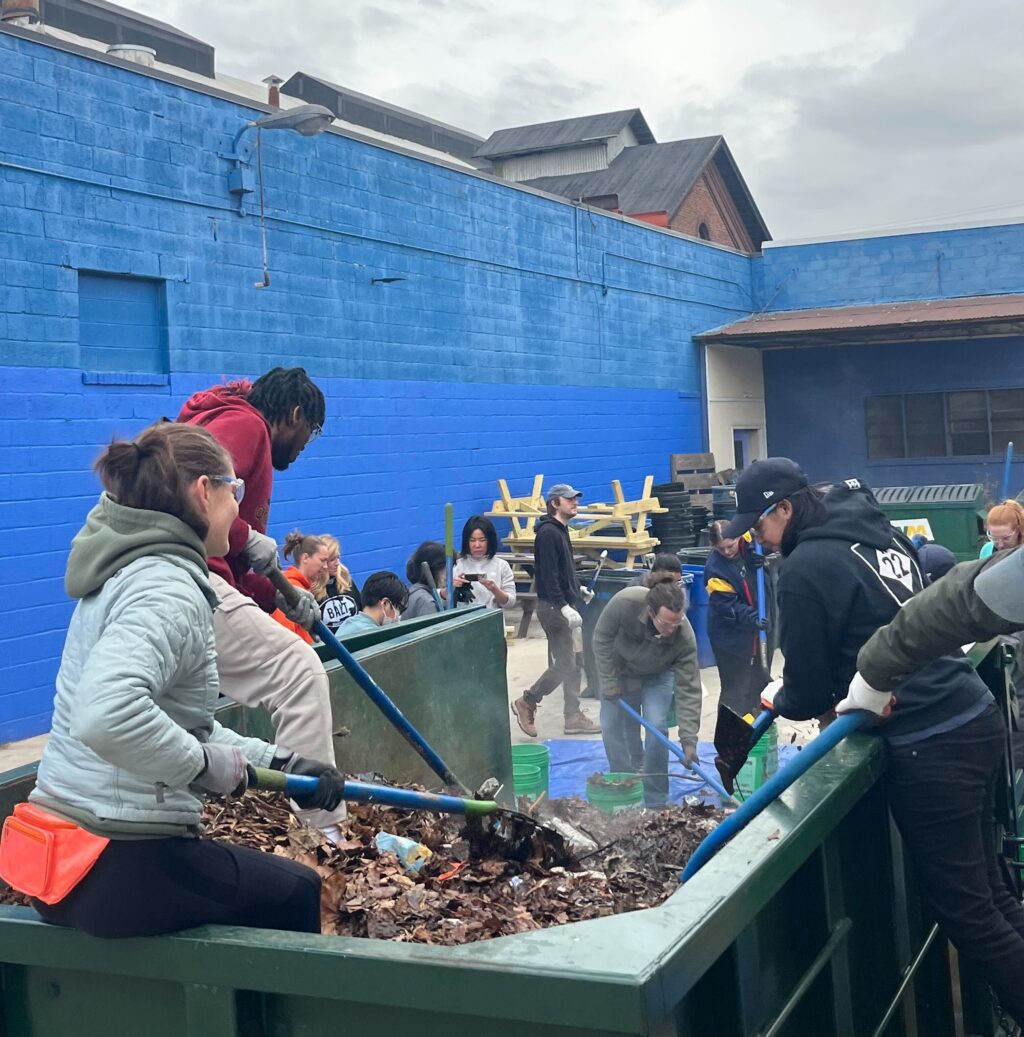
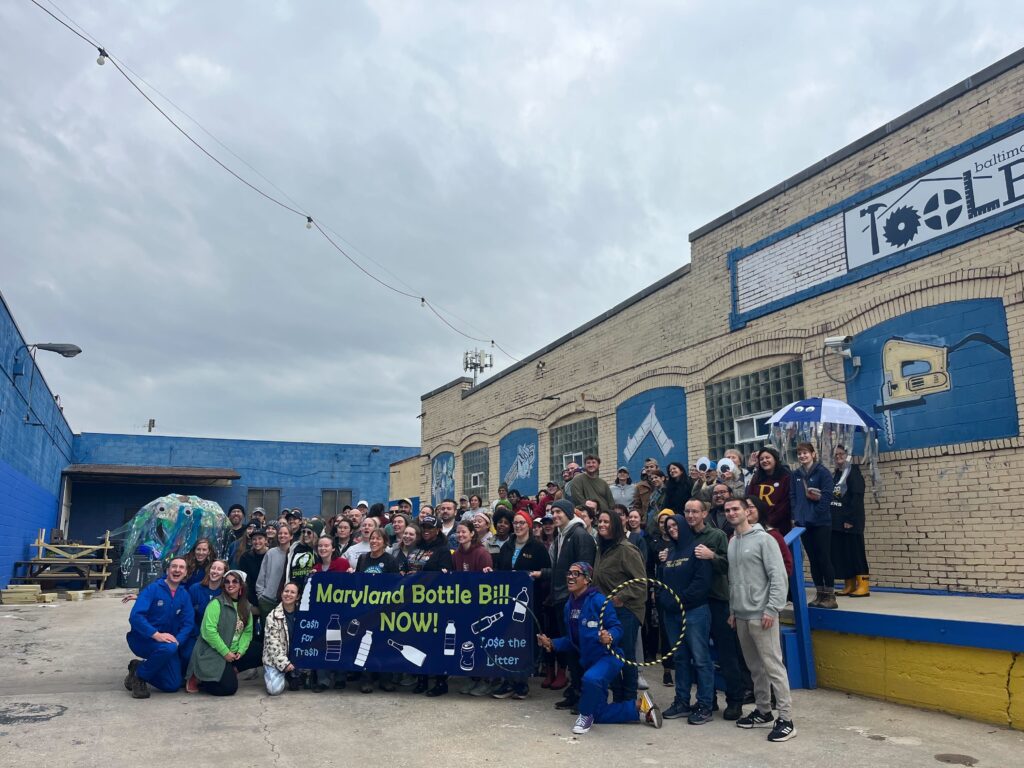
This was Mr. Trash Wheel’s 8th annual Dumpster Dive. On Saturday, over 150 volunteers gathered at the Community Toolbank in Baltimore’s Pigtown neighborhood to dig through the contents of Mr. Trash Wheel’s dumpster, pulled from the trash interceptor’s location at the mouth of the Jones Falls River. Waterfront Partnership collaborated with the Baltimore Community Toolbank for the event, which had the critical purpose this year of gathering data to support advocacy for a Maryland Bottle Bill.
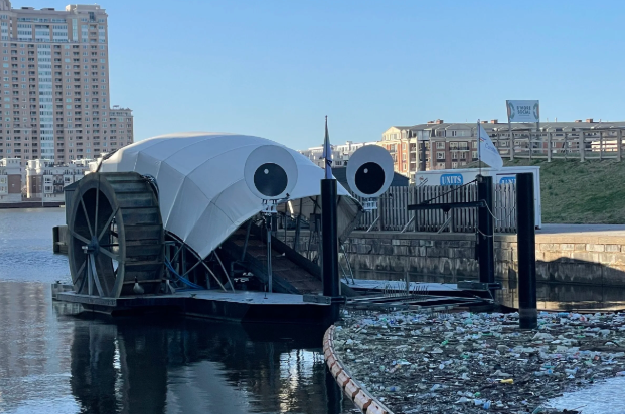
Perhaps you’ve heard of Mr. Trash Wheel, the googly-eyed contraption that scoops trash from the Inner Harbor with a hydro- and solar-powered conveyor belt. The first-of-its-kind trash interceptor when installed in 2014, he and his colleagues Professor Trash Wheel, Captain Trash Wheel, and Gwynnda the Good Wheel of the West work night and day to remove trash from Baltimore’s beloved waterways. Together, they use renewable energy to remove about 500 tons of trash every year before it can flow into the Chesapeake Bay.
The trash counted annually at Mr. Trash Wheel’s Dumpster Dive informs researchers about what kinds of pollution are in the water, helping policymakers with projects like the bottle trade-in bill. “With this data, we know how many bottles are in our waterways, and when new policy is enacted, we can test the efficacy of that policy change,” says Allison Blood, Senior Manager of Environmental Projects and Advocacy at the Waterfront Partnership of Baltimore.
The bill, which passed the House Environment and Transportation Committee in the 2025 legislative session, would introduce a small deposit (5-10¢) to the cost of single-use beverage containers, redeemable upon their return. “Bottle bills really reduce the amount of litter that comes from beverage containers,” says Blood. “When there’s a value associated with those containers, then people are better stewards of them. That translates into fewer bottles being in our alleys, roadsides, and waterways.”
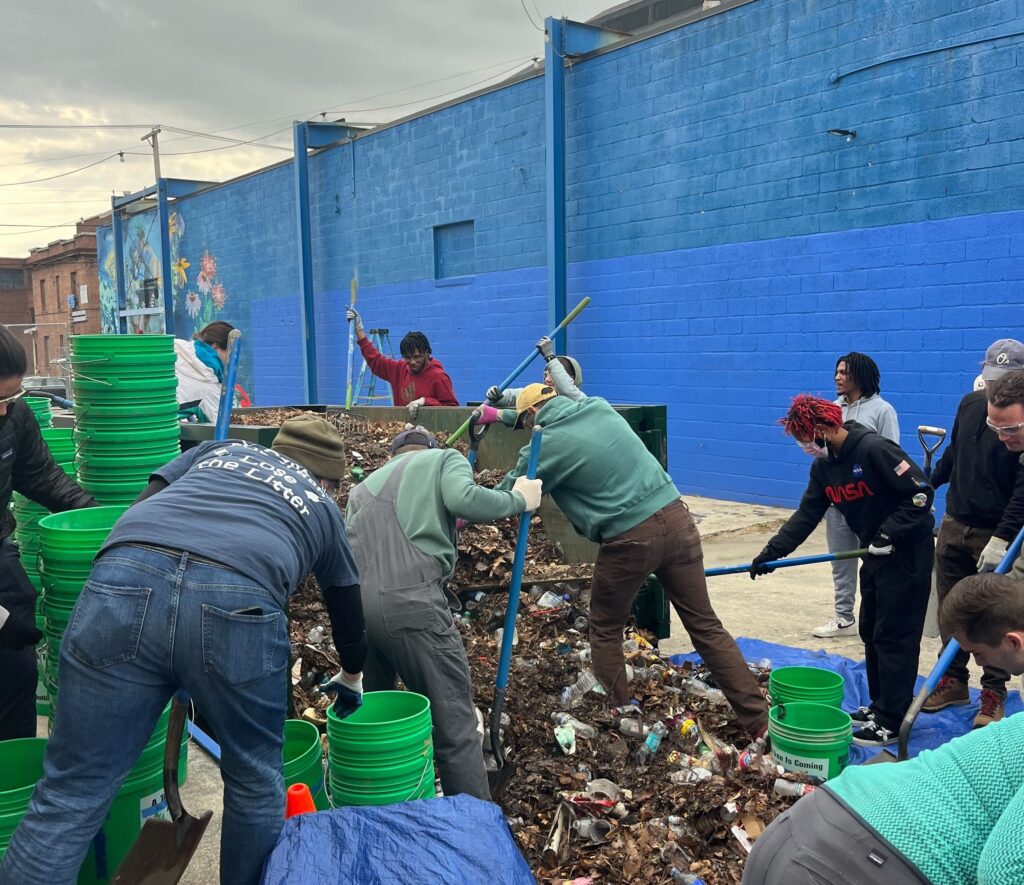
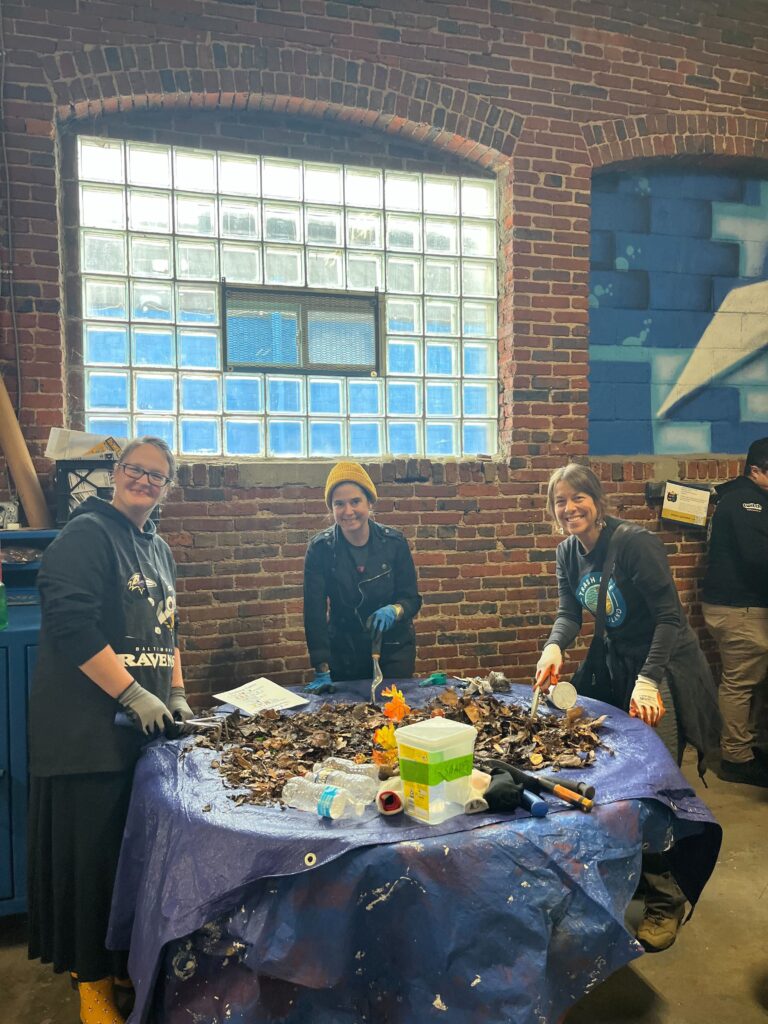
For efficient trash sorting, the Saturday volunteers split up into 4 groups. Diggers braved the 3-ton dumpster with shovels and buckets. Runners brought the buckets of trash into the warehouse for the sorters, who picked through the debris on tarp-covered tables, separating bottles and cans from cigarette lighters and piles of wet autumn leaves. The accounting group tallied up the trash. A fifth group, the artists, decorated umbrellas as jellyfish with spirals of cut-up plastic bottles and other recycled trash, which they hung from the rafters of the warehouse.
In the corner, a “party table” displayed the wackiest findings of the morning: a disco ball, children’s toys, sneakers and sandals, and even a Stanley water bottle. Upbeat music boomed from the speakers. Spirits were high.
“Who would have thought that 150 people would volunteer their Saturday morning to dig through a dumpster full of wet, stinky trash? But they will do it if a googly-eyed trash interceptor asks them to do it,” said Adam Lindquist, Vice President of the Waterfront Partnership of Baltimore.
“I want to do more community work,” said Emerson, a 15-year-old who calls Baltimore home. She was there with her mother, Amy, sorting trash with other volunteers. “I think it’s a very valuable experience in general, but also, as a kid, I want to get out and see more of my community. That’s why I’m here.”
“Mr. Trash Wheel has really become an icon for Baltimore City and a mascot for the restoration of the Baltimore Harbor,” said Lindquist. The anthropomorphic trash interceptor has inspired all sorts of creations, including the Lost Python Ale, an IPA from the local Peabody Heights Brewery, named for the live ball python that was found on Mr. Trash Wheel in 2015. Saturday’s Dumpster Dive began with a sing-along about Mr. Trash Wheel written by Jonathan Jensen, a retired bass player for the Baltimore Symphony Orchestra.
The work of Saturday’s volunteers is one more step toward passing a Maryland Bottle Bill. “Recycling alone is never going to solve the problem. We have to put value on an empty container. That’s what the Bottle Bill will do,” said Martha Ainsworth, chair of the Maryland Sierra Club’s Zero Waste team and a member of the Bottle Bill Coalition, a group of organizations determined to get a Bottle Bill in Maryland.
Mr. Trash Wheel’s data was successfully used to support policy change in 2020, when Maryland became the first state to ban styrofoam containers. “Now we’ve seen an 80% drop in the amount of Styrofoam ending up in Mr. Trash Wheel, thanks to that legislation,” said Lindquist. Currently, 10 other states have Bottle Bills and have seen up to 90% reduction rates of pollution by single-use beverage containers.
“Our goal is to put Mr. Trash Wheel out of business,” said Lindquist on Saturday. That’s one of the reasons we’re all here today. If we can put a beverage container deposit on bottles and cans so that they get returned, that will go a long way into helping Mr. Trash Wheel go into retirement.”