Traditional craftsmanship is alive and well in the Bay. The work of this local painter proves it.
I drove into the Safe Harbor Oxford boatyard on a windy Friday afternoon, tires crunching on gravel. Past a row of tarp-covered sailboats, a shiny red Bertram 31 was nestled in the back corner. Flakes of gold leaf swirled from the stern, floating on the Bay breeze.
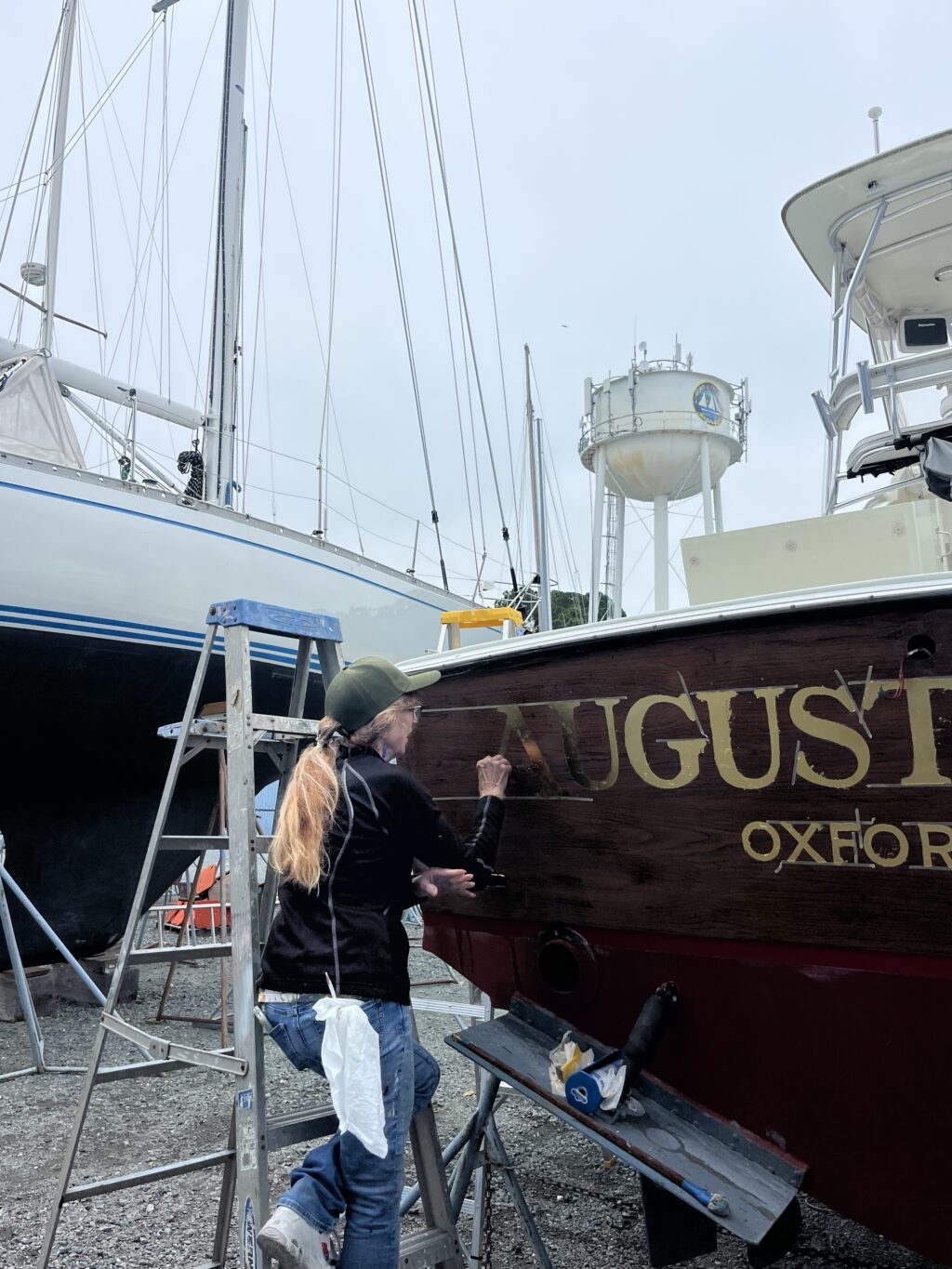
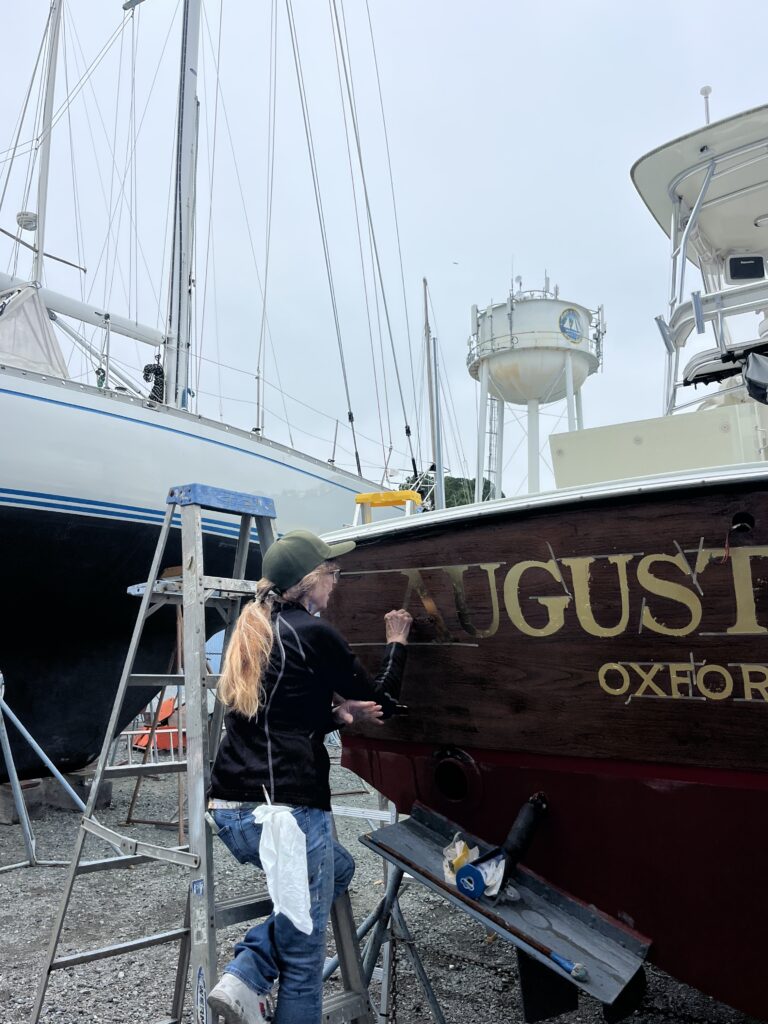
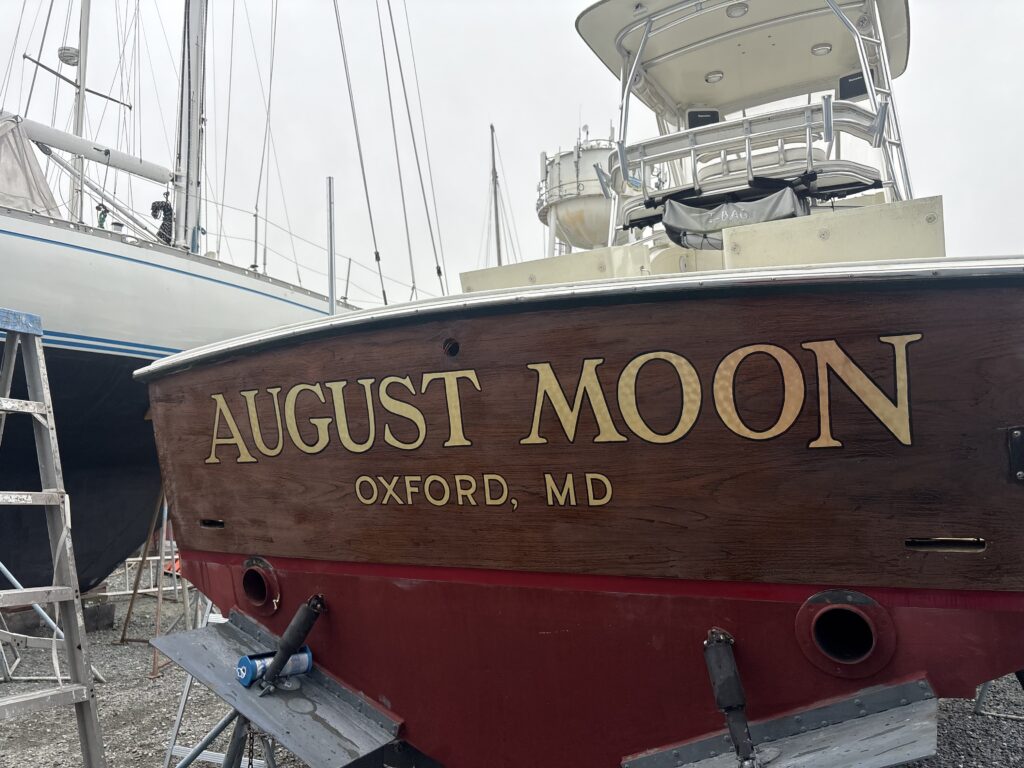
Was the Bertram enchanted? The gold sparkled like fairy dust. But the woman in blue jeans on a ladder behind the boat—although graceful—was no fairy: she was Cindy Fletcher Holden, a boat painter practicing the lost art of hand lettering. Her project today was the August Moon—the name of the boat done in 24-karat gold.
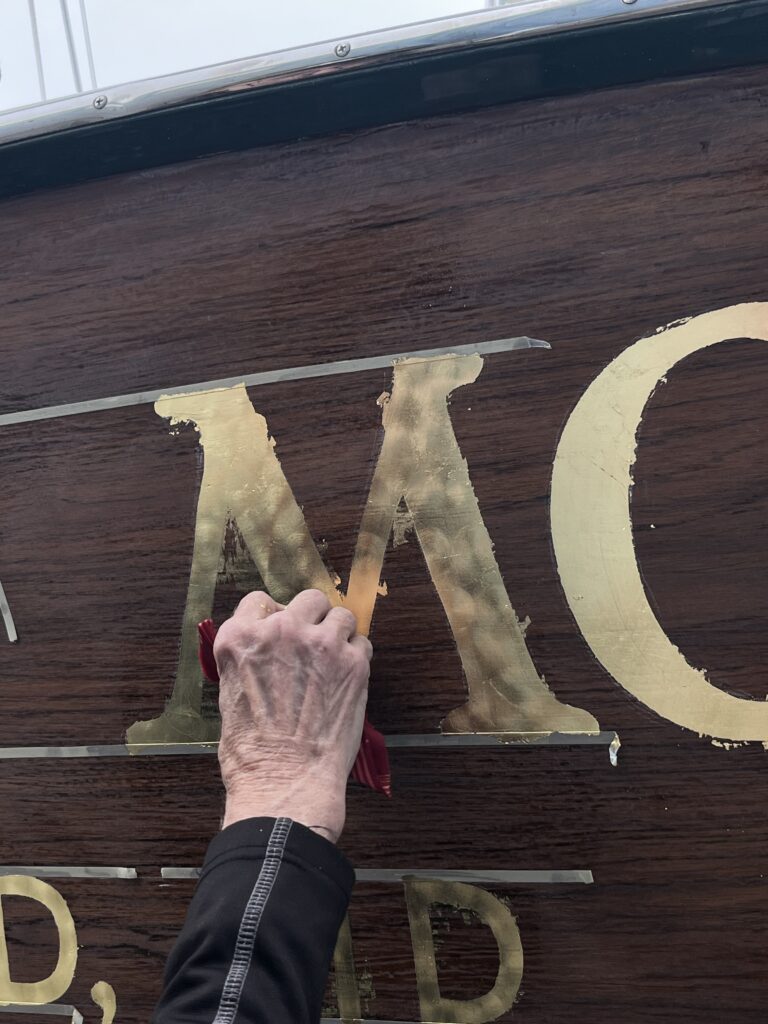
When I arrived, Holden was straddling two ladders, burnishing the letters on the transom with a rag. The owner of this boat had requested “swirls” in the gold, an extra touch that creates a circular pattern when it catches the light. “It should look like stacked coins,” Holden explained. To achieve this effect, she was painstakingly rubbing swirls onto each square inch of the letters, stepping back every few moments to make sure they were visible.
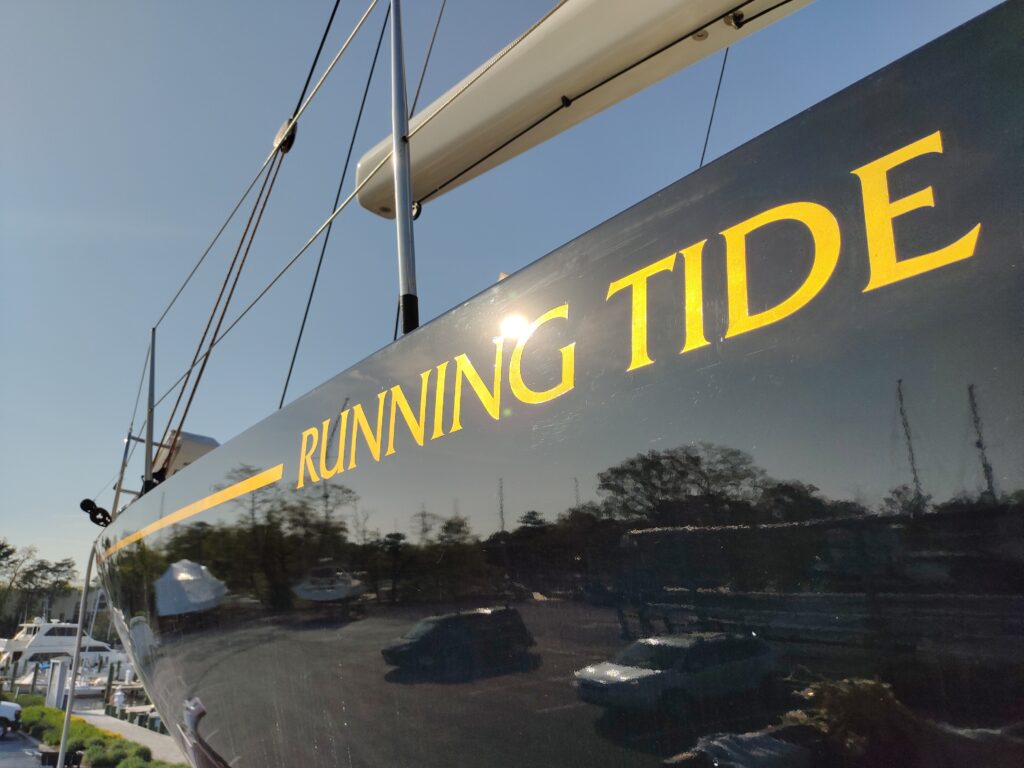
Holden is that rare creature who sparks inspiration in us all: a working artist. With her hand lettering, she offers a time-honored alternative to the more common vinyl lettering used on boats today. You may already know some of her work—she has painted the name on Running Tide, the legendary ‘70s racing yacht that now lives in the Chesapeake Bay, and the Wilma Lee, a historic skipjack belonging to the Annapolis Maritime Museum. But the road to expertise is often a long one. For Holden, it began with failure.
She went to school at the Maryland Institute College of Art (MICA) and graduated with a degree in painting. “I thought I was something,” she laughed. But when a yacht broker rejected her first attempt at a hand-lettered sign, opting to go with the local sign shop instead, she realized she had a lot to learn. “I was so humiliated that I went to that same sign shop [in Annapolis]–and asked for a job.” Her determination paid off. Over two years of apprenticeship at Accent Graphics, she learned the craft. “It was hard and slow work.”
Now, she has no lack of commissions in the Chesapeake Bay. “A lot of people like traditional boats,” she said, “and if they’re gonna have a traditional boat they want it done in a traditional way.”
The August Moon is a perfect example. This 1975 Bertram 31 is an iconic classic boat. It’s owned by Bart Eckhardt and his wife, Bonnie Johnson. “Cindy is authentic,” Bart said. “There’s a quality of craftsmanship that you really don’t see too much anymore.”
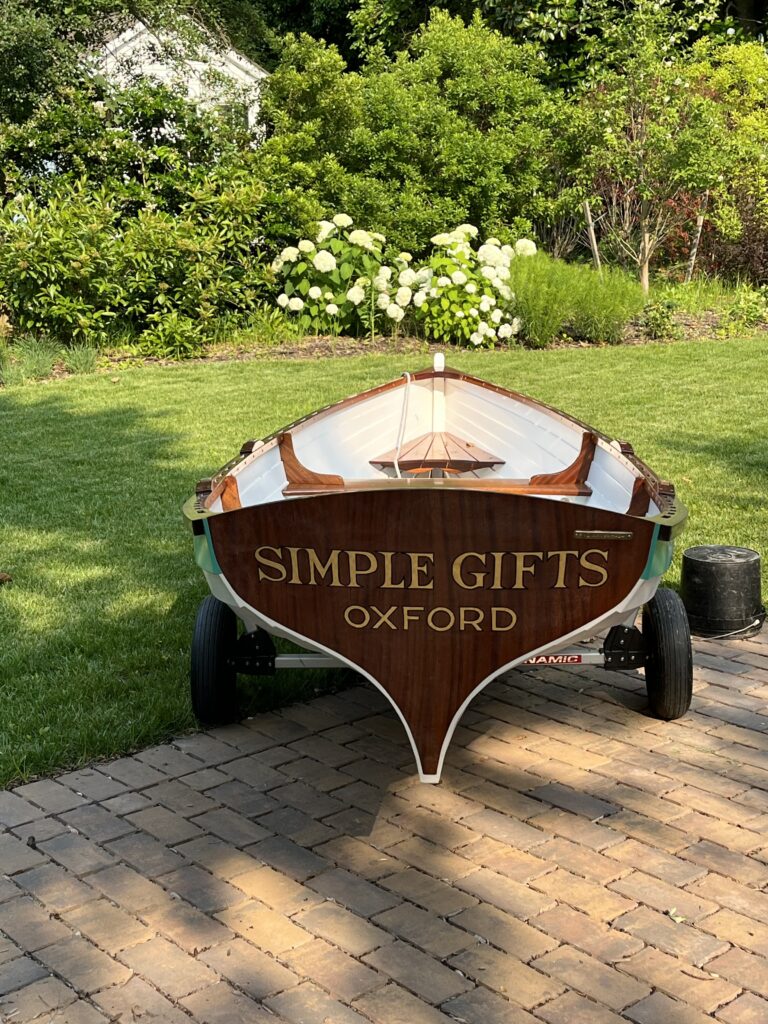
Along with the August Moon, Eckhardt and Johnson also have a 1961 Boston Whaler and a rowboat— a custom-built Penobscot Wherry from Cottrell Boatbuilding in Maine. Holden painted that one, too: Simple Gifts shines from the wooden transom in gold leaf. Eckhardt says the Whaler is next. He’s engaged other artists in the past, but Holden is the only one comfortable doing gold leaf. “My dad was a craftsman of the highest order in New York City, and he told me when I was a child how difficult gold leaf is. It’s amazing that Cindy is able to do that.”
But the boat painter’s life is not all golden transoms and sparkles. She must sometimes contend with the challenge of painting a boat in the water. “I’ve had to hang upside down, lay on my stomach, tie myself so I don’t fall off the back of the boat,” she recalled. One such commission was a comedy of errors involving three flights of stairs, an inflatable dinghy with a slow leak, and a paint bucket upset in the wake of a passing motorboat. Suffice it to say her job is easier in the boatyard.
Don’t mistake her for a landlubber, though; she grew up on boats. When she was young, her family always had a boat on the Bay, and now she and her husband own a semi-custom ketch, a Dillon 47 called Tenacity that they’ve sailed around the world. She even wrote a book about it.
“We’ve put tens of thousands of miles on that boat, we’ve visited many countries, but our favorite place to cruise is still the Chesapeake Bay.” Holden smiled. “I love the trees here and the sounds of summer, like the cicadas and birds. You don’t always hear that in Europe and Africa.” She and her husband have faithfully cruised the Chesapeake for the past 37 years and they don’t show signs of stopping.
Holden considers herself a craftswoman. “I have an affection for all the people in trades that involve a skill, like sign painting,” she said. “To me, they’re all artists. The woodworkers, boatyard professionals, the guys that do the varnish, the guys that do the spray painting on the sides of the boats. We often talk shop and compare notes on paint and weather and brushes.”
In fact, she’s got it in her blood: her grandfather, Oscar Benkert, was a sign painter, too. He was an artist from Germany, sponsored in the 1930s to come to the States as a muralist. Holden also paints murals: she did the Eastport 150th anniversary mural, as well as a wildlife scene at the Annapolis Maritime Museum. She recently finished a Bay waterfront scene in the psychiatric ward at the Baltimore Washington Hospital. She even does sign painting for Starbucks— a company that still appreciates hand lettering, she says.
Boat and mural commissions pay the bills, but Holden’s true passion is studio art. She has a show in November 2026 at the Jo Fleming Contemporary Art Gallery in Annapolis. “I have a year and a half to make six paintings and guess what?” she laughed. “That may not be enough time!”
Meanwhile, she continues to paint names on boats. “A lot of that is based out of economic necessity, and also just the pride of getting good at something,” she said. “There’s something very satisfying when you’re working and people are paying you.” And people do pay her: when I asked how much she charges for gold leaf, she laughed. “It starts at one boat unit,” she told me slyly. She means $1,000. Her murals, meanwhile, average around $10,000.
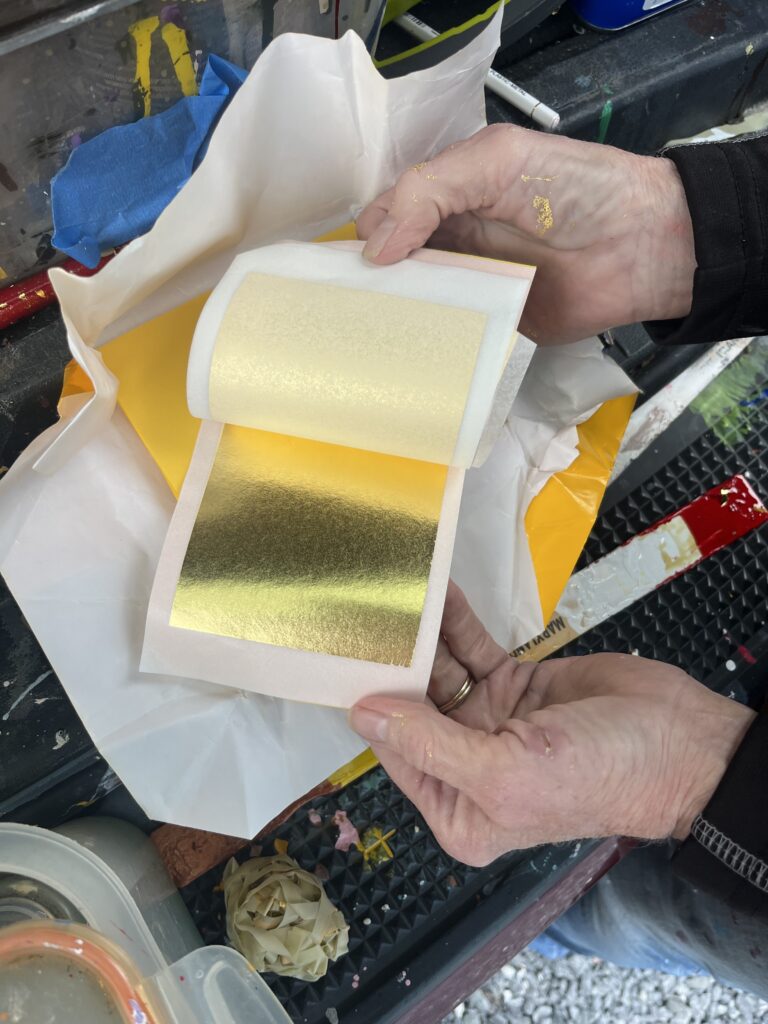
Holden worries that her craft is disappearing. “There aren’t many hand painters left,” she said. “They’re either dying off or retiring. But the art of lettering deserves to be carried on.” She’s doing her best to preserve it: this summer, she has a young apprentice— Liza Love, a student and artist from St. John’s College in Annapolis.
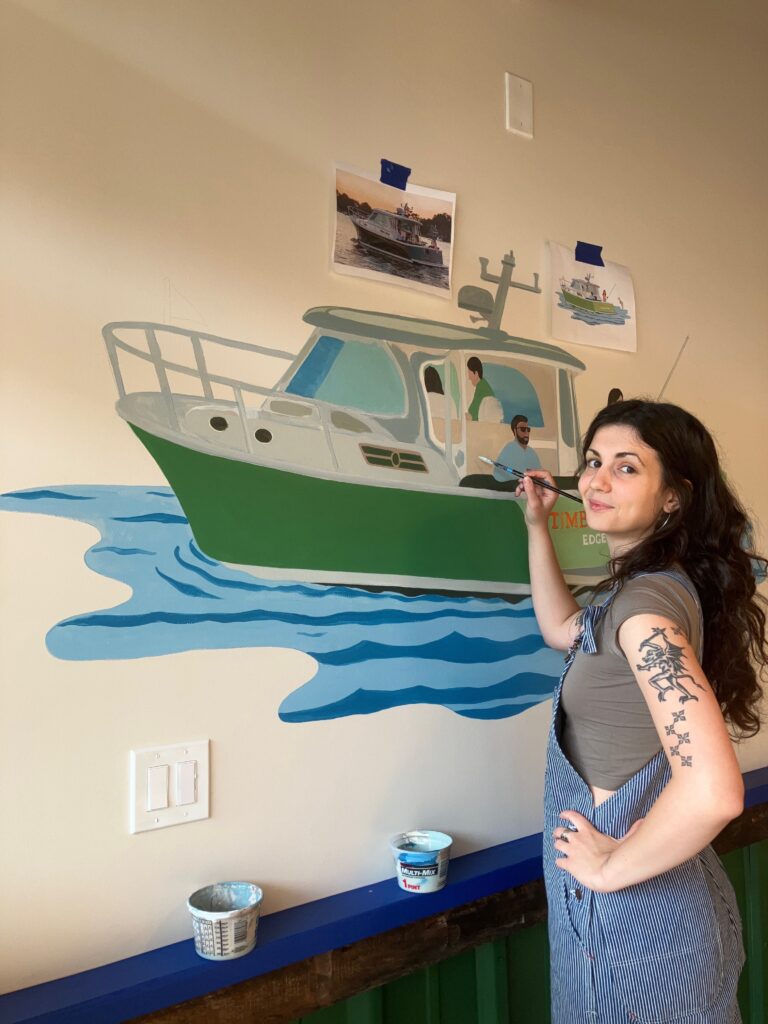
This is Love’s first time working with boats. “I’ve always had an interest in lettering, but working with Cindy has inspired a real love for the craft, and for waterfront life as well,” she said. Her first job with Holden was in Oxford. “She told me stories about growing up on the Chesapeake Bay while effortlessly laying out the letters for the hailing port.” Having started as an apprentice herself, it’s fitting that Holden is passing her knowledge to another young woman.
Boat owners like Eckhardt and Johnson help keep Holden’s craft alive, too. “There’s a quality of craftsmanship that you really don’t see too much anymore today,” said Eckhardt. “Artisanship is so often under-appreciated. Especially in this virtual world—I don’t think there is a substitute.”
In the boatyard, I walked with Holden to her car as she rummaged through her trunk for more paint. She looked at me over her shoulder: “Have you ever read The Wind in the Willows? There’s a line in there that I like.” She paused to recall it: “’There is nothing – absolutely nothing – half so much worth doing as simply messing about in boats.’”
For Cindy Fletcher Holden, that just about sums it up.