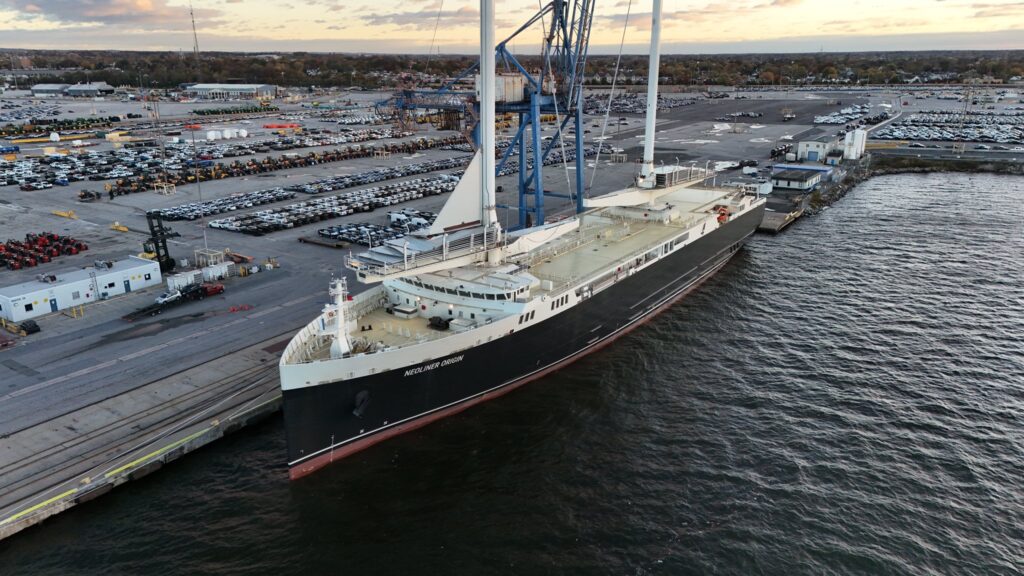
It was a strange sight, visible all the way from the entrance of the Port of Baltimore’s Dundalk Marine Terminal on Tuesday: a ship sitting at the dock with two massive white masts folded towards each other in the shape of a giant “X”.
The ship carrying those two masts is unlike any other vessel to call on the Port of Baltimore—or any other vessel in the world, for that matter. It is the Neoliner Origin, a wind-powered roll on/ roll off cargo vessel that was just delivered to its owner in September. The ship’s two foldable masts are each 295 feet tall, carrying up to 32,000 square feet of total sail area. Under the right conditions, the vessel can get 60% to 70% of its propulsion from the wind. Hybrid diesel-electric engines are used when needed. Its goal? To reduce greenhouse gas emissions significantly. According to computer models, the ship’s propulsion system is capable of reducing carbon monoxide emissions by up to 80% (compared to a conventional ship of the same size).
We told you about the Neoliner Origin when it made its first visit to Baltimore on Oct. 30. That was also its first ever transatlantic journey (France to Baltimore by way of the French island Saint-Pierre, off the coast of Canada). And on Tuesday, Dec. 16, the ship made its second voyage to Baltimore, the only U.S. port it is calling on. After all of the cargo was unloaded Tuesday morning, Chesapeake Bay Magazine was invited on board to see the inner workings of the unique ship.
We toured alongside leaders from the Port of Baltimore and the public-private partnership Ports America Chesapeake. Maryland Port Administration Executive Director Jonathan Daniels and Ports America Chesapeake President Mark Schmidt were also getting their first look inside the Neoliner Origin, seven years after discussions between Neoline and Baltimore first began.
“Proof of concept” is the phrase that came up again and again as Neoline President Jean Zanuttini led us on our ship tour. After a decade of development, Neoline is watching its cutting-edge concept play out on a real shipping route with real cargo on board.
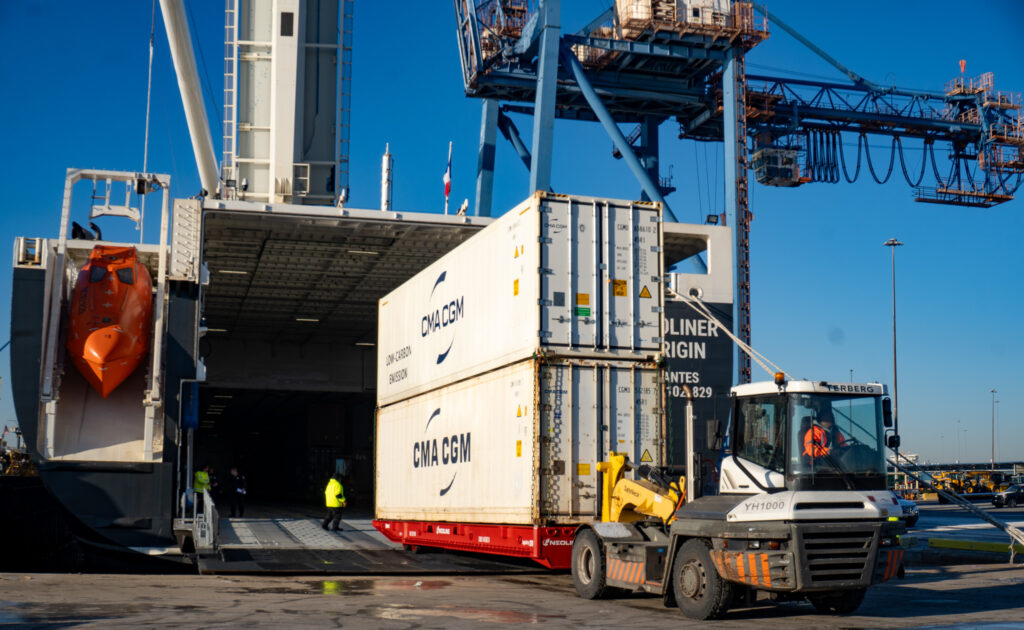
Approaching the ship, the first thing we noticed was the massive ramp and garage. It’s designed to hold all kinds of cargo, including oversized project equipment, ro/ro farm and construction vehicles, and containers. The soaring ceiling, which Zanuttini refers to as “the church”, can accommodate cargo up to about 32 feet tall. There are smaller decks for pallets and other cargo. As we climbed the ramp to visit them, Schmidt noted the smell of fresh paint still lingered inside—the equivalent of that new car smell.
The living quarters in the Neoliner Origin are similarly pristine. Along with crew quarters and a crew mess, there is a mess for officers and passengers and passenger staterooms complete with private balconies. Yes, we said passengers. The ship can carry up to 12 guests in addition to its cargo and crew of 13. While the Neoliner Origin follows a rather chilly northern route, the spectacle of two behemoth carbon masts unfurling their sails is enough to draw adventurous ocean-going tourists.
The captain and crew on board were carefully hired based on not only their mariner credentials, but their motivation to trailblaze a green solution to shipping with the use of sails. The captain has experience with large motor vessels, but has also worked on a historic three-masted barque cargo ship. “This is a community of seamen who are really willing to use wind for shipping,” Zanuttini said.
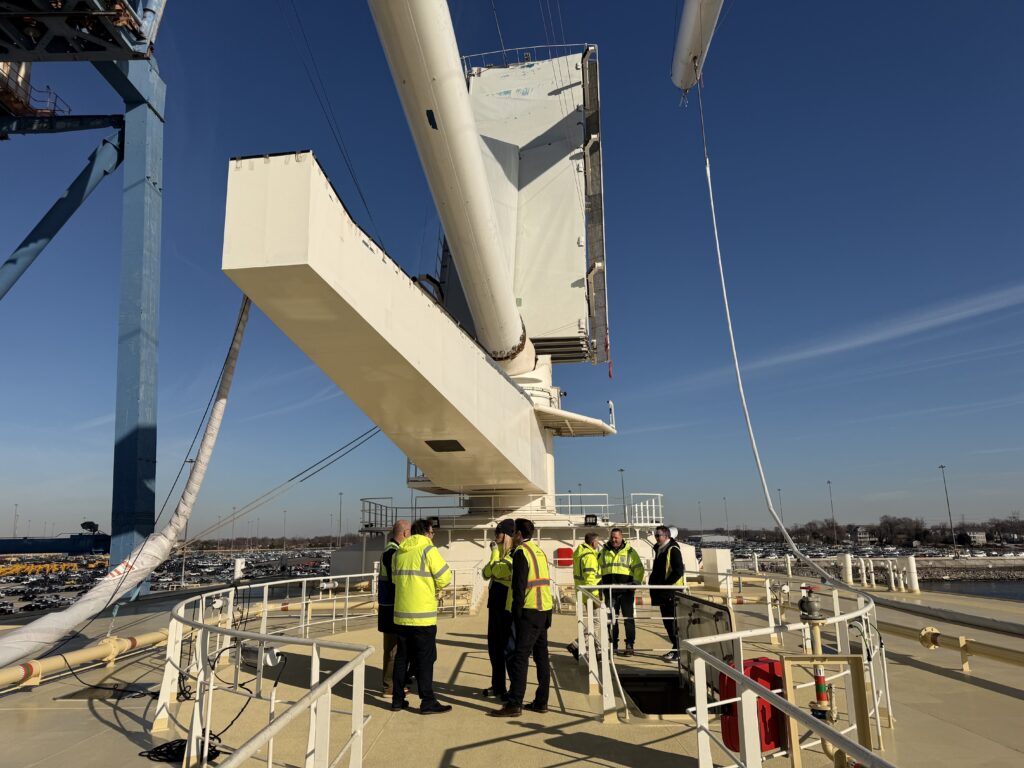
Standing on what Zanuttini jokingly called “the spa deck” up top, we could see the ship’s huge masts. They are each supported, down below, by four motors. They are capable of being tilted to allow the Neoliner Origin to pass under bridges like the Chesapeake Bay Bridge. After all, the Bay Bridge’s maximum clearance of 186 feet wouldn’t even come close to accommodating the ship’s 295-foot-tall masts. The tilting process, on paper, should take about 90 minutes, but Neoline says it currently takes closer to three hours, as the ship’s operators learn the system. The masts are intended to be up at sea, only coming down for bridge passages and while at port.
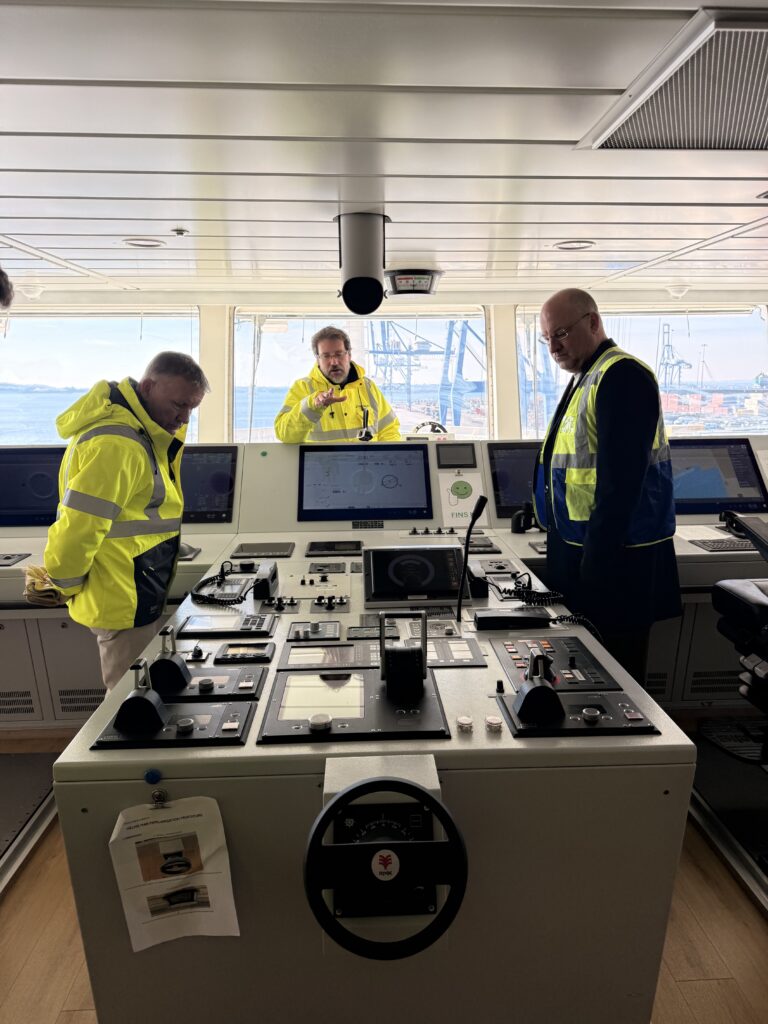
Each mast has a mainsail and a jib, which can be raised, lowered, and trimmed with the push of a button from the bridge. The sails are designed to withstand harsh conditions, but there may be some kinks yet to be worked out. On the ship’s first passage to the U.S., the upper panels of the aft sail were damaged. After some preliminary repairs in Baltimore, the ship’s sails made it back to France in one piece, but Zanuttini said there were more small issues on the passage back to Baltimore, too. The Neoliner Origin will undergo more significant repairs in France to address the problem fully.
With fully functioning sails, Neoline Technical Manager Guilhem Péan told me the goal is for the ship to spend 80% of the time under sail. “The idea is to be under sail all the time, until we get to port,” he said. But it will take additional trips and more time to optimize sail propulsion.
Despite being a monohull sailboat, the Neoliner Origin does not have a keel. Instead, there are two anti-drift fins, nearly 20 feet long each, that can be angled using controls on the bridge. The ship’s skeg and long rudder also help with drift. But the hull itself is flat-bottomed like a traditional cargo ship.
Neoline’s choice to team up with Baltimore for its proof-of-concept liner service fits with the port’s goals of reducing emissions. “Baltimore provides an entire green solution,” says Ports America Chesapeake Commercial Operations Manager Kevin Dowling. Moving towards a goal of net zero emissions by 2050, the port is already using electric vehicles, hybrid electric cranes, and green stevedoring equipment.
Baltimore also made sense because Neoline’s first two committed customers were French boatbuilder Beneteau and construction/farm equipment company Manitou. Both were already shipping at the Port of Baltimore, and have been able to keep their chain consistent.
So far, Neoline does not have any exports to ship out of Baltimore. The vessel left empty of cargo. That’s something the Maryland Port Administration and Ports America Chesapeake are working to change. During our tour, Daniels, Schmidt, and Ports America Director of Operations Tim Beall brainstormed with Zanuttini about the possible types of cargo the Neoliner Origin could carry. The size of the garage and stern ramp make the ship useful for oversized cargo. Being enclosed and protected from the elements, the cargo space would be ideal for new boats or repositioning mid-sized private yachts, Daniels said.
“I’d love to see this whole thing filled door to door,” Beall told us after the tour, looking at the cavernous cargo space. For now, the ship will continue shipping limited cargo: double-stacked containers with French luxury items inside, refrigerated containers, and small ro/ro vehicles. Oh, and the ship’s passengers.
The guests staying aboard the ship as it leaves Baltimore will be at sea for Christmas this year. The ship is bound for Saint-Pierre on its way back to Saint Nazaire, France, with expected arrival in France on Dec. 30. The Neoliner Origin is leaving the Chesapeake Bay the same way she came, by rounding Cape Henry.
If you missed her coming and going this time, never fear: the Neoliner Origin will be back in February, March and April as Neoline continues working to test and improve their “proof of concept” and establish regular liner service.