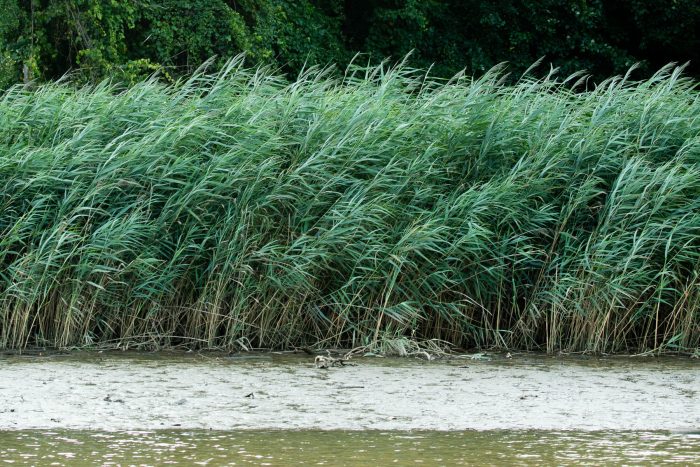
You’ve seen plenty of it along Chesapeake waterfronts: the common reed, with its tall, feathery seed heads. You probably even call it by the Latin name of its genus, Phragmites. If so, you probably also know that it’s considered an undesirable, invasive species scorned for crowding out native wetland plants. It grows well on disturbed soils, such as the waterfront edges of constructed sites like bridge crossings, laying down dense, tangled root mats and quickly developing thickets of tough, pale green stalks.
Although there is only one species, Phragmites australis, two subspecies live around the Chesapeake. Phragmites australis americanus is native, but here it lives only along rivers on Maryland’s Eastern Shore. The much more widespread subspecies, Phragmites australis australis, apparently turned up here late in the nineteenth century and took off. Today, conventional wisdom dictates removing it, but doing so turns out to be a difficult, expensive challenge. That challenge poses a serious question about what we are trying to accomplish when we talk about restoring the Chesapeake.
One time years ago, I asked a friend who was acting in a play at Hanover (VA) Tavern what he would “go back to” after the play completed its run. “I won’t go back,” he responded, “I’ll go on to something else.” That pretty much sums up our Chesapeake restoration efforts. We can’t ever go back to the Bay ecosystem that existed when the Jamestown colonists landed in 1607. About 50,000 people lived in the Chesapeake watershed then. We are 19 million now, and climbing, along with the ecological changes that we continue to create in the water, on the land, and in the air.
The most obvious water quality improvements we have made in the past fifty years have been with increasingly sophisticated treatment of “point source pollution” (pipe outflows), especially our sewage wastewater. That engineering has brought rivers near population centers back from the dead, including the Potomac River around Washington, DC and the James below Richmond. They are healthier today than they have been since 1870. The greater challenge, though, is more widespread and less readily controlled: rainwater runoff from land that we have modified from 1607’s old-growth forests, especially including along the shorelines of our vast network of waterways. Engineering offers some solutions here, but often they work best when carefully, artfully integrated with natural processes.
Such integration requires deep searches for, and attention to scientific details, as well as the enduring lesson that anyone looking for simple answers has come to the wrong estuary. It goes ‘way beyond blanket statements, like “Eradicate all Phragmites.” In that vein, a new study from Maryland’s Department of Natural Resources breaks down the pluses and minuses of ecosystem services provided or taken away by stands of Phragmites as opposed to native wetland plant communities.
Using cost/benefit analysis, the scientists carefully went through and compared studies from existing research of wetland community performance in the categories of carbon sequestration, nitrogen removal, and wildlife habitat. They contrasted data from natural brackish high marshes with those from stands of Phragmites australis australis. If you read the study, you’ll find that the data together provide ranges of performance, but there are clear trends. Phragmites stands tend to deliver greater carbon sequestration, while native high marshes provide greater nitrogen removal and offer better, more diverse wildlife habitat. On average, the introduced and native communities offer similar ecosystem service values, though under optimal conditions, native marsh communities are more valuable.
The catch comes when looking at the Chesapeake’s wetlands as they are, in June of 2026, with many, many stands of Phragmites well established all over the Bay ecosystem, and considering the high cost of eradicating the plants, which require repeated manual, year-on-year applications of herbicide. The big reed is here to stay in today’s Chesapeake, and it does offer valuable ecological benefits, especially in carbon sequestration. Those considerations bring to mind the first maxim attributed to Hippocrates: “First, Do No Harm.” As the study’s authors conclude, “it is not a net economic benefit to control for Phragmites, unless the cost is low to moderate and the benefit is high, i.e., the system can maintain or return to optimal wildlife habitat…we recommend that landscape factors and management goals be considered when making these decisions for marshes in the Chesapeake Bay Region.”
In other words, Phragmites appears to have some useful roles in the Bay and rivers of the future. One more time, there are no simple answers here, but there is fresh Chesapeake information to guide careful thinking about “going on to something else.”