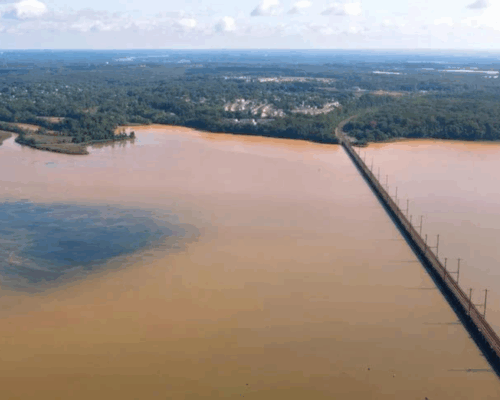
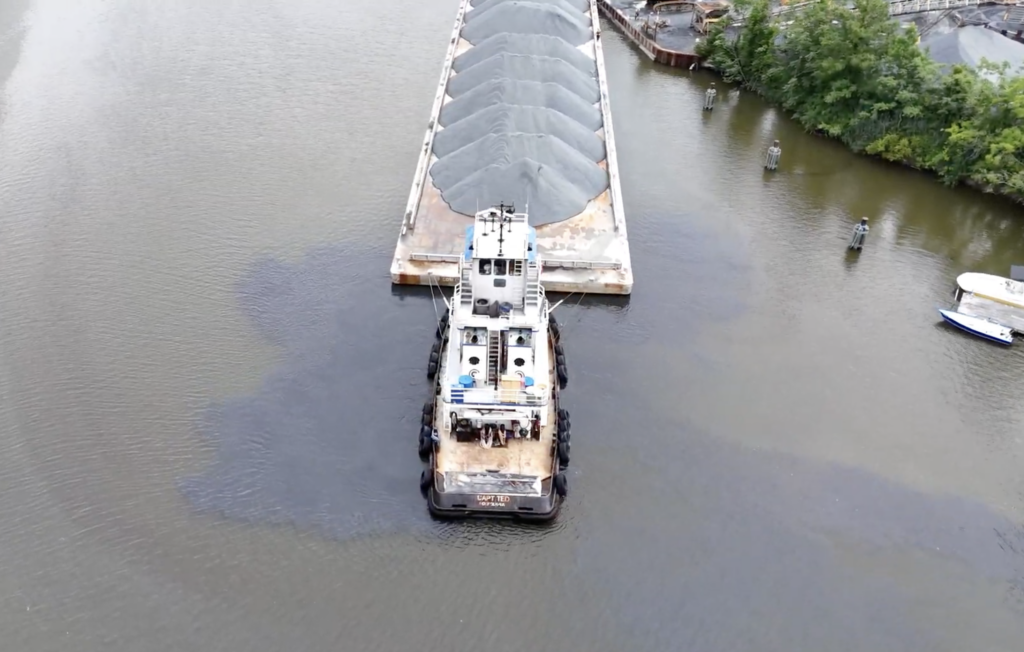
On a clear spring day at low tide, a barge carrying construction aggregate—sand, gravel, and crushed stone—plows through the bottom mud of the Tred Avon, stirring up a murky brown plume nearly five miles long as it heads to a dock in Easton. When that plume settles, it blankets underwater grasses and oyster reefs, smothering them and other vital aquatic habitats.
Matt Pluta, the director of riverkeeper programs for the environmental group Shore Rivers, says he shot video of the barge’s trip April 15, but added this has been going on “since 2016 or 2017.” He says he has met with representatives of Vulcan Materials, the barge owners, and an array of state and federal officials “and was promised all these different behaviors, but nothing has changed.”
He also enlisted the help of Delegate Thomas Hutchinson, an Eastern Shore Republican whose district includes the Tred Avon.
Hutchinson said he worked with Maryland’s Department of the Environment to get Vulcan to make some changes.
“We’ve seen the pictures of the barge going up the river,” he said. “And we have an awful lot of regulations on how things happen on the bay and to see that go unregulated is something.”
He said he has “encouraged MDE to work with them on that.”
A letter dated June 26 from Maryland’s Department of the Environment to Jimmy Ellis, Vulcan’s Marine Operations Manager, noted that the company said in a meeting in May that it brings its barges upriver two hours before high tide. Yet Pluta says he has a report of a barge trip 45 minutes after low tide on the same day the letter went out.
That letter from Andrew Gosden, an MDE compliance manager, recommended that Vulcan tugs push the loaded barges upriver bow first and push the empty ones aft first back down the river to comply with its wetlands license conditions. In addition, the tugboat crew is to photograph the river conditions to demonstrate any effects on those conditions during the operations and to provide reports to MDE within 14 days of any trip.
Jack Bonnikson, a Vulcan spokesman, says he’s “surprised” that barges coming up the river at low tide “is an issue.”
“Our people do their best not to do that,” he said. “I would say maybe one percent of the trips are at low tide. There are a lot of factors that come into play. And the reason why there’s only that one photo is it’s not a matter of repeat behavior.”
He said the company has not been cited for any environmental violations in the trips the barges have made from its quarry at Havre de Grace to a distribution yard in Easton, nor have they received any complaints from local businesses.
MDE spokesman Jay Apperson confirms that the agency’s water and science compliance program has no record of violations at Vulcan’s Easton terminal.
Yet, the minutes of an April 18, 2018, Maryland Board of Public Works meeting note objections from Pluta and others at Shore Rivers to a dredging permit allowing Vulcan to deepen the area around its dock in Easton.
The organization had complained that barge movement caused “excessive turbidity” in the Tred Avon, an oyster sanctuary, and submitted a petition with 56 signatures asking for a stipulation in the permit that required commercial barge operators “to operate responsibly.”
The minutes show that a clause that would have forbidden the barges to “approach or depart the facility at any tide elevation lower than the local Mean Low Water level,” was struck from the permit.
Bonnikson noted the eight-year lag between the complaints to the Board of Public Works and Pluta’s video from last April show that the barge trips that plow up the bottom mud only happen occasionally and cause no real problem.
But Pluta has pictures of barge trips leaving plumes of mud from October and November of 2017, May of 2022, March of 2023 and April and July of this year. The most recent is a video recorded during an exceptionally high tide July 9 when Vulcan was operating as described in the MDE letter.
Pluta said that demonstrates the barges “are too big for this river.”
The Tred Avon, only 17 miles long from its headwaters until it flows into the Choptank just south of Oxford, is Easton’s “main highway on the water,” Pluta says. It supports commercial and recreational crabbing and fishing, helped by the oysters, well known filter feeders that help clean the water and build three-dimensional reefs that provide habitat for crabs and fin fish.
Then Governor Martin O’Malley launched state efforts to revive oyster beds in the river in 2008 with a program that encouraged waterfront homeowners to grow oysters in cages hanging from their docks, then transfer them to a protected sanctuary in the Tred Avon. Large scale efforts began in 2015 and now there are more than a dozen restored reefs, covering about 130 acres from the mouth of the river to Peach Blossom Creek, about 12 miles.
Vulcan, a Birmingham, Alabama based company, is the largest producer of construction materials in the US with more than 400 facilities—including the quarry in Havre de Grace and the yard in Easton—serving 22 states. Bonnikson, the spokesman, says the company is proud of the operation of the Havre de Grace quarry and that they have used much of the material they get from that quarry in shoreline restoration and to help build oyster reefs.
“Balancing our operations with environmental stewardship defines us,” he said in a statement. “We take pride in protecting the Chesapeake’s unique marine ecosystem.”
He points out that company has provided more than a million tons of material for shoreline restoration projects at Barren and James islands in the Chesapeake and more for oyster restoration projects in six bay tributaries, including the Tred Avon.
“Our barge operations on the Tred Avon…have not had an adverse impact on the oyster industry,” he said.
Pluta says he’s aware of and appreciates the environmental work the company has done and that he recognizes there’s a need for the material Vulcan provides for new construction in fast-growing Eastern Shore communities. “And we have nothing against that,” he said. “We have nothing against the company or the work they do. But nobody has the right to treat the river like that.”