There are more Black watermen working out of Kent Narrows than anywhere else on the East Coast. That’s the deeply-held truth of the still-active captains and watermen in Wells Cove, an area of the Narrows that is laden with Black history. Soon, the watermen’s lasting legacy will be commemorated with a large monument that is already gaining support from the community and the local government in Queen Anne’s County.
A Maryland Watermen’s Monument already stands in Kent Narrows, depicting two men in a rowboat and dedicated to those who have died while working in the seafood industry in the state. The artist who sculpted it, Captain Tilghman Hemsley, is a charter boat operator himself. While the memorial is a beloved local landmark, he says he received feedback that there it reflects no Black representation, nor does any other monument exist to honor the contributions of Black watermen.
“I’m a doer,” Hemsley tells us, “so I said, ‘Well then let’s do a Black watermen’s memorial.'” Already known for multiple sculptures he has produced, he formed the nonprofit organization American Patriotic Monuments, Inc. Together with Executive Director Linda Rohrbaugh and an advisory board that includes active Black watermen, the nonprofit has already won approval from Queen Anne’s County to move forward with its monument.

On Saturday, Nov. 8, a benefit fundraiser was held to support the Black Watermen’s Monument, a design comprised of six life-sized bronze figures in action and two stainless steel partial workboats, also life-sized. The planned monument, which was displayed as a scale model at the fundraiser, reflects different waterfront roles past and present, from hand-tonging for oysters, crabbing, and clamming, to charter boat operations. “Picking crabs and cleaning fish really weren’t represented in the original sculpture,” Hemsley points out.

Because of its size, the new monument will be interactive, allowing people to walk inside each workboat sculpture and see the figures up close. The history of the watermen will be engraved on the steel sides of the workboats, Hemsley says. The monument will be installed at Wells Cove, where today’s headboat charter captains operate. Its prime location, on county property between The Jetty and Bridges restaurants, will ensure visibility for charter guests, visitors, and diners.
Captain Tyrone Meredith, operator of the 55-foot, turquoise-hulled headboat Island Queen II, is one of the industry leaders on the advisory board. He says he first discussed the idea of a Black watermen’s memorial several years ago with then-Senator Ben Cardin and the late Vince Leggett, founder of Blacks of the Chesapeake. Meredith’s roots run deep on Kent Island; he is a fifth-generation waterman and still owns local land bought by his great-great-grandfather in 1865.
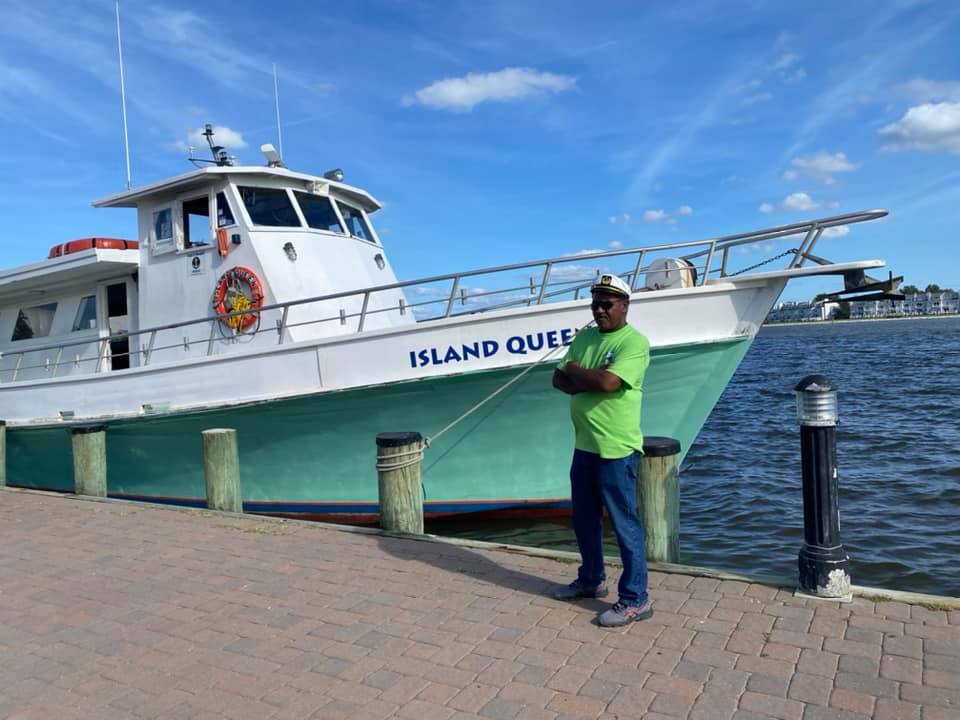
Like many of today’s Black headboat operators in Kent Narrows, Meredith works in several facets of the seafood industry, including hand-tonging for oysters. He and his mate, John Clopin, describe the hydraulic lift that helps them raise the heavy, 28-foot-long tongs to the boat. It doesn’t help them with the scraping, which remains extremely labor-intensive. For Meredith, traditional retirement isn’t a consideration. He plans to continue his work as long as possible, telling us, “Keep on going ’til you’re gone. Don’t stop! You’ve gotta look forward to doing something everyday.”

He’s proud of the monument’s depictions of tonging, a little boy fishing, a woman picking crabs, and other parts of the seafood process. Crab, oyster, and clam processing historically relied on Black labor. Of the more than 20 seafood packing houses in Kent Narrows at one time, many provided one-room shanties to house Black workers. These communities were known as shantytowns. Today’s Wells Cove sits at the site of these shanties, making the new monument’s location even more significant.
Another important voice on the monument’s advisory board is Captain Montro Wright. He’ll turn 86 years old in December, making him the area’s oldest Black captain. He’s been working the water for 69 years, so long that he is now on the third boat he named after his wife, the Shirley B III. In the past 20 years, he has stuck to operating his headboat four months of the year and taking time off in the winter. “We catch spot, perch, and catfish,” he says, with spot being the biggest draw for clients. He will start up again in May 2026.
Wright says of the monument, “We approve and everything is going according to plan.” Preserving the watermen’s history is important. He estimates there are only about 17 Black watermen left, from the Eastern Shore of Virginia to Maryland’s western shore. “Younger people never took to it. It’s a real hard life. You need to grow up on the water. There’s too much you have to learn, and a lot of danger out there.”
Vince Leggett’s family and friends, who are continuing Leggett’s work at Blacks of the Chesapeake since his passing in November 2024, are excited to hear his dream of a Black Watermen’s Monument will come to fruition. “That was something he was definitely a champion for,” his wife, Aldena Leggett, tells us. “He was just a champion in making sure that everyone was acknowledged and seen and heard.”
Such a large and involved monument will require a good bit of funding, with Hemsley’s estimate of the total cost at $450,000-$550,000. American Patriotic Monuments is working to secure a $250,000 from the state and applying for other grants. The organizers are also relying on grassroots fundraising, like Saturday’s event. The fundraiser included generous silent and live auction donations, like charter trips, photography and art by Jay Fleming, David Sites, Marc Castelli, and even Capt. Tilghman Hemsley, who paints in his spare time. Local businesses, like United Shellfish, have stepped up as well.

To learn more about the Black Watermen’s Monument or to make a donation, visit apmiart.org.