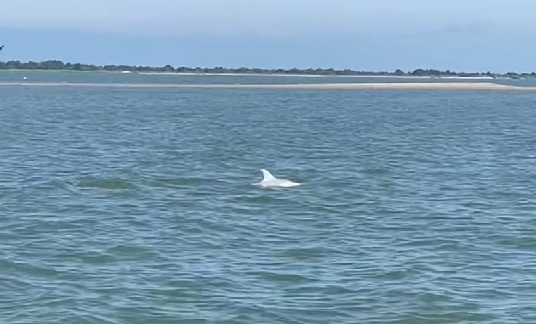
A Chincoteague, Virginia, tour boat operator loves showing off the famed ponies, bald eagles, and other wildlife to tour guests. But one group got a truly special wildlife sighting last Friday: a rare, all-white bottlenose dolphin.
Captain John Shields of Snug Harbor Marina had about five guests out for a tour just off the coast of Chincoteague on Friday, Aug. 15, when they spotted a pod of dolphins close by. While getting to observe a group of Atlantic bottlenose dolphins is a treat many boaters enjoy in our region, this sighting was something special.
“It was a pretty, sunny day, with dolphins swimming around the boat, when all of a sudden a big white dolphin comes up,” Shields tells us. “I couldn’t believe it! It was so bright and sunny that when the white dolphin came up, it basically glowed… When I first saw it, I was a little bit in disbelief. I was like, ‘Did I just see that? Was that really a white dolphin?'”
Shields had the tour boat near a sandbar where the dolphins were feeding, so he and the tour participants were able to watch the white dolphin and its pod for a period of about 15 minutes. He was able to capture video of the white dolphin surfacing and swimming. “It was so bright that even underwater, you could track it. I was able to track that dolphin under the water and knew exactly where he was going to pop up.” Take a look at this video he shared with Chesapeake Bay Magazine, and keep your eyes on the center of the screen:
” I’ve been doing tours my whole life and never seen anything quite like that before… My ancestors were some of the first people to settle in these parts and we’ve never seen anything like this,” Shields says.
The experts at the Virginia Aquarium and Marine Science Center tell us that an animal like this is extremely rare. Their own tour boat operator, Mike Mizell, confirms that it appears to be an Atlantic bottlenose. And it’s a first for him, too. “My understanding is that they are very rare,” Mizell tells us. “In all my time here at the aquarium, I have never seen one and can’t remember of hearing of any in the area until this week.”
Is the dolphin albino, as some would assume? Maybe, maybe not, says the Aquarium’s Chief of Animal Care and Conservation Programs, Steve Lacy. “It is unclear if the dolphin in the video is leucistic or albino,” he explains. “A leucistic animal has darker pigmented eyes versus an almost red color in albino animals. I have seen orca that appeared to albino, but again, this is very rare.”
Just how rare? NOAA says there have only been about 14 sightings of albino bottlenose dolphins since 1962. And if the dolphin is leucistic and not albino, that’s a particularly rare characteristic, too. Lacy pointed us to a 2020 study of leucistic dolphins (looking at all species, not limited to bottlenose only). From 1929 to 2019, there have been only 14 recorded cases of leucistic dolphins worldwide.
Shields says this white dolphin didn’t show its eyes when it surfaced, so he couldn’t tell whether they were red or a darker color. He did notice that the dolphin’s coloring appeared to be solid white, not patchy, with a hint of pinkish tint.
Shields says his tour guests didn’t realize just how rare the sighting was. They just found the animal unusual-looking and beautiful. After Shields shared one of his videos, other tour operators said they had seen the same one, but there haven’t been any reported sightings since Friday. “We’ve been out for the last few days and haven’t seen it,” Shields says. “We were looking pretty good for it but haven’t seen it again.”
We asked Lacy whether the white dolphin might be more vulnerable to predators. He says, “Dolphins typically employ a color pattern (called countershading) that helps them to blend into their background. The dorsal surface of the dolphins is typically dark and would blend into the depths of the ocean when viewed from above. If viewing from below, their lighter ventral (or belly) side blends into the light from the surface.”
Unlike a typical dolphin, the white dolphin would stand out against a dark background and possibly draw attention to itself. But we shouldn’t worry about its fate too much. Lacy says, “The good news is that dolphins do swim in pods. Not only are there more eyes to spot potential trouble, but more family members to help if they can’t avoid it.”