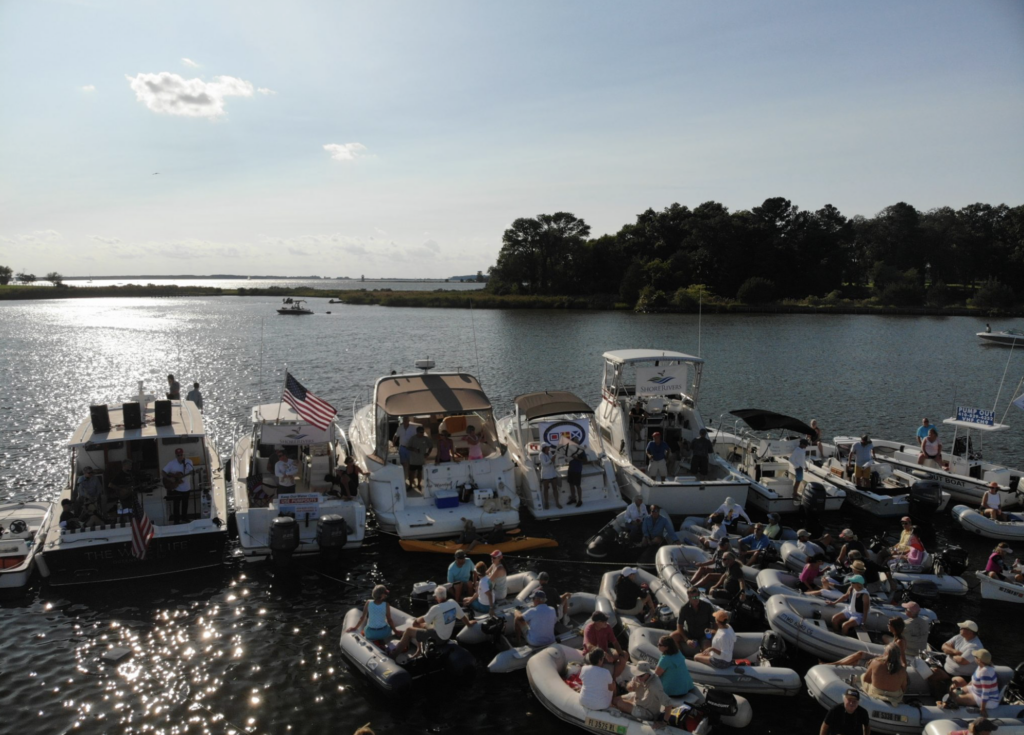
Basic boating handbooks devote some space to ‘rafting up’—the term describing multiple boats tied together for a fun social connection on the water—like making sure your lines are long enough to secure your bow and stern to another boat.
After participating in many raft-ups—and gathering tips from other rafters— here are the ones I think you need to be sure to follow this summer:
- Have an entry plan for your next tie-up
- Have a plan for exiting (and a backup plan!)
- Pick a well-known or well-scouted site (taking into consideration the draft of all boats)
- Pick an anchoring spot far enough from a shoreline that is also deep and large enough
- Use caution around areas with sandy shoals
- The host boat is positioned at the center of the raft up
- The largest and heaviest boat drops anchor first, and all boats will swing as one
- * Aligning stern to stern is best to avoid climbing over gunwales and handrails
- Be aware of your surroundings; go slow and be extra alert to spot people on water boards, mats or toys
- Deploy fenders on approach, adjusting height to match the height of the
rubrails of the boat next to you - Tie bows and sterns to ideally create an “X” shape
- It’s best if boats of similar freeboard are tied next to each other
- Keep lines tied to the ‘raft’ as tight as possible (for example, in a wake scenario all the crafts would rise and fall together)
- Exit the raft-up in reverse order of entry
- For breaking up the raft-up, the last boat in should be the first one off, and it is best to back down from the raft-up
- As the Brits say, “Mind the tides!”
Photos courtesy of Shore Rivers