Folksinger Alice Gerrard must have known something when she wrote Sweet South Anna River, a long, lovely song about a tributary of the Pamunkey River. Despite its narrow, wooded course, the South Anna flows to the Pamunkey, the York, and the Chesapeake’s mainstem, so it’s open to the Atlantic. Now this sweet river has a cascading restoration success story, in which one restoration project has made another one possible, benefiting two threatened “ecosystem engineers.”
The South Anna was fully open to the Atlantic for some 10,000 years after the last Ice Age, flowing southeast about 100 miles from its source in the Blue Ridge foothills near Gordonsville to join the North Anna River and form the Pamunkey River about 5 miles northeast of Ashland. For most of those years, it served the ancestors of today’s Pamunkey Indian Tribe well, including feeding them with spring runs of shad and river herring. In the 18th century, though, English colonists began damming rivers like the South Anna for water power, cutting off those long-established runs, and the long-established food webs in which they played integral parts (including for us humans).
The South Anna lost more than 400 miles of river and stream spawning habitat in 1916 with the construction of the Ashland Mill Dam across the river just west of where U.S. Route 1 crosses it. The good news is that multiple partners removed it in 2024, and they have already documented American shad, alewives, and blueback herring swimming upstream of the site in both of the past spring runs. That news is very important in itself, since stocks of all three of these valuable fish species are low enough that harvest of them has been completely closed since 1994 (American shad) and 2012 (both river herring). Part of their problem has been chronic loss of spawning habitat, a problem on which projects like this one focus.
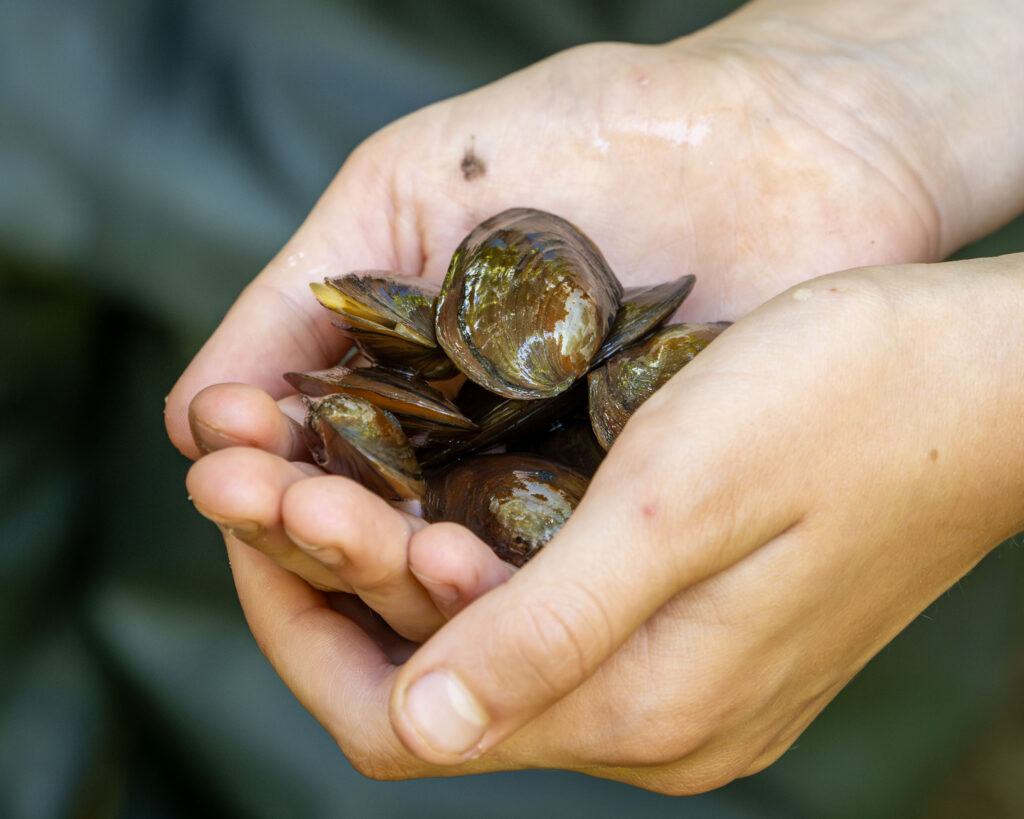
Now, the return of alewives to the upper South Anna makes possible the return of another ecologically crucial critter, the Alewife Floater freshwater mussel. Uniquely adapted to living with a nontidal, downstream current, these filter-feeding bivalve cousins of oysters, clams, and saltwater mussels evolved over thousands of years into many, many specific niches in freshwater streams across North America, including the upper watersheds of the Chesapeake’s waterways. There, their beds have contributed mightily to the benthic (bottom) habitat quality of those waters, in many of the same basic ways that oyster reefs have in the Chesapeake system.
Widespread human activity, however, has over the past several hundred years damaged many of their communities to the point that they are all now protected by law from harvest or disturbance. Sedimentation, channel modification, dredging, and dam construction that blocks stream habitat have all contributed to the mussels’ problems.
The removal of the Ashland Mill Dam illustrates the unique life cycle of the alewife floater. Male floaters anchored in the sandy river bottom broadcast sperm that current carries downstream to females who take in the sperm through their siphons. They allow the sperm to fertilize their eggs internally, after which they release the resulting glochidia (larvae) into the water column. The problem is that in a one-way current stream, the resulting larvae would from year to year gradually move the mussel community downstream. Incredibly but ingeniously, freshwater mussels have instead evolved over eons to employ multiple fish species as taxis to carry their young back upstream.
(I’m not making this story up!) In the case of the alewife floater, the carrier is, naturally, the alewife herring. A healthy run of these fish in early spring in a stream like the South Anna includes thousands of fish, driven by the season’s (normally) strong seasonal runoff and rising water temperature. Triggered by temperature or a chemical cue, the female floaters release their glochidia (about 250,000 each) as the alewives swim past. The broadcast glochidia attach to the fishes’ gill filaments, which grow capsules of tissue over them while they develop for several weeks. They develop into tiny juvenile mussels and then drop off at random, upstream of their birth sites. If they land in suitable stream bottom, they develop there, live their lives of five-to-ten years, and produce more young for succeeding spring herring runs to distribute. The process is random, but alewife floater females produce enough glochidia to hedge their bets.
Enter Dr. Joe Wood, the Chesapeake Bay Foundation ‘s Virginia Senior Scientist, who has become increasingly fascinated and excited by the Commonwealth’s freshwater mussels over the past ten years. Last year, he pulled together a partnership called the Pamunkey Freshwater Mussel Alliance that includes, in addition to CBF, the Pamunkey Tribe, Virginia Commonwealth University, the York River and Small Coastal Basin Roundtable, the Virginia Department of Wildlife Resources (DWR), Randolph-Macon College (RMC), Wetland Restoration and Training LLC, and the U.S. Fish and Wildlife Service (USFWS). The Alliance applied for and received a grant from the Chesapeake Watershed Investments for Landscape Defense (WILD) Grants Program to support the partnership’s mussel restoration efforts in the Pamunkey River watershed.
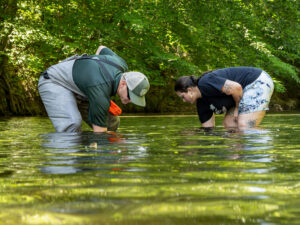
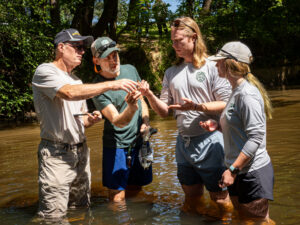
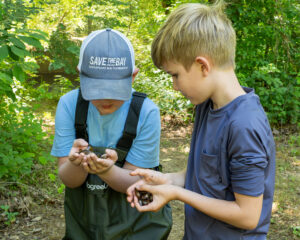
In April, Wood convened a first in-person meeting of the Alliance to develop priorities and from them, an agenda of restoration opportunities. One of the first was the South Anna, following two years’ evidence that alewives were swimming well upstream of the old Ashland Mill Dam site. On June 4, a crew of Wood, other CBF staff, Alan Weaver (DWR), Zach Taylor (DWR), Charles Gowan (RMC), Carrie Fox (Pamunkey Tribe), and a group of volunteers convened about nine miles above the dam site to plant 750 hatchery-reared alewife floaters by hand into the river’s sandy bottom. All are marked with passive integrated transponder (PIT) tags, and some have acoustic tags, so the Pamunkey Alliance partners will be able to track their progress.
And so, this summer, the Sweet South Anna River has some new/old life: ancestral species that haven’t lived there for more than a century are returning. There will be juvenile herring growing in this upper tributary all summer, along with 750 young alewife floaters filtering food from the several thousand gallons of water a day that flows through their gills. They will help clarify the water while they grow to maturity over the next few years. The communities of algae, insect larvae, and worms will grow on their shells and feed the river’s food web, from crayfish and darters to kingfishers, smallmouth bass, and river otters. Alice Gerrard’s vision is coming back!
Photos by Sue Mangan Photography