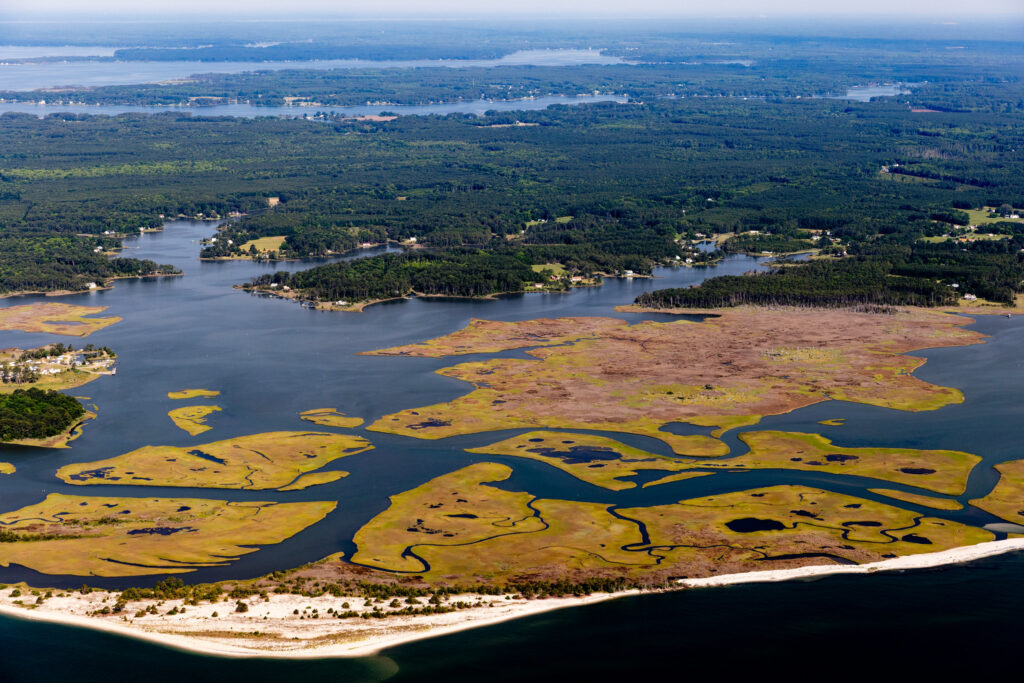
A push in Virginia to invest in shorelines and marshes may be paying off. Natural wetlands and man-made living shorelines around Virginia’s Middle Peninsula generate just under $90 million of economic value each year, according to a new study led by William & Mary’s Batten School & VIMS.
The Middle Peninsula (Gloucester, Mathews, & Middlesex counties) has been a Habitat Focus Area of the National Oceanic and Atmospheric Administration’s Chesapeake Bay Office (NCBO) since 2022. That Office funded the study, which combines ecological data, spatial modeling, economic valuation, and surveys to assess the current and predicted benefits of marsh ecosystems. Researchers used numbers from the study to develop a new online tool for coastal communities to estimate the economic benefits of marsh and living shoreline projects. It’s known as SHORE-BET (Shoreline Benefit Estimation Tool).
“This study looks at wetlands from a number of perspectives and puts research-informed values on the benefits they provide,” said Donna Bilkovic, professor and assistant director of the Center for Coastal Resources Management at the Batten School & VIMS. “These data serve as the foundation for SHORE-BET, allowing local planners and individual landowners to better understand the potential environmental and economic benefits associated with living shoreline projects and marsh protection and restoration.”
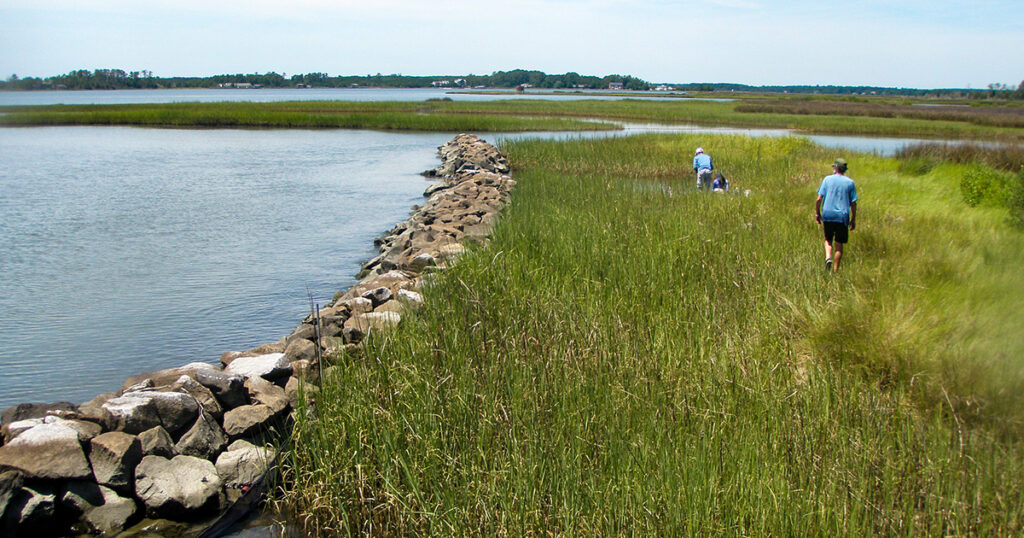
The study detailed ecological services provided by marshes and living shorelines, including storm protection, nutrient removal, carbon sequestration, habitat for fish and wildlife, and recreation and tourism benefits. Together, they make up 3.3% of the Middle Peninsula’s annual gross domestic product. Prospects for marsh expansion and construction of living shorelines for erosion protection build the potential for annual benefits to $168 million by 2050.
“Our survey results highlighted differences in the ways that stakeholder groups perceive benefits related to coastal marshes,” said Bilkovic. “Policymakers tended to prioritize storm risk reduction and ecological benefits, while local residents and anglers also placed a high value on recreation and fisheries.”
Virginia legislation requires living shorelines for erosion control projects where suitable. The study projects the potential for enhancement and restoration of more than 6,000 acres of marsh, bringing valuable economic and ecological benefits.
“Our goal in designing SHORE-BET was to create a user-friendly online platform to help coastal decision makers, planners and property owners explore the community benefits provided by living shorelines,” said Andrew Scheld, study coauthor and expert in fisheries economics at the Batten School & VIMS. “It’s among the first tools of its kind to integrate economic, ecological and geospatial data to guide shoreline management decisions.”
SHORE-BET allows users to calculate ecological service values for specific living shorelines and natural marshes. With it, a landowner can project the long-term benefits of shoreline protection and restoration strategies. “By combining data from field research and community input, SHORE-BET can help ensure shoreline decisions reflect both science and stakeholder priorities, potentially fostering a shift toward a model focused on watershed-scale planning that maximizes shared benefits across communities,” said Bilkovic.
To learn more, visit vims.edu/ccrm/research/climate_change/adaptation/eco-services/