One group’s grassroots community effort has paved the way for large-scale oyster restoration, and it’s all because they believed in their waterway’s environmental potential.
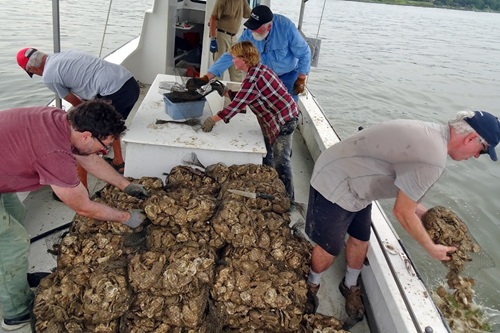
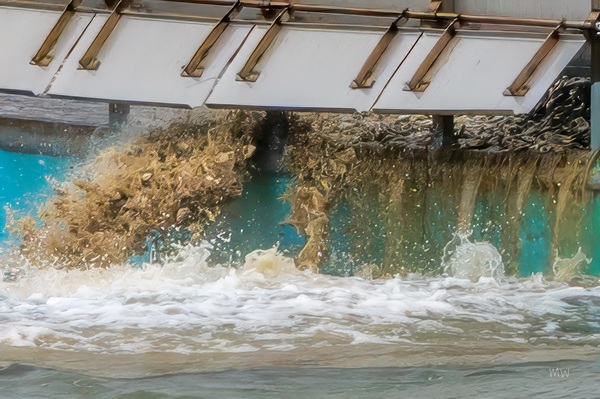
One fine day in 2019, a small group of volunteers loaded their trucks with 25-pound bags of juvenile oysters and drove from Horn Point Oyster Hatchery to the shores of Herring Bay. From the deck of their boat, they sliced the bags open, hoisted them overboard, and emptied the oysters into the water. When the backbreaking work was done, they’d planted around a million. It took three years. This spring, they watched as many millions of spat-on-shell were sprayed from an oyster planting vessel contracted by the Oyster Recovery Partnership (ORP). Now, 9.7 million new juvenile oysters sit at the bottom— all thanks to the tiny community group Advocates for Herring Bay (AHB).
AHB has just completed their oyster restoration campaign “Happy Oysters, Healthy Bay,” a community-funded effort to put 10 million oysters in Herring Bay by 2025. They collaborated with ORP to plant the oysters on a 2-acre site this spring, demonstrating the importance of watershed communities in caring for the Bay.
Situated on the western shore of the Chesapeake south of the West River, Herring Bay was designated an oyster sanctuary in 2010 and has been the focus of several government projects since. In 2023, the DNR planted 26.5 million juvenile oysters there, and they’re working to plant 60 million more in 2025 with mitigation funds from the container ship Ever Forward. But AHB has been working even longer than that, albeit on a smaller scale.
“We’re advocates for Herring Bay because we know and care about its environmental resources,” says Kathy Gramp, AHB president. When a 2020 DNR report mentioned Herring Bay as a “level D” oyster sanctuary (a low rating with “poor habitat” for oysters), community members wondered why. “That didn’t ring true to us,” says Gramp. “We were asking a different question: could oysters make a comeback in Herring Bay?”
Several things make Herring Bay an opportune place for oysters to flourish: In the protected sanctuary, oysters can build up on shoals and act as reefs, providing structured habitats for all kinds of other aquatic life. There’s also a higher chance that oyster reseeding efforts here will spread to the rest of the Bay, since Herring Bay is open water rather than a tributary. So, the question was an important one: could oysters thrive here?
Familiar with their backyard environment, and hopeful that their optimism would pay off, AHB got permission from the DNR to reseed a quarter-acre test site with around one million oyster spat. It was a DIY project: “We literally had volunteers drive to the Eastern Shore, pick up bags of spat from the hatchery at the end of the season, take them out on a boat, and manually put them overboard,” Gramp recalls.
The results of this reseeding were excellent. “A restoration goal is 50 live oysters per square meter, and I think we were over 200,” says Birgit Sharp, AHB co-chair and volunteer. The answer was yes: oysters could make a comeback in Herring Bay.
Encouraged, AHB launched their campaign “Happy Oysters, Healthy Bay,” to plant 10 million by 2025. This spring, they collaborated with the Oyster Recovery Partnership to finish the project, and the last batch was planted on June 11 for a total of 9.7 million oysters.
Mike Zuralow, co-chair, recalls that first restoration project, when they manually emptied hundreds of bags of oysters into the Bay. Their partnership with ORP shows just how far they’ve come: “Seeing millions of spat-on-shell being sprayed off the deck of the Robert Lee was a gratifying culmination of the community’s efforts,” Zuralow says.
Herring Bay will stay in the spotlight for oyster restoration: the DNR has chosen it as one of three large-scale restoration sites, along with the Nanticoke River and Hoopers Strait. The Herring Bay project is slated to begin in 2026 and might be the “state’s largest restoration effort to date,” according to an October 2024 press release.
Meanwhile, AHB’s oysters are planted, but they’re still fundraising: the project—costing tens of thousands of dollars— was backstopped by many of its volunteers. To help meet their goal, they’re hosting a contra dance at the Captain Avery Museum on June 28. All proceeds will go toward the recently planted oysters.
AHB exemplifies the importance of community-based restoration efforts in the watershed. “I hope we can be a model for other small areas,” says Kathy Gramp. “Yes, you the people— you can make a difference.”