By Kendall Osborne
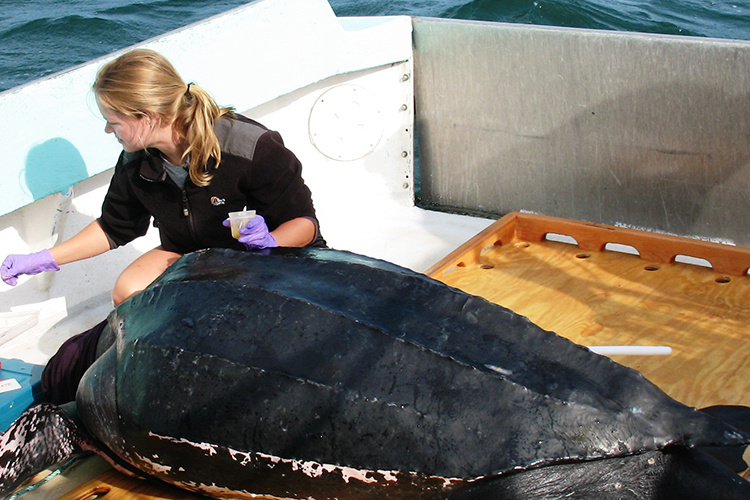
Leatherback turtles are the largest turtles in the world, in some cases growing beyond eight feet in length. That’s right; a turtle can be longer than you are tall. For the first time reported, a leatherback sea turtle has nested in coastal Virginia.
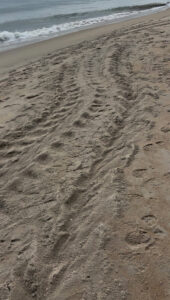
One Sunday last July, a volunteer discovered large tracks on the sand at Dam Neck in Virginia Beach. The tracks were large and wide, and looked more like truck or ATV tracks than turtle tracks. The volunteer called the Virginia Aquarium and Marine Science Center’s Stranding Response hotline. Erin Bates, Rehab Manager at Stranding Response, and her staff were prepared for this call. “We knew the day would come when a leatherback nested in Virginia, so we had everyone ready ahead of time,” Bates says. “Lots of volunteers and other agency personnel responded.”
“When I saw the tracks I had no doubt this was a leatherback nest,” Bates says upon seeing the tracks. Bates explained that leatherbacks disturb a lot of the beach when they come ashore to nest. This “crawl” all over the sand makes it more difficult for predators to locate the eggs. “The tracks were 2.5 meters wide, which is much bigger than the tracks of a smaller and more common loggerhead,” Bates notes.
It took the volunteers two and a half hours to finally find eggs. “The size of the eggs also points to a leatherback,” Bates says. “Loggerhead eggs are the size of ping pong balls. The eggs we found were the size of pool balls, which is the size of leatherback eggs.” On the following Monday, the Aquarium received a call from an angler who had been on the beach Saturday night. The angler provided photographic proof that a leatherback had indeed nested in Virginia. (The angler has not given permission for the photos to be published). The nest has been protected, and will be watched by volunteers. As the time for hatching approaches, the nest will be monitored both day and night.
According to the National Oceanic and Atmospheric Administration (NOAA), leatherbacks have been around since the days of the dinosaurs, and have the widest distribution of any reptile in the world. They are much larger than the more familiar loggerheads. Instead of a scaled shell, they have a dark rubbery shell, hence the name leatherbacks. They can hold their breath for 85 minutes, and can cover 10,000 ocean miles to feed and find a nesting site. They are considered endangered, and their population has declined by 40 percent over the last 3 generations. The biggest threats to their survival are poaching of eggs and turtles themselves, and entanglement in fishing gear.
Bates reminds everyone that sea turtles only leave the ocean to lay eggs or if they are ill or injured. Therefore, if you see a turtle on the beach you should always call Stranding Response because you have either found a nest or a sick animal. In addition, anglers who accidentally hook a turtle should call Stranding Response. Anglers should not attempt to remove hooks themselves. Even if the hook falls out, the turtle should be examined by the team to monitor the turtle’s health. To date, Stranding Response has aided 78 turtles in 2026. To contact them, call 757.385.7575.