An impressive array of brilliant wildlife artists come from all over the country to the Waterfowl Festival in Easton. One sculptor’s background as a Smithsonian taxidermist gives his art a fascinating realistic quality. We talked with the Maryland native about the inside knowledge that prepared him for a wildlife art career.
From an early age, Paul Rhymer has loved the outdoors. Fishing, hunting, birding, and camping were part of a storybook childhood in Montgomery County, Maryland. He was raised by two artist parents: his mother Kay is a painter and his late father Dan was a carver and a taxidermist, as was Paul’s grandfather. Art was everywhere in the Rhymer family home and it was not surprising for a free-range child with art in his genes to grow up as a nature artist. Heeding the call of the wild loud and clear, Paul allowed Mother Nature to be his guide, which she remains to this day.
“Those experiences, as well as bird watching, offered constant ideas and inspiration,” says Rhymer. After receiving an Associate of Arts degree from Montgomery Community College in 1983, Paul worked at a solar panel factory. Soon after, he got a job at the Smithsonian as an illustrator. “It was doing very entry-/assistant-level design work and graphic art,” says Rhymer.
At the time, the Smithsonian ran tours all over the world. “They would send you a brochure, like ‘Canoeing the Everglades’ or ‘Trekking New Zealand’,” says the artist. He was a part of a team that illustrated and designed the pamphlets by hand—literally pen on paper. A typesetter would paste together the text and illustrations and send the finished work to a printer. The job got Paul in the door with the Smithsonian, where he met the people doing model-making and taxidermy.
“They would bring you in entry-level jobs and train you in the museum way,” says Rhymer.
When a position as a taxidermist opened up in the same office, Paul made the switch to his family’s trade and became a full-time employee. Taxidermy and model making offered a better career path for the recent graduate. Model making was a solid foundation for sculpting and developing his 3D perspective while taxidermy provided him with the knowledge of anatomy and armature making.
“The mold making was a skill that is directly used in the bronze/lost wax casting process,” says Rhymer. “All the production knowledge and experience freed my mind to learn more about being artistic rather than just making bronze models.”
As a taxidermist for the Smithsonian for over three decades, Paul put together all species of animals from orangutans to skunks and all manner of fowl. According to the Smithsonian, many of Rhymer’s (and his father’s and grandfather’s) stuffed creations still stand in the Natural History Museum’s Hall of Mammals in Washington, D.C.
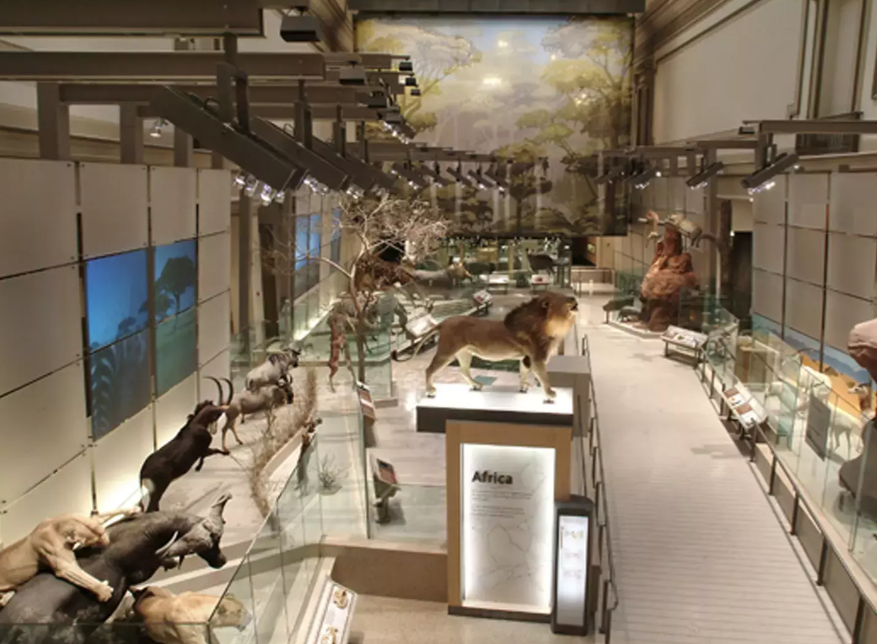
His knowledge of the skeletal framework and essence of his subjects is evident in his sculpture, which is realistic but far from one-dimensional. Gradually his brain and hands started working in tandem with height, width and depth; in other words, in three dimensions (3D).
“My own work gravitated towards sculpture,” says the artist. “A lot of wildlife artists started as taxidermists. It’s very common in our world.” Working with curators and designers further sharpened his skills and made it easy to look for and learn from criticism from colleagues and mentors. According to Paul, many artists are extremely shy about seeking this experience so they can get better. In the museum world, avoiding critique is not an option. By the late 1990s, Paul was all in with sculpture.
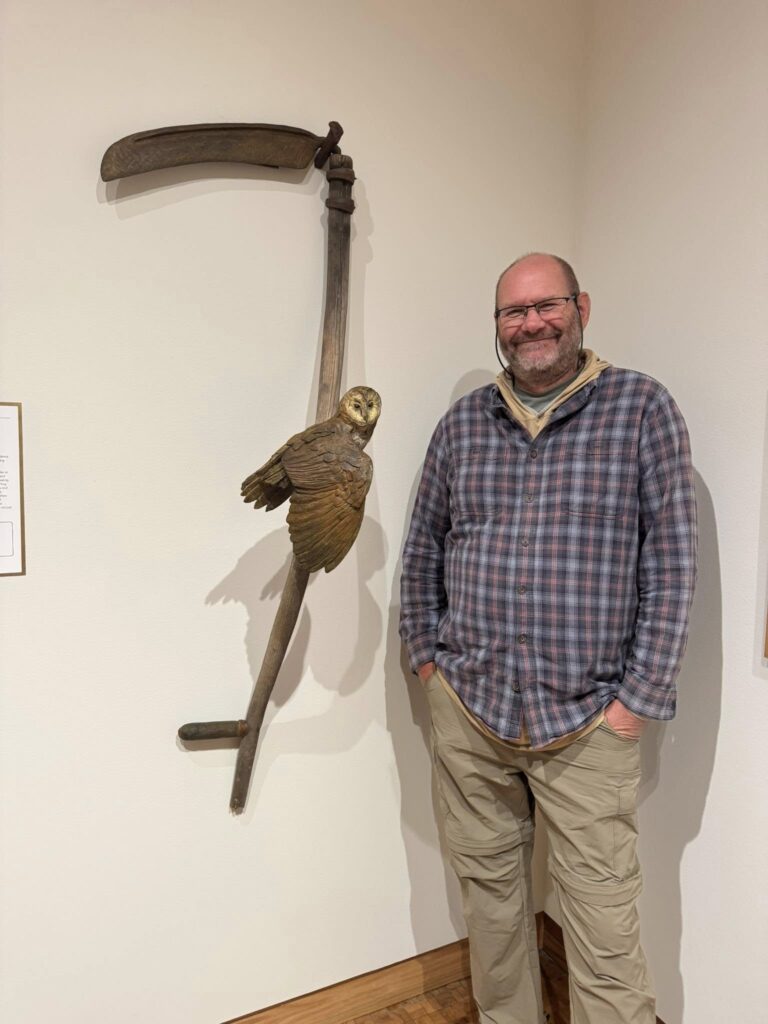
“Once I started sculpting and I cast my first or second piece, it was no longer a hobby,” says Rhymer. “I thought, ‘This is what I’m going to be doing now, and all my free brain space went into that.’”
Paul met his wife Carolyn in the model shop at the Smithsonian where they were colleagues. Today she is retired and works as a full-time photographer. The two still find time to work together and are bidding on a bronze model job for a zoo. The couple lives in Point of Rocks, MD, about a half mile from the Potomac River, a spot they initially chose so they could commute by train into D.C. for work. Paul and his team operate in an old church-turned-studio that sits literally across the street from the house the couple bought when they got married. The two buildings sit on two acres.
“Like any other studio, it’s an absolute train wreck,” laughs Rhymer. His team consists of three full-time workers and a few summer employees. The team runs a small foundry casting the work, which begins with the furnaces where they pour bronzes. There is a wax area where they make ceramic molds. Everything is cast in pieces, which all gets reworked in patina. Two of his staff can conduct every function in the shop, which makes for a smooth operation and lots of noise.
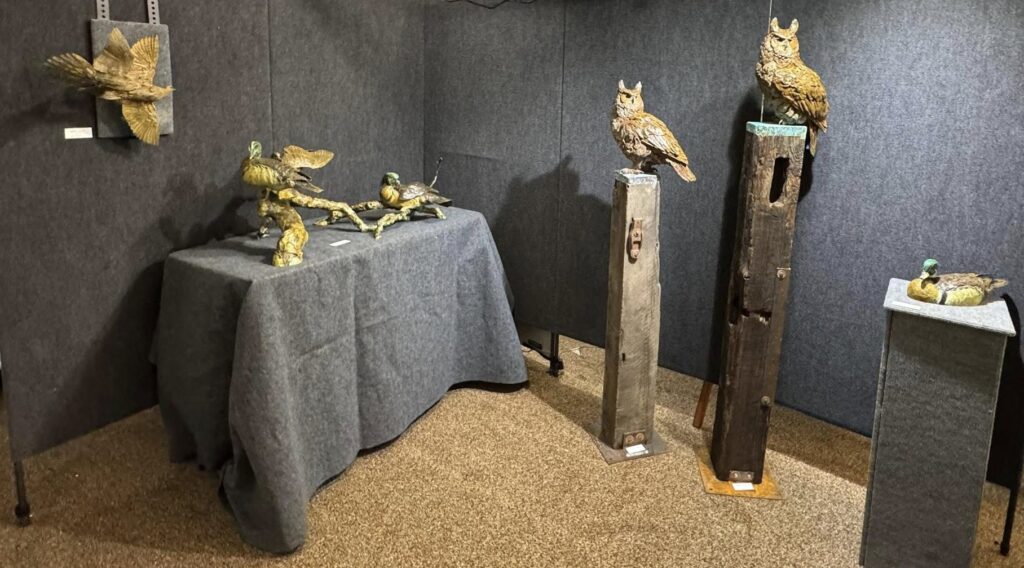
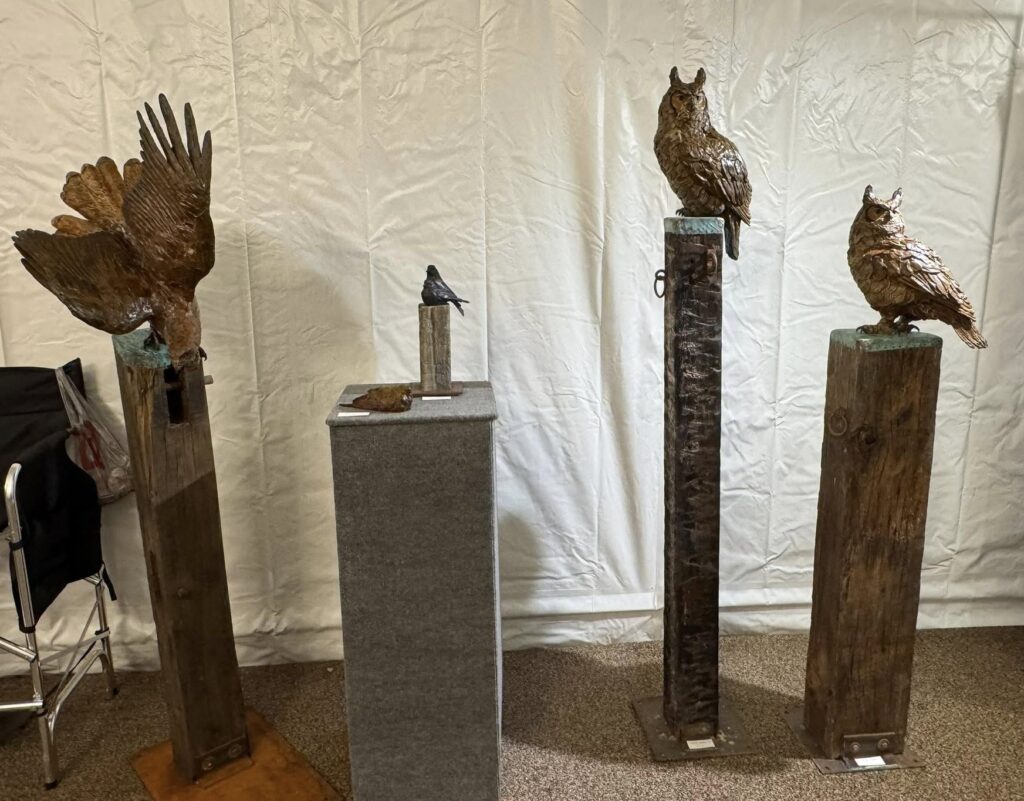
Paul’s creations often appear in situ, as if seen along a trail or in a field or marsh. With skills as an outdoorsman and a taxidermist combined with his artistic and creative eye, Rhymer manages to create work that is both precise and soulful. Lifelike and naturalistic, and detailed to the claw, talon, beak and feather, much of his work has been exhibited at the National Sculpture Society and at art festivals all over the country. Some of his wildlife sculptures are on permanent display at the National Zoo, the National Museum of Natural History, and the Denver Zoo as well as in various public buildings and parks and private collections throughout the U.S.
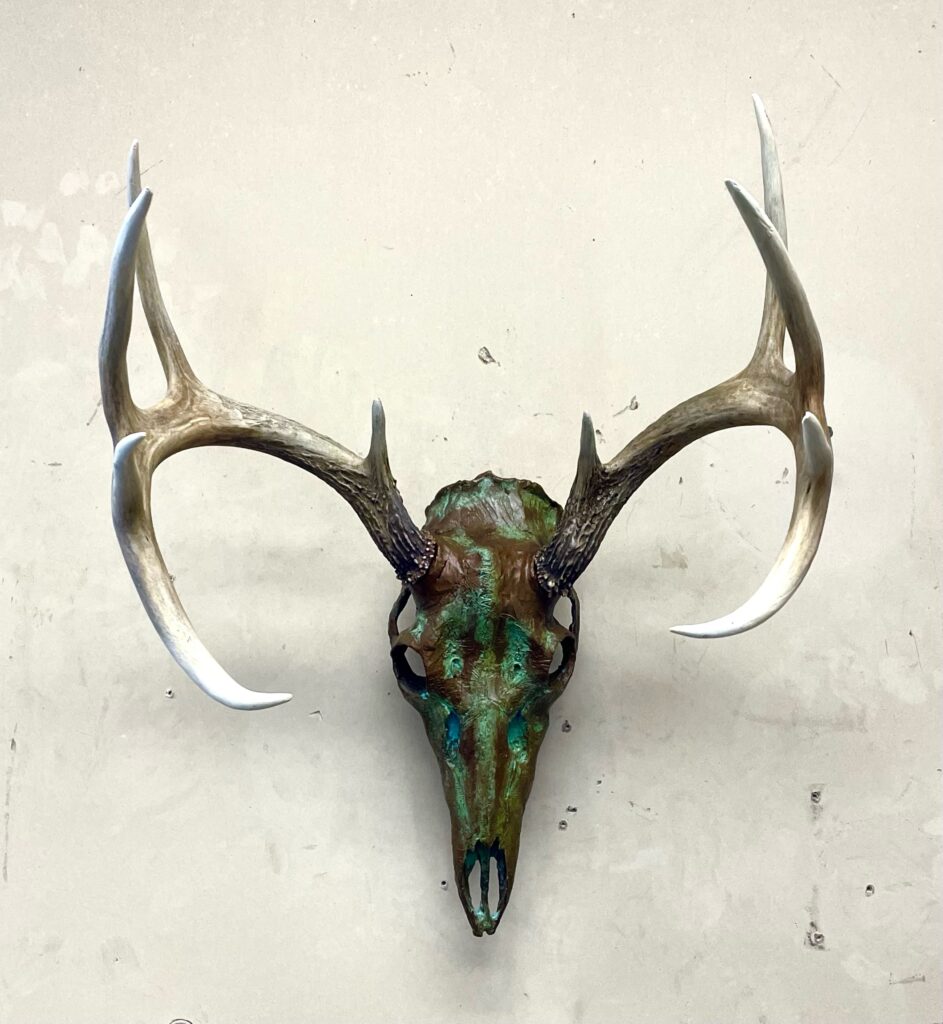
Rhymer’s bronze deer skulls with real (naturally shed) antlers came from a project first commissioned by a Wyoming resident. They are now part of his repertoire. For a nature-loving outdoorsy kid to grow up doing the same things that brought him joy as a young man is a dream come true.
The effort never stops and neither do the accolades. In 2023, Rhymer was named Birds in Art Master Wildlife Artist. He is always looking at nature and its inhabitants for some new inspiration. For the Waterfowl Festival in Easton this year, the sculptor is wrapping up a new project: a pair of great blue herons that will have their premiere in the Exhibitor tent. For more information, please visit rhymerstudio.com or waterfowlfestival.org.