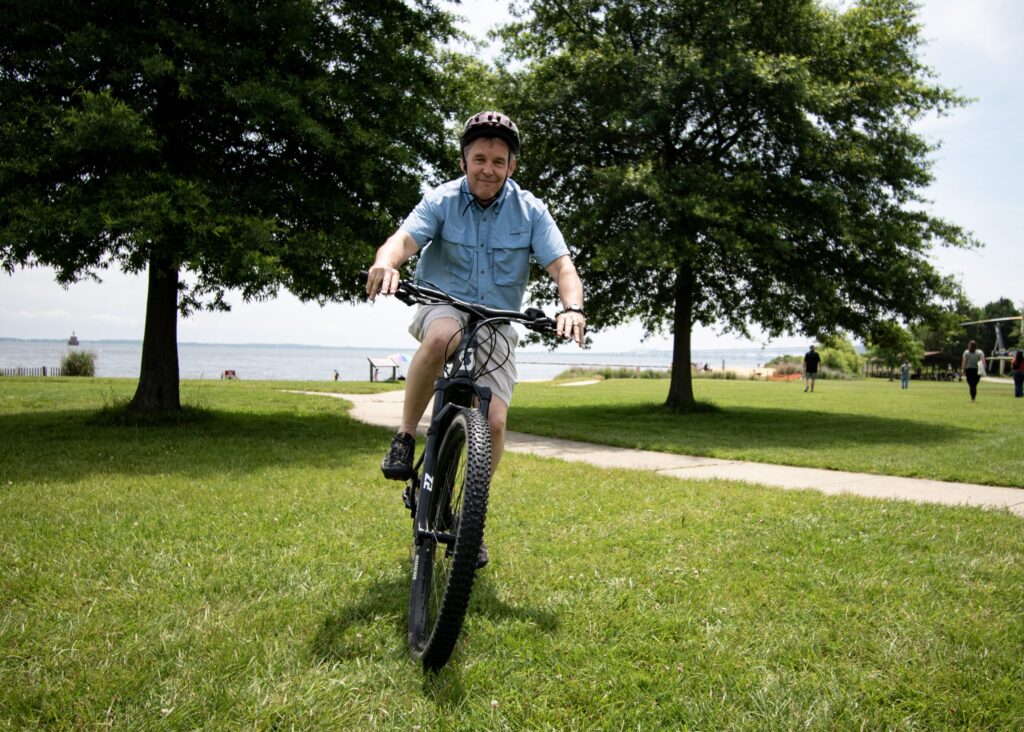
Love them or hate them, e-bikes are here to stay. Electric bicycles have been exploding in popularity nationwide, as anyone who frequents local bike trails (or suburban neighborhoods) can attest. Now, the Maryland Department of Natural Resources (DNR) is considering allowing pedal-assist electric bicycles on state bike trails, and they’re seeking public comment on the proposal.
Right now in Maryland, the only state trails that allow e-bikes are the Torrey C. Brown Rail Trail (known locally as the NCR Trail) and the Western Maryland Rail Trail. Under a proposed regulation, pedal-assist e-bikes would be permitted on most state trails where bikes are already allowed.
These “pedal-assist e-bikes” include Class 1 and Class 3 e-bikes, which require a person to be pedaling to activate the electric assist function. These bikes stop providing electric assistance when the bike reaches 20 mph and 28 mph, respectively.
Class 2 bikes, which would not be allowed, provide pedal-assist up to 20 mph and also have a throttle up to 20 mph and do not require pedaling. This type of bike would only be allowed if it is an “adaptive bike”, one made for people with physical disabilities or mobility challenges. Adaptive bikes may have hand-cycles, three-wheeled designs for stability, reinforced frames, adaptive seating, or specialized controls.
While the e-bike regulation would allow for riding on all trails that bicycle riders may currently use, DNR notes that there may be exceptions “for trails that were designed for specific user groups, such as pedestrians, for infrastructure concerns, for safety concerns and for habitat protection, at the department’s discretion.” Some single-track mountain biking trails, for example, could potentially suffer damage to the environment if motorized e-bikes start treading on them.
DNR says it drafted the proposed regulation to increase accessibility and enjoyment of Maryland’s public lands, reasoning that it will “lay a foundation for a burgeoning electric cyclist community in the state.”
Indeed, e-bikes are becoming more and more prevalent, both in Maryland and nationwide. The U.S. Department of Energy’s Vehicle Technologies Office says that more than 1.1 million e-bikes were sold nationwide in 2022, according to the most recent year’s available numbers. That’s about four times as many as were sold in 2019.
“This e-bike policy will help even more people enjoy Maryland’s multi-use trails,” said Sandi Olek, director of the Maryland Office of Outdoor Recreation.
Jon Korin, president of Bicycle Advocates For Annapolis And Anne Arundel County (BikeAAA) encouraged DNR to add the regulation because it allows people of all abilities to get on a trail. “Some older people tell me, ‘I couldn’t (or wouldn’t) be out here if not for this e-bike,’.”
He points out that a statewide allowance for e-bikes will offer consistency with local trails that already allow e-bikes. As an example, he points to Anne Arundel County’s nearly-completed Broadneck Trail, which will essentially extend the B&A Trail all the way to Sandy Point State Park. Under current law, e-cyclists can enjoy a long ride on the Broadneck peninsula, only to be barred from riding into Sandy Point State Park. The new regulation would change that. He also points to the paved areas of the popular Patapsco Valley State Park as good spots for e-bikes.
Korin is pleased to see that the regulation distinguishes between Classes 1, 2, and 3, calling it an example of a nuanced approach.
What about the increased speed of e-bikes and potential risk of collision? DNR advises that e-cyclists should “Say Hey, Give Way, and Enjoy the Day,” yielding to pedestrians and equestrians. They should also turn off their motors when passing a horse to avoid spooking it, the department says.
Korin’s philosophy is to “manage the behavior, not the device.” Yes, some e-bike riders go too fast and fail to announce they are passing, he says. But, “there are jerks on roadbikes [bicycles] who ride too fast and don’t announce.” Using driving laws as an example, Korin points out, “On the roads, we don’t say,’No Maseratis’ because they can go 200mph. We say, ‘The speed limit is 40.'”
DNR will accept public comments on the proposed regulation, posted in the Maryland Register Online, now through September 22. You can send comments to the Office of Outdoor Recreation, Maryland Department of Natural Resources, 580 Taylor Ave C-4, Annapolis, MD 21401; email [email protected], or submit an online comment form.