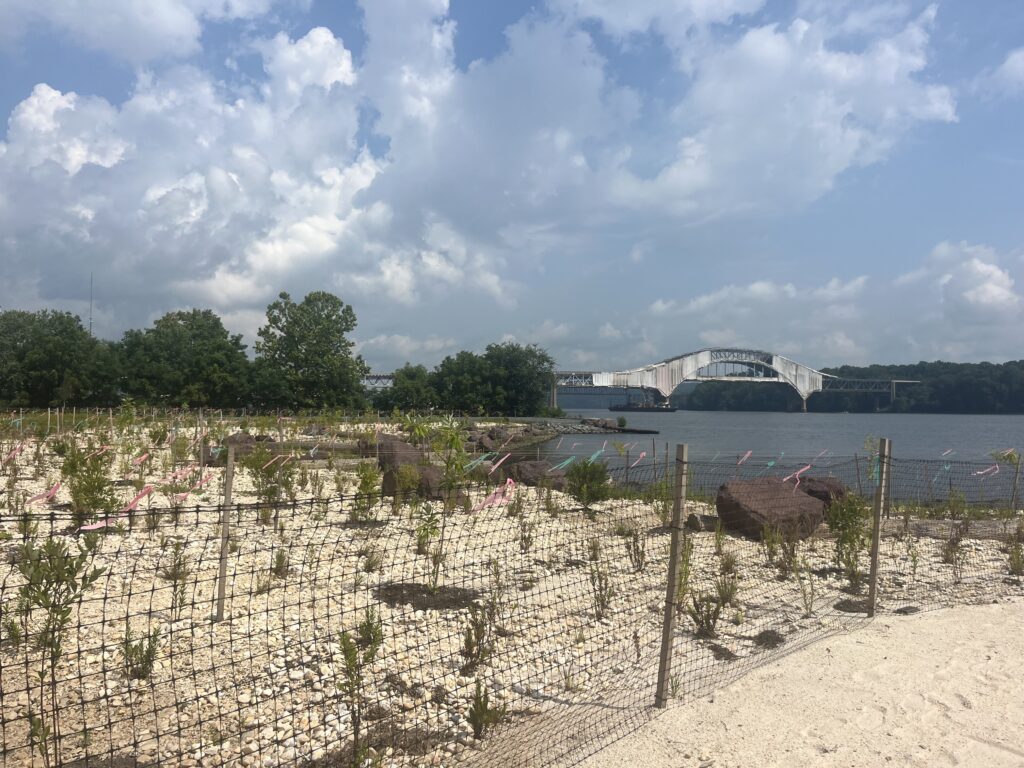
At the mouth of the Susquehanna River, the largest tributary of the Chesapeake Bay, water laps against the pebbles, logs, and verdant grasses of a newly restored shoreline. Once a dilapidated bulkhead, this waterfront landscape in the heart of Havre De Grace, Maryland, is now a thriving ecosystem that benefits both its community and the Bay.
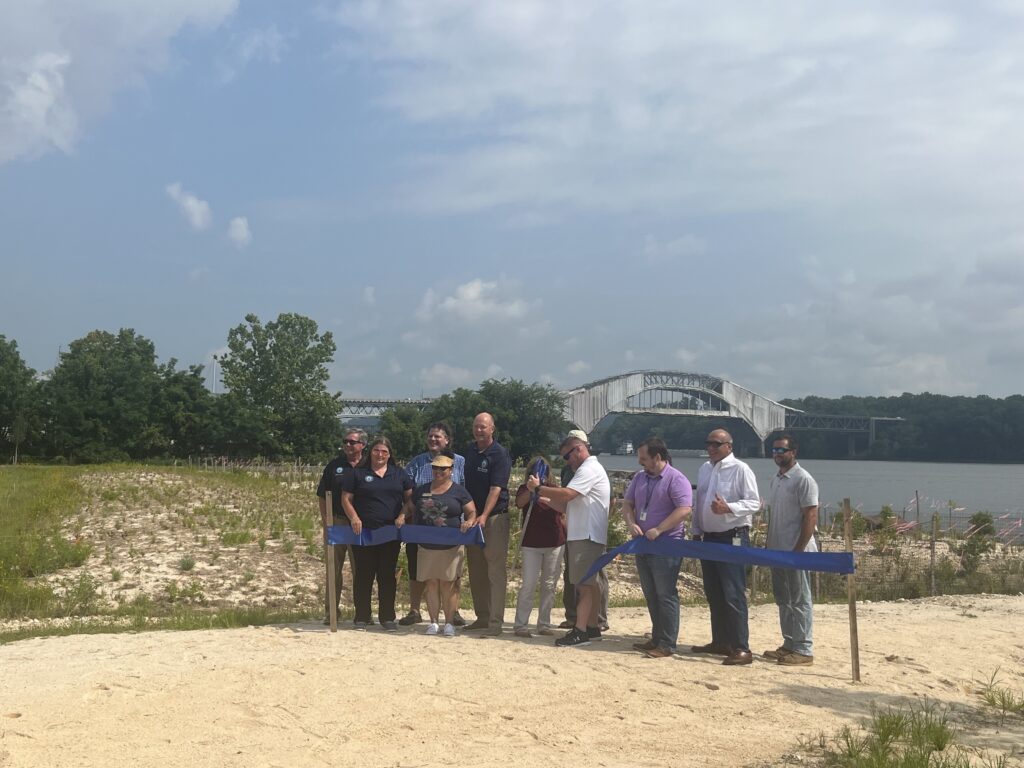
On Thursday, Havre De Grace Mayor Bill Martin cut the ribbon on 1,700 feet of shoreline near Water Street. It marks phase three in the town’s multi-year waterfront restoration project spanning a total of almost 3,000 feet. Over the course of a few months, contractors, engineers, and volunteers transformed a post-industrial bulkhead into a sloping shore with a public boat ramp and kayak launch. The new landscape will help with water filtration and make the waterfront more resilient to storms and high-energy waves.
The area was turned into a “deep-water living shoreline,” said Kate Vogel, Senior Manager of Coastal Resilience with the National Wildlife Federation. Restoration workers began 17 feet deep in the water and worked backward to rebuild the shore. Before, it was an old concrete bulkhead just one storm away from failing: nothing stood between the pollutants of the city streets and the precious water flowing into the Bay—including a nearby drinking water treatment plant.
“Before the project, there was only straight outflow into the Chesapeake Bay,” said Martin. “Every chewing gum wrapper and cigarette butt would flow into an outfall when it rained. Nothing was slowing it down.”
On the new shoreline, runoff is fed and filtered slowly through rocky ravines full of pebbles that let water through but leave trash behind. These layers of rocks were intentionally placed, and the soil was sealed from pollutants, said Naomi Wright, Manager of Constructions in Havre de Grace. In addition to filtering water, the restored landscape will also withstand high-energy waves from storms and releases from the upriver Conowingo Dam.
The town collaborated with the National Wildlife Federation, using $2.5 million of grant money from the National Fish and Wildlife Foundation. They worked with local companies Cianelli Construction and BayLand Consulting for construction and engineering work, and all 4,000 native plants were hand-planted by a group of 40 volunteers in May.
“These are our favorite kinds of projects,” said Bill Heckert, Project Manager with BayLand Consulting. “It’s not like paving roads or putting in sidewalks. It requires adaptability.” By restoring the waterfront, Havre De Grace benefits from the resilience of a natural shoreline, ensuring a thriving future in the face of changing weather and tides.
“Let’s make sure the future can hold onto the past,” said Jacob Bennett, Harford County councilman, “so that our kids and grandkids can walk down Water Street, not canoe down Underwater Street.”
Work doesn’t end here: Havre de Grace will continue to maintain their newly restored shoreline, keeping their small plot of land at home clean so that the Bay can be a little cleaner, too.