As we reported last week, underwater grasses increased in Chesapeake Bay last year, reaching their highest point since 2018 and coming within 615 acres of the interim goal of 90,000 acres by 2030 set in the Chesapeake Bay Watershed Agreement.
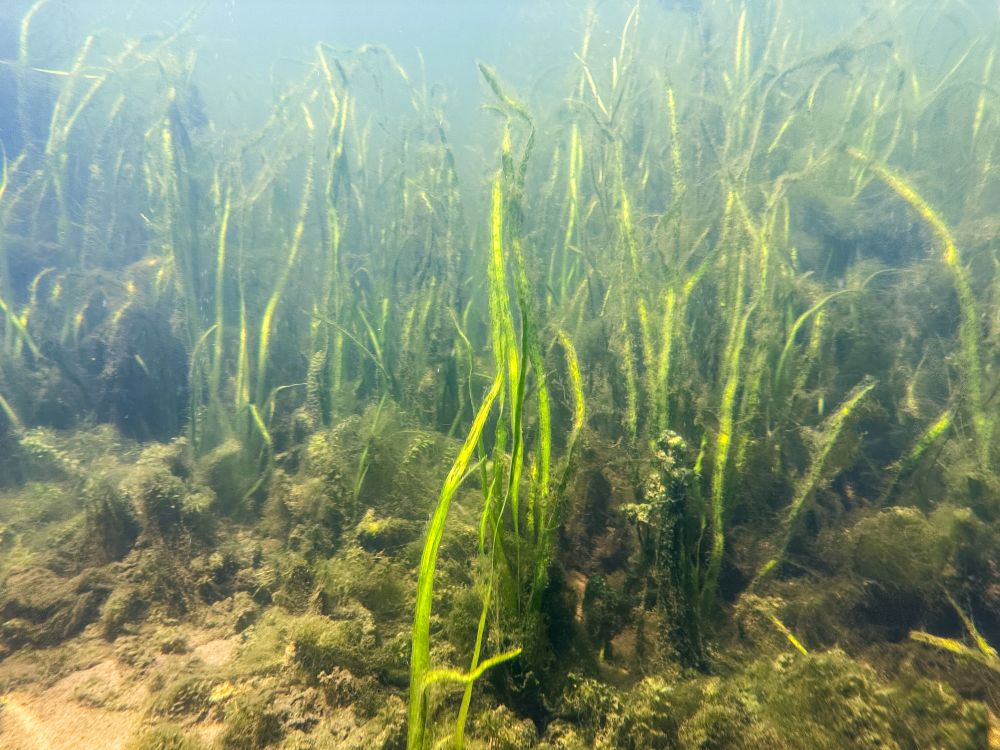
Surveys conducted in 2025 by the Virginia Institute of Marine Science (VIMS) and the Maryland Department of Natural Resources and recently released found 89,385 acres of underwater grasses, or subaquatic vegetation (SAV), which provide many environmental benefits throughout the bay and its tidal tributaries.
And while that’s closing in on the interim goal, it’s still a little less than halfway to the ultimate, Bay agreement’s long-term goal of 196,600 acres by 2040.
Dan Coogan, director of EPA’s Chesapeake Bay Program, called the results “an encouraging sign of what sustained coordination and investment at the federal, state and local level in bay restoration can accomplish.”
But the good news came for the most part in the saltier portions of the Bay. Sections of the Potomac, Patapsco, Gunpowder, Rappahannock, and James rivers experienced dramatic declines in underwater grasses.
“The different stories unfolding among the salinity zones really highlights just how incredibly large and complex the Chesapeake Bay ecosystem is,” said Christopher J. Patrick, associate professor and director of the SAV Monitoring and Restoration Program at VIMS. “It’s never just one story; it’s a collection of stories. A good year for SAV in one river can also be a terrible year for SAV in another.”
Underwater grasses are important to the health of the bay and an indicator of the estuary’s overall health. They help clean the water by absorbing excess nutrients and sediment while adding dissolved oxygen. They reduce wave energy to help stabilize shorelines while providing shelter and food for blue crabs, fish, and waterfowl. They also mitigate climate change and diminish acidification caused in part by greenhouse gas emissions.
When VIMS began monitoring SAV in 1984, scientists estimated the Bay contained only 38,958 acres of underwater grasses. Since bay restoration efforts began, estimates have ranged from that historic low to a high of 108,078 acres in 2018, and a long-term average of 70,978 acres. The 2025 total of 89,385 acres is well above that and marks the sixth-highest acreage recorded in the survey’s history.
“We have more than doubled the acreage of SAV documented when the Bay-wide SAV survey began in 1984, and today, SAV occupies tens of thousands of acres of habitat that had previously been lost,” said Brooke Landry, chair of the Chesapeake Bay Program’s SAV Workgroup and chief of the SAV Program at Maryland’s Department of Natural Resources. “That recovery demonstrates how far we have come in our efforts to restore the Bay despite a growing population, changes in land use, and changes in environmental conditions.”
Joe Wood, the Chesapeake Bay Foundation’s Virginia Senior Scientist, saw the increases as “a clear sign of how the Bay is healing,” and found “plenty to celebrate with more grasses in saltier parts of the Bay.” But he warned that the declines in those five rivers “reveal that significant work remains.”
“Polluted runoff from sources like development and agriculture remains a big threat to underwater grasses, and this is exacerbated by rising temperatures and more intense storms fueled by climate change,” he said.