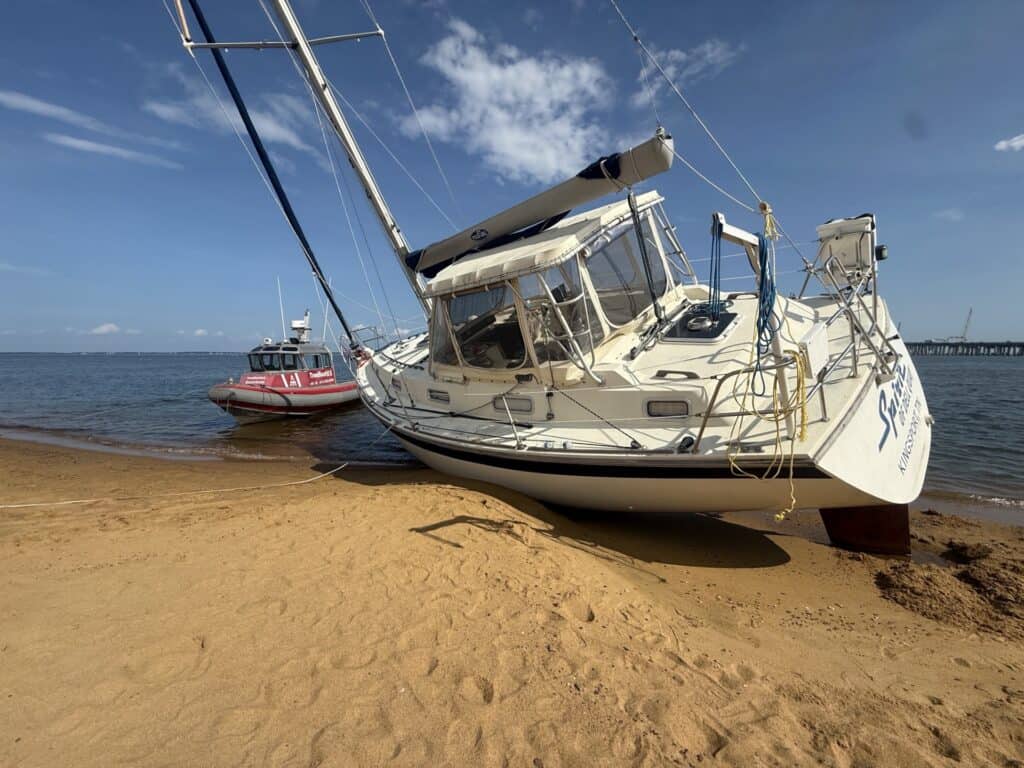
The storm blew up quickly that Saturday night in mid-August, with wind gusts in some places recorded at more than 50 knots. There was a coastal flood advisory in effect and warnings of an exceptionally high tide at midnight. The 35-foot Westerly, Spirit of Dell Quay, was just north of the Chesapeake Bay Bridge, headed for Delaware, as the wind howled, pushing the waves ever higher. Then the engine conked out, leaving the boat at the mercy of the wind and waves.
By morning she lay on her port side on the beach at Sandy Point State Park, an ungainly site in a spot usually covered with beach chairs and beachgoers.
The owner—who wouldn’t give his name—said only that he had just taken delivery of the boat, which has a hailing port of Kingsport, TN, emblazoned on its stern, and that his engine failed.
Brandon Jackson, the Towboat US captain who helped tow Spirit off the beach and later to Bert Jabin’s Yacht Yard in Annapolis for repairs, said the owner told him he was beset by weather and he had back problems.
“He said he fell once and then just hung on,” Jackson recalled.
Although this wreck wasn’t as dramatic as many and no one died, or even was seriously injured, it adds Spirit of Dell Quay to the list of vessels that have suffered at the hands of the Chesapeake Bay.
Donald G. Shomette, author, historian and underwater archaeologist, says he has documented some 6,000 vessels lost in the Bay. That’s three times the number he said were documented in his 1982 book Shipwrecks on the Chesapeake, but, as he notes, that was 40 years ago. He’s had time to find more since then.
“There were Spanish Galleons and a prehistoric log canoe fleet that was 5,000 years old,” he said.
In his book, Shomette tells of the first recorded disaster in the winter of 1608, less than a year after the founding of Jamestown, the first permanent English settlement in the Americas. A party of 11 set out from Jamestown for Hog Island, just a few miles downstream on the James River, despite pleas of their fellow settlers not to risk it in their grossly overladen small craft as a storm was brewing. They didn’t make it. Their bodies washed ashore a few days later below the settlement.
Shomette says losses could be laid to fires, storms, collisions, ice and in some cases poor seamanship or the lack of navigational aids.
Vessels entering the Bay in Colonial times, long before the days of channel markers and such, took their chances passing between Cape Charles and Cape Henry and what’s known as the dreaded Middle Ground directly between them, where the constantly shifting shoals tricked many a seaman.
Richmond, a merchantman out of Bristol, England, loaded with cargo bound for the Rappahannock River, passed through the Capes with all sails set on April 4, 1738, and headed straight up the Bay, only to run aground on the shoals. The ship bounced so severely on the bottom that seams opened, and water began pouring into the hold. The skipper, a Captain Smith, ordered the ship abandoned and put passengers and crew off in the longboats. He forgot one thing. He left the sails set.
When he and a salvage crew came back sometime later, all traces of the ship were gone. They never could figure out whether she was beaten to pieces or whether the sails caught the wind and drove the ship off the shoal to who knows where.
Many of the losses on the Bay can be attributed to war.
“There have been more battles fought on the waters of the Chesapeake Bay than any other body of water in the Western Hemisphere,” Shomette said. One of those was the loss of Joshua Barney’s Chesapeake Flotilla.
Barney, a Revolutionary War hero, came up with a plan to fight the Royal Navy, which had turned Chesapeake Bay into what Shomette called “a British lake” after the beginning of the War of 1812, attacking and plundering the Tidewater region from a base on Tangier Island. He would use a flotilla of shallow-draft barges with oars, light sails and one heavy gun to take advantage of the shoal water to harass British ships.
By the spring of 1814, Barney set out with a flotilla of 18 vessels to attack the main British base on Tangier Island.
On June 1, they encountered a British fleet off St. Jerome’s Creek in St. Mary’s County and retreated into the Patuxent River, then to St. Leonard’s Creek, where he took on and defeated the British in a series of battles. But by this time, the British had amassed an invasion force and were ready to march on Washington, up the Patuxent to Benedict to take on the Chesapeake Flotilla, then overland.
At the same time, Barney and most of his crew left to join the Army in defense of Washington with orders for the skeleton crew left behind to destroy the squadron rather than let it fall into British hands.
On August 22, 1814, British Admiral Cockburn advanced upriver, determined to capture Barney’s flotilla. But by the time he came within sight of it, Barney’s flagship was in flames and blew up, then 16 of the 17 of the other vessels suffered the same fate. All that was left were merchant vessels and Cockburn decided they weren’t worth the effort to take them.
Steamboats, which, at the time of their invention, appeared to be a step forward in transportation, had problems of their own. The boilers.
In September 1823, the boiler of the 181-ton steamer Powhatan blew up at Norfolk. Less than a year later the boiler on Eagle, a 110-foot-long vessel in commercial service on the bay erupted in a massive explosion at the mouth of the Patapsco River, killing one passenger and scalding the skipper so badly he never returned to service.
There were others, including Medora, 180 feet of steamboat designed for Baltimore to Norfolk service, that never made it more than a few feet from her dock on her maiden voyage. With regular crew and yard workers aboard and crowds gathered onshore in Baltimore Harbor to watch, she slipped her lines and was pulling away from the dock when the boiler in the bow blew up in a massive explosion, splintering giant oak beams and creating a cloud of steam that scalded anyone it touched. Medora sank to the bottom of the Patapsco mere feet from her dock. Twenty-six persons died, 38 were injured and only 15 escaped unscathed.
There was Three Rivers, a 180-foot-long steamer of the Baltimore, Chesapeake and Atlantic line, making the Baltimore to Crisfield run with cargo and passengers. On this trip, she left Baltimore on July 3, 1924, with nearly 90 passengers on board, including 59 members of the Baltimore Evening Sun Newsboys Band, bound for the Chesapeake Bay Workboat championship races in Crisfield, an annual event sponsored by the newspaper.
All went well until about midnight on the return trip when the boat was off Cove Point, just north of the mouth of Patuxent, when a frantic passenger told the skipper, Capt. Spencer Hall, of a fire on the saloon deck. It was burning out of control. The captain and crew rushed to wake sleeping passengers. Some quickly secured life vests and jumped into the water. Others lowered two of the lifeboats to escape, but no one could reach the other lifeboats because of the dense smoke. Captain Hall and his crew began distributing the remaining life preservers to passengers and told them to jump overboard.
As the fire roared, the crew of the Middlesex, a side-wheeler steamer also owned by the Baltimore, Chesapeake and Atlantic line, that was six miles away, saw the glow in the sky and made for it, as did other vessels. They began picking up survivors and some drowning victims. A head count found that five of newsboys were missing. Their charred bodies were found later in the burnt-out hull of the ship when it was towed back to Baltimore. They’re buried in Loudon Park Cemetery in Baltimore and former members of the newspaper staff make an annual pilgrimage on the Fourth of July to remember them.
And although the Spirit of Dell Quay was not lost, nor was anyone seriously injured, her beaching brings to mind others lost to Chesapeake Bay.