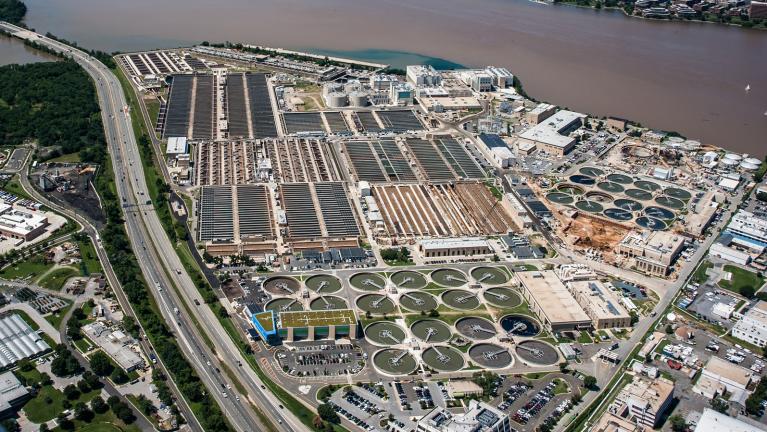
It’s ironic that January’s 243-million-gallon Potomac River sewage overflow came from a break in the 54-mile-long Potomac Interceptor system. That pipe feeds wastewater into DC Water’s Blue Plains Advanced Wastewater Treatment Plant, arguably the finest wastewater treatment plant in the United States. That plant has played the major role in bringing The Nation’s River around Washington back to life, as anyone who has spent time on that portion of the river over the past forty years can attest.
In a funny way, this story is the reverse of last week’s Bay News, about Coastal Virginia Offshore Wind. That story focused on distribution of a valuable commodity—electrical power–that while produced in bulk at a wind farm, we humans need to have distributed in fine scale to our individual homes, businesses, and offices. On the other hand, this story is about fine scale collection of another, negatively valued commodity–human waste—from our individual homes, businesses, and offices for transport to a large treatment plant (which handles around 300 million gallons/day from all sources).
Yes, Blue Plains is a Star in the cleanup of the Potomac River, and has been for half a century. However, DC Water’s overall job is much larger, including approximately 1,800 miles of sanitary and combined sewers, 16 stormwater stations, 75,000 catch basins and manholes, 22 flow-metering stations, and 9 wastewater pumping stations. The authority also has responsibility for reducing stormwater runoff pollution, providing drinking water, and ensuring that more than 9,000 fire hydrants are ready for emergency at a moment’s notice.
The Potomac Interceptor ranges in size from 30” to 96” inside diameter. It serves approximately 376 square miles and about 500,000 people in Fairfax and Loudoun Counties, the Town of Vienna, the Town of Herndon, and Dulles Airport in Virginia, plus Montgomery Count in Maryland. The pipeline carries about 60 million gallons of wastewater daily to the Potomac Pumping Station in Washington, DC, and thence to Blue Plains for treatment before discharge into the tidal Potomac. A product of the 86th Congress in 1960, the pipeline began to convey sewage in 1964. The District of Columbia owns it; DC Water operates and maintains it.
We tend to think that rebar-reinforced concrete lasts and remains impervious to water forever, whether in a sewer line or a large aquarium. It’s out of sight, out of mind. Nope. Ask a civil engineer, or an experienced plumber. Water is amazing in its ability to infiltrate over time. Infiltration might make sense in an aquarium over a period of years, but concrete pipe buried in earth? Remember groundwater, which allows trees and other plants to grow, and at depth gives us wells. The region around Washington, DC receives 40-45” of rain each year, on average.
The Interceptor must snake its 54-mile way down several hundred feet of elevation from the rolling Piedmont land around Dulles Airport to the tidewater location of Blue Plains. The section of pipe collapsed on January 19, between Great Falls and Little Falls. Remember the soaking rainy, snowy weather we had this winter? Alternate freezing and thawing makes both water and soil move. Combined with the weight of soil and rocks around the pipe, that groundwater puts tremendous pressure on buried conduits, especially those made of 66-year-old concrete whose rebar has been exposed to water and air, even small amounts, for that long a time. Concrete erodes, just soil does. In addition, human sewage emits corrosive fumes that hasten the process, especially when they condense inside the pipe, in the airspace above the liquid it carries.
To keep a system like this running, DC Water’s engineers and technicians have, over the years, developed some remarkable tools, schedules, and alarm systems to inspect the authority’s sewer lines, keep them running, and sound a warning when a problem arises.
In spite of the winter weather, within five days, DC Water crews and contractors had constructed a bypass to help contain the overflow. On January 24, using powerful pumps and the C & O Canal, they rerouted wastewater around the collapse and back into the Interceptor. The last overflow reached the Potomac on February 8. Clean-up efforts around the break began on March 2, while the crews completed emergency repairs March 14 and successfully returned the flow to the Interceptor.
According to DC Water, “[c]onstruction has now transitioned to the previously planned long-term rehabilitation of more than 2700 linear feet of the Potomac Interceptor in this area. The work is expected to take 9-10 months and will strengthen and reinforce the pipe to like-new condition.” The next time you hear or read something about sewage or wastewater treatment, remember this story. From large utilities like DC Water, the Hampton Roads Sanitation District Commission, and AlexRenew to smaller agencies like Easton Utilities on the Eastern Shore, public agencies around the Chesapeake–with only a couple of exceptions–have done the most to restore the Bay’s health in recent years. Remember to thank them every time you flush a toilet.