Nutrient pollution is one of the biggest threats to the health of the Chesapeake Bay, and urban areas with antiquated wastewater treatment systems are some of the worst offenders. A number of cities are working to improve their sewage systems, and one Virginia metropolitan area has just hit an impressive milestone in their efforts.
Humans have been taking water out of the ground for centuries, but the Hampton Roads Sanitation District (HRSD) is doing just the opposite. HRSD is returning water into the ground. By adding drinking-water quality SWIFT Water back into the Potomac aquifer, HRSD has just achieved a significant milestone. They’ve now added more than one billion gallons back underground through a project called SWIFT, or Sustainable Initiative for Tomorrow. This is excellent news for the Bay.
HRSD treats approximately 150 million gallons of sewage wastewater per day in southeast Virginia and the Eastern Shore. Most wastewater treatment plants, including some of HRSD’s, treat wastewater then return the highly treated water back into local waterways once it has met all regulatory requirements. HRSD’s SWIFT project is different. SWIFT takes the highly treated wastewater that would otherwise be returned to local waterways and further treats it until it reaches drinking-water quality. Germano Salazar-Benites, a SWIFT treatment process engineer, said the water goes through a five-step treatment process that includes coagulation, flocculation and sedimentation, ozonation, biofiltration, granular activated carbon filters and UV disinfection.
The SWIFT Water is used to replenish the Potomac aquifer instead of being released into the surface environment. The Potomac aquifer is a gigantic underground body of water. Larger than the Great Lakes, it lies under much of the eastern seaboard. Humans have been digging wells and using this water for centuries. As a confined aquifer, it replenishes very slowly, and water is being withdrawn from it faster than it can be replenished naturally.
This means wells have to go deeper. Water pressure underground can be reduced, resulting in the loss of artesian wells. Land can even subside. This is a particular problem in coastal Virginia, where the combination of sea-level rise and sinking land has resulted in more flooding. The SWIFT project will measure land movement with an Extensometer, a device that measures the length of an object. In this case, it can be used to detect tiny changes in ground elevation. The team has already detected movements in the ground from aquifer replenishment at the SWIFT Research Center.
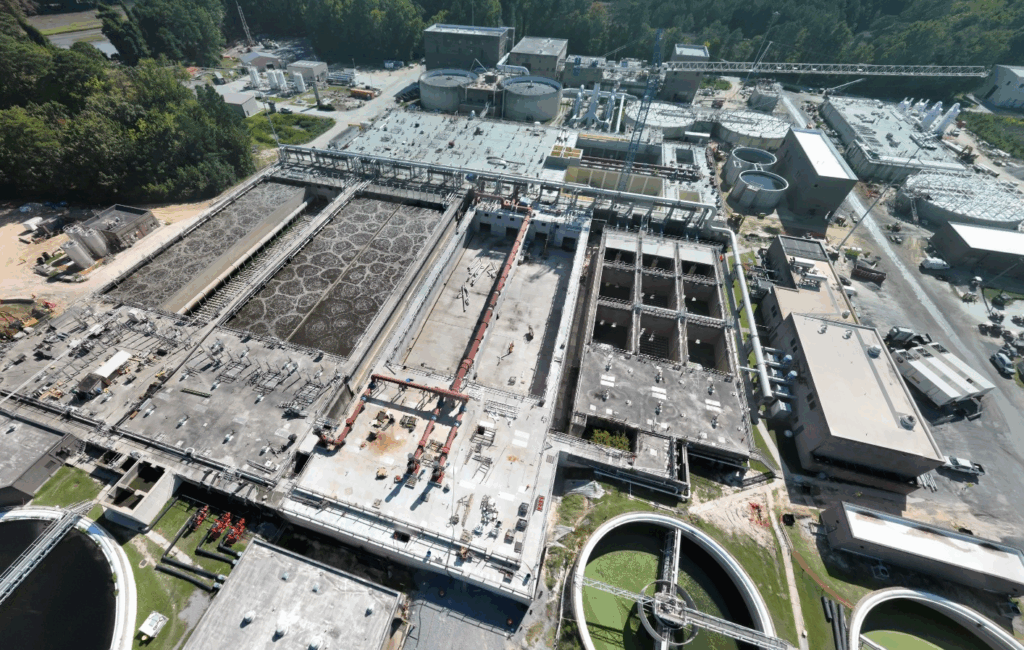
HRSD currently operates the SWIFT Research Center in Suffolk, which can replenish the aquifer with up to one million gallons of SWIFT Water per day and recently achieved the one billion gallon milestone. A full-scale SWIFT facility is also currently under construction in Suffolk, which will have the capacity to replenish the aquifer with an additional 34 million gallons of SWIFT Water when it comes online in spring 2029.
The first full-scale SWIFT facility will open in late 2026 in Newport News at HRSD’s James River Treatment Plant and will be able to replenish the aquifer with up to 16 million gallons of SWIFT Water per day. At the Newport News plant, a larger environmental project includes shoreline stabilization, two miles of new walking trails within Riverview Farm Park (providing public access to river views and the nearby marina), restrooms, and a public meeting space.
Once both full-scale SWIFT facilities are operational, HRSD’s discharges into the James River for nitrogen will be reduced by over 70% and phosphorus will be reduced by over 50% compared to 2021 discharges, representing approximately 45% of the nutrient reductions for the James River needed as part of Virginia’s Watershed Implementation Plan 3.
Overall, the two SWIFT plants will cost $2.8 billion. Part of the money comes from a $1.3 billion low-interest federal loan through the Water Infrastructure Finance and Innovation Act program a few years ago. Learn more about the SWIFT plants here.