Maryland’s new striped bass seasons are in force, permitting catch-and-release fishing (C&R) in the Bay‘s main stem (excluding the spawning reaches above Worton Point). Harvest season is open May 1 through July 31. August is closed to C&R as well as harvest, but the season reopens September to run through December 5, when C&R begins again. (Virginia’s harvest season, by the way, closes June 16 and reopens October 4).
There’s plenty of data documenting low rockfish/striper mortality from C&R in cool winter/spring water–with good handling practices—and high C&R mortality in the water temperatures common in high summer in the upper Bay. Some anglers, however, have argued that springtime C&R fishing affects the behavior of large cow rockfish, causing them to turn away from their spawning grounds or spawn less effectively. It’s a reasonable question, though history tells us that large year classes, especially in the 1990s, occurred when C&R was common, especially on the Susquehanna Flats.
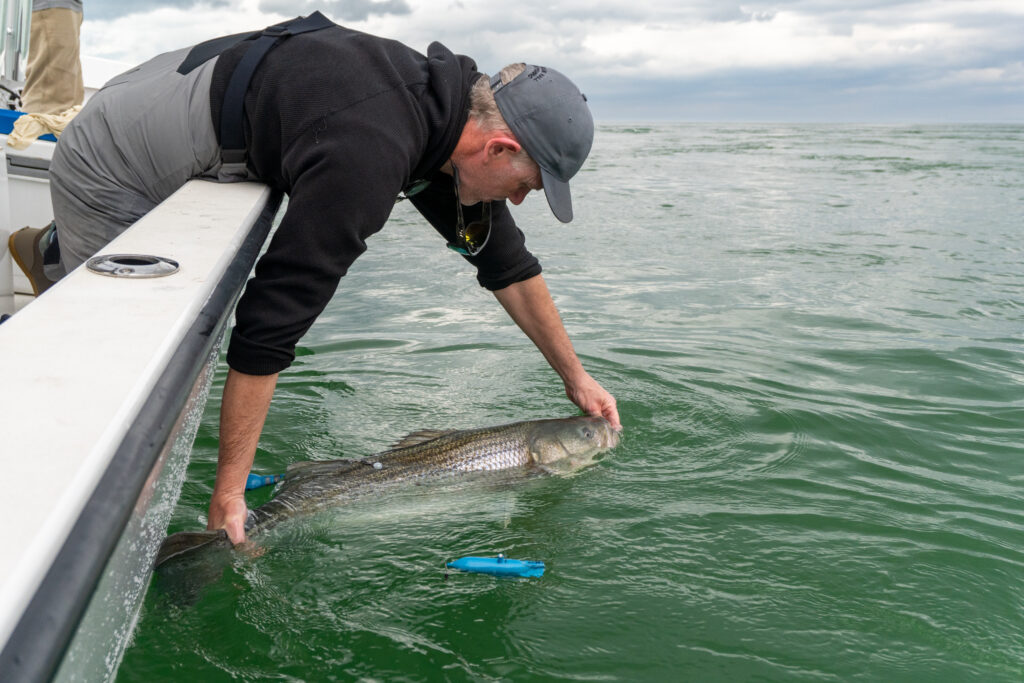
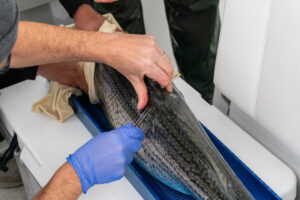
In any case, the scientists at the University of Chicago’s Striped Bass Initiative have developed an innovative tagging program that tracks fish behavior after release. At the end of March, they brought it to the Chesapeake, tagging twenty rock from 38” to 47” in the Bay’s main stem and a couple of tributaries between Point Lookout and the mouth of the Choptank. The first task, of course, was to capture some big fish. For that, they hired Griffin’s Guide Service for five days, along with enlisting several fisheries scientists from Maryland’s Department of Natural Resources (DNR) and operating under a DNR scientific collecting permit. Griffin’s crew provided tackle appropriate for large rockfish, from lures like large jerkbaits (with treble hooks changed out to online singles) and 7” soft swimbaits to high quality rods, reels, and lines sized to keep fight times short. The team picked up the fish at boatside with both rubber and woven nylon nets, placed them on a bump board for processing and tagging, covered their eyes with wet chamois to calm them, and released them always within two minutes (the fastest turnaround was one minute, 5 seconds).
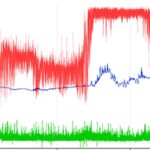
On the Chesapeake, the Striped Bass Initiative employed a combination of two tagging techniques. First, the Initiative used dorsally implanted “data logger” tags that continuously log and archive depth, temperature, light, and location estimate data. The Initiative’s scientists program these tags to release from the fish at set dates, float to the surface, and transmit their stored data via satellite, providing massive, fascinating continuous records of behavior outside the range of the ACT Network. These tags, however, provide only rough location estimates. For the precision required to track the behavior of this study’s C&R fish, the Initiative’s scientists used ingenious SPOT (Smart POsition and Temperature Tag) tags, satellite-linked devices that provide high-precision location data by pinging satellites each time a tagged fish surfaced, recording exact positions in near real-time. They are attached using a tether, so that anytime the fish is close to the surface, the SPOT tag bobs up and sends a location to the satellites.
The Initiative’s crew released all twenty fish they caught with SPOT tags but ten also “tandem tagged” with SPOT + data loggers. Early data is fascinating: all animals have survived surgery and are actively reporting in the Bay, appearing to indicate pre-spawning staging behavior. A careful analysis of the position data over the coming weeks will provide unprecedented insights into where and how they move about the Bay during spawning season.
This is obviously a continuing story. Chesapeake Bay Magazine will keep in touch with the Striped Bass Initiative as this year’s spawning season progresses. The project is already providing fascinating insight into the behavior of the Bay’s beloved rockfish, but there’s much more to come. Stay tuned.