A new study from the Virginia Institute of Marine Science showed that a species of parasitic worm has done more than co-evolve with the crab to withstand salty and freshwaters. It’s also proving to be a helpful tool to manage the Chesapeake Bay’s blue crab population. Published in July, the study comes at a time when surveys show the blue crab population has fallen to its second lowest level in 35 years, and researchers are hungry for clues.
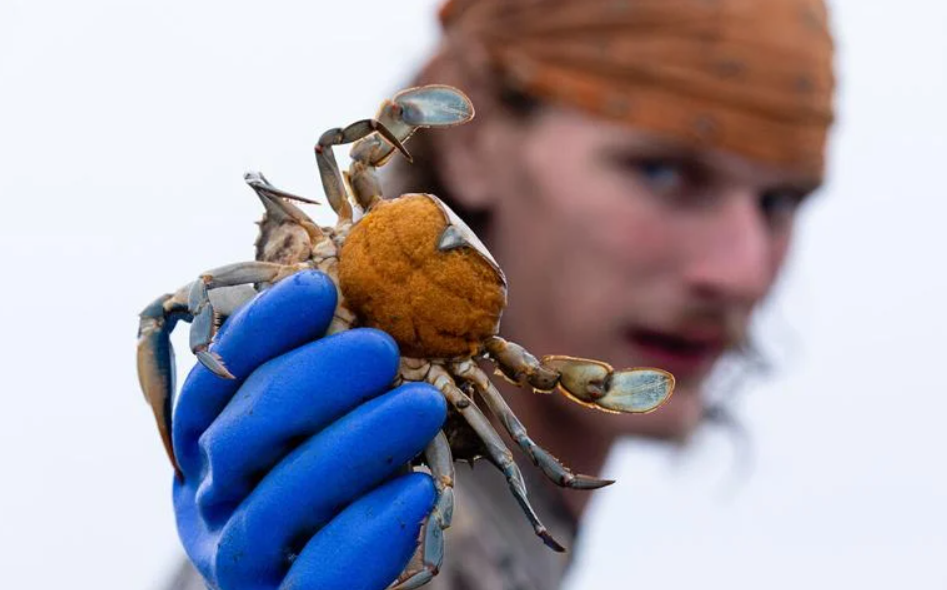
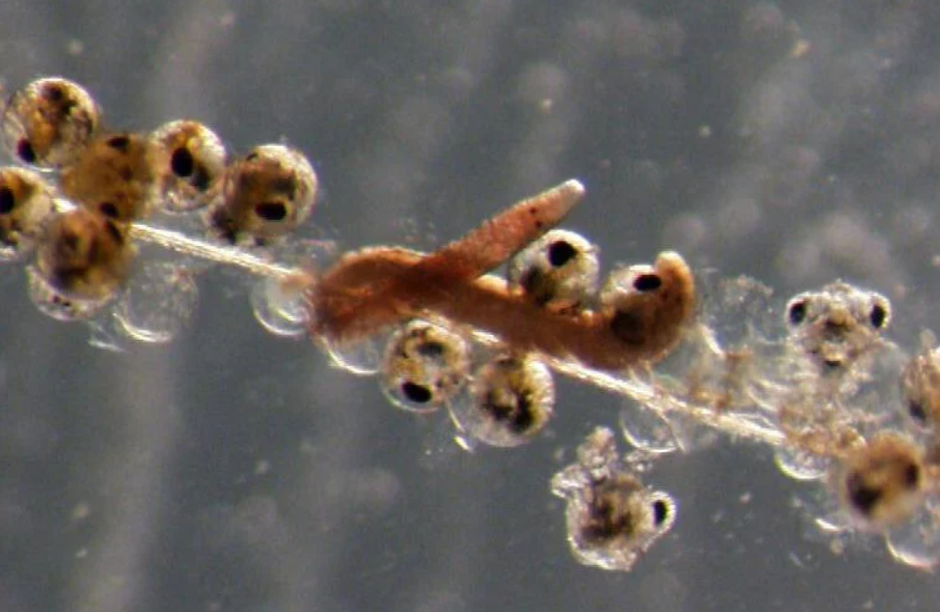
These tiny parasitic worms find safety in the dark, crowded egg sponges of female blue crabs. As they feast on the eggs, they transform from white and small to larger, pink worms. Despite camping out in the sponges, research has shown that they don’t eat enough eggs to hinder blue crab reproduction.
This transformation and colocation have made the worms a biomarker that helps researchers to track whether a female blue crab has reproduced. The presence of white worms means there are no eggs to eat because the crab hasn’t reproduced yet. The pink ones mean that reproduction has occurred.
Alex Schneider, co-author of the study, said blue crabs reproduce less as they age, but it’s difficult to estimate the age of female blue crabs in the wild because they don’t accumulate age bands like fish or clams. But they stop molting once they’re sexually mature, which means the crabs won’t shed the worms during mating season.
“It ends up being a useful tool for us to be able to understand if a female has spawned or not, without having to worry about it negatively impacting her reproductive output,” Schneider said.
Female blue crabs migrate in the Bay toward salty water so their embryos form properly. Schneider and lead author Alex Pomroy suggest in the paper that this species of worm has co-evolved with the blue crab’s migration pattern because it can tolerate wider ranges of salinity than others in its genus.
Schneider and Pomroy analyzed how the worms behaved in water with salinity from five parts per thousand to 30 parts per thousand over five days. The worms did well if they were active and moved away from light.
The study found that the worms died in salinity of less than five parts per thousand. The worms’ responsiveness improved by day four and five in 10 parts per thousand of salinity. Worms in higher salinity remained active over all five days.
The latest dredge survey of the Bay’s blue crab population found that the number of spawning-age females dropped by 19% in 2025 but has remained above the minimum threshold. Using the worms and other variables, the survey also found that about 80% of the females caught will be first-time spawners. This means the current blue crab population is relying on one class of females.
Rom Lipcius, who directs the annual survey at VIMS, said it’s important to protect that class to build a resilient stock with females that reproduce two to three times a year.
“What that means is that the population can spring back rather quickly from being in low abundance, as long as there are enough females that can reproduce,” Lipcius said.
Lipcius hopes to eventually use the data that Schneider and Pomroy collected from the worms to assess the spawning stock.
This article originally appeared at bayjournal.com on Sept. 29, 2025.