By Krista Pfunder Photos courtesy of Dr. Bryan D. Watts, Center for Conservation Biology, William & Mary
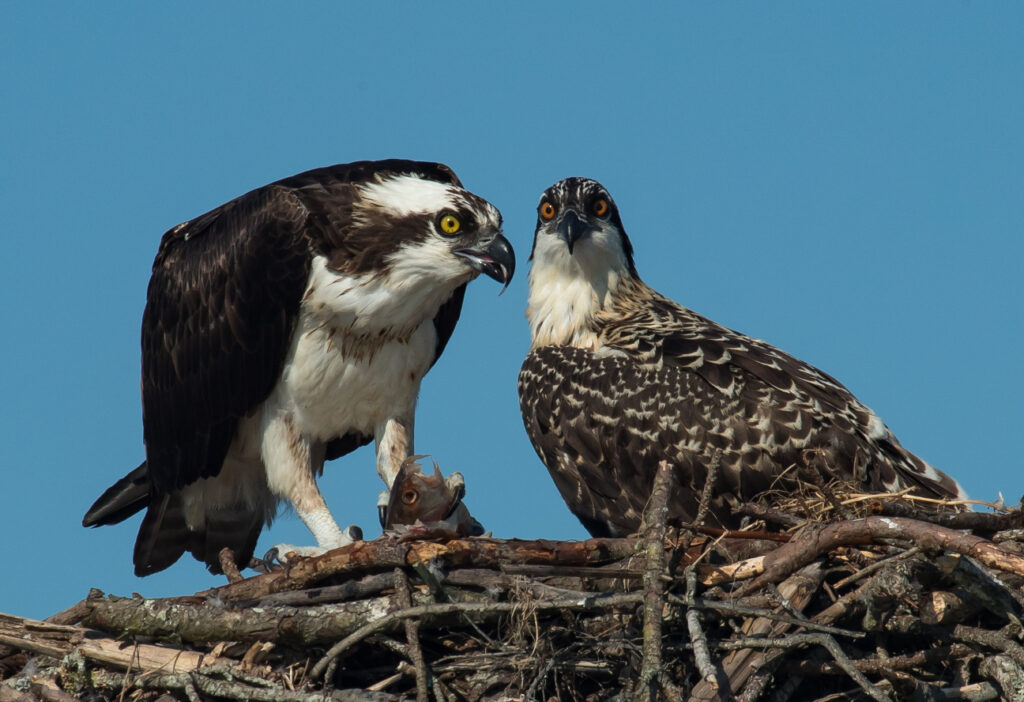
Extreme food stress during nesting season has resulted in poor breeding performance in ospreys in the Bay, according to a recent assessment.
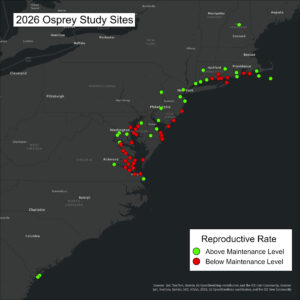
The reported osprey breeding performance in 2026 was the worst ever recorded in the Bay, says the Center for Conservation Biology at William & Mary in Virginia. The study population consisted of 973 breeding pairs from 23 study areas, which include Maryland and Virginia.
Ospreys have long been considered an important indicator of the health of the Bay, in part because a thriving osprey population relies on clean water and plentiful fish.
In recent years, however, the breeding success of the Bay osprey population has declined to critically low levels that now threaten the stability of this the largest osprey population in the world.
The Bay is considered “ground zero,” by the Center. Of the 16 study sites that experienced extreme deficits (below 25% of maintenance levels), 15 of those sites were located in the saltier portions of the Bay. Based on the current trends, the Center says it expects the breeding populations within those study areas to decline at an average rate of -14% a year. This annual decline is dramatic and without a change in course is expected to result in a 50% reduction in these populations over the next decade, says the Center. While Ospreys within the Bay have been experiencing low reproductive rates for several years, documentation of significant birth rate decline is now being observed elsewhere along the Atlantic Coast.
Violent storms, heat stress, predation by raccoons and other raptors as well as human disturbance were once the primary causes of osprey nest failures, but, in the Bay, a threatened food supply is now taking center stage. The primary food source of the Chesapeake Bay osprey is the Atlantic menhaden which accounts for roughly 75% of its diet. Schools of this herring-like fish were once plentiful in all waters of the Chesapeake estuary, but populations have been steadily declining for decades, due to being over-harvested by the omega-3 fish oil industry. The result has been that in some parts of the Bay, the rate of delivery of menhaden to osprey nests has dropped by more than 80% since the 1980s. The shift in diet away from menhaden towards less nutrient-rich fish has resulted in a 50% decline in the energy content of osprey diets. This combination of a reduced rate of menhaden delivery to the nests with the resultant lower dietary nutrition available for juvenile chicks has resulted in greater nest failures and a reduced mean brood size.
“My group has been working osprey in the Bay since 1970 during the height of the DDT crisis,” says Dr. Bryan Watts of The Center for Conservation Biology at William & Mary. “There are some scattered reports going back to the 1930s but significant osprey work in the Bay goes back to the mid-1960s.”
When asked how the public can help support the ospreys, Watts points to the current open public comment period for a possible change to the menhaden harvest limit by the Atlantic States Marine Fisheries Commission. Public comment period is open until October 9 and the Commission will meet at the end of November to re-evaluate local regulations.