For the Pride of Baltimore II and the organization that supports her, the next year-and-a-half brings a remarkable group of interrelated milestones. Fifty years ago this spring, workers began re-creating an open-air “Clipper shipyard” at the western end of Baltimore’s Inner Harbor under the sponsorship of Pride of Baltimore, Inc. Its purpose was to build a new Baltimore Clipper, the first in more than 150 years. She would be the Pride of Baltimore, a name symbolic of the city’s then-current revitalization efforts, focused especially on the maritime heritage of its harbor. It also paid homage to Chasseur, the largest of the legendary Baltimore-built topsail schooners that helped win the War of 1812. Her nickname had been “Pride of Baltimore”.
The new Pride would be a full-size Clipper replica, constructed by skilled shipwrights with period techniques and tools such as the adz, the caulker’s hammer and iron, and the ship’s saw for shaping curving timbers. Some of the fifteen shipwrights came from Belize, others from Maryland. A master shipsmith set up shop on site and forged thousands of special fittings for the vessel.
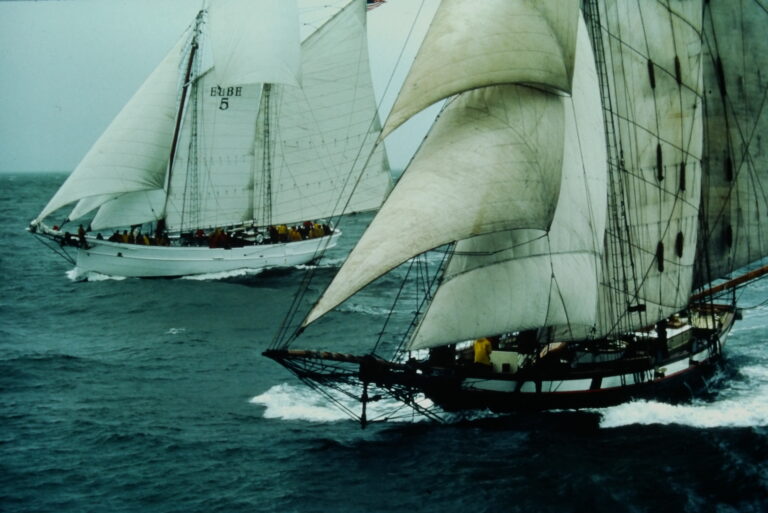
Commissioned with much (justified) joy on May 1, 1977 on her home water, this Pride sailed more than 150,000 nautical miles in nine years as a Goodwill Ambassador for Baltimore. Like her predecessors, she looked fast even tied to her dock, low-slung and graceful, with steeply raked masts. Her crew said she “came alive” on the first strong puff of wind she received on her maiden voyage down the Chesapeake, headed for the Atlantic.
She visited ports along the Eastern Seaboard from Newfoundland to the Florida Keys, the Great Lakes, the Caribbean Sea and the Gulf of Mexico, and the West Coast of America as far north as British Columbia. On her final voyage, she visited European ports in the Irish Sea, the North Sea, the Baltic Sea, the English Channel, and the Mediterranean — the first Baltimore Clipper to be seen in those waters in 150 years. Ironically, on her way home from that voyage, she was struck by a freak squall and sunk off the coast of Puerto Rico on May 14, 1986. The 40th anniversary of that tragedy is coming up in two months.
The loss of the Pride of Baltimore caused overwhelming outpouring of public support that Pride of Baltimore, Inc. could not ignore. By late summer, plans for a replacement taking shape. She would be Pride of Baltimore II, continuing the mission and serving as a live memorial to the original Pride and her crewmembers that were lost. The new vessel, updated with lessons learned from her sister, was commissioned on October 23, 1988, at Brown’s Wharf in Baltimore’s Fells Point, just blocks from the shipyard where Chasseur had been built 176 years earlier.
Since her commissioning, Pride II has sailed over 275,000 nautical miles and visited communities in more than 200 ports in 40 countries in North, South, and Central America; Europe; and Asia. She will participate in America’s 250th anniversary celebrations this summer and the 50th anniversary of her famous sister, while offering not just remembrance, but renewed purpose. She is not a replica of a single historical vessel, but a living expression of the qualities that made Baltimore privateers so effective: speed, power, weatherliness, and purpose. As America approaches its 250th anniversary, Pride offers a tangible link to the maritime strategy, commerce, and innovation that helped secure American independence.Privateering helped win the American Revolution. Baltimore helped shape the vessel that made it possible. Pride of Baltimore II keeps that story alive.