
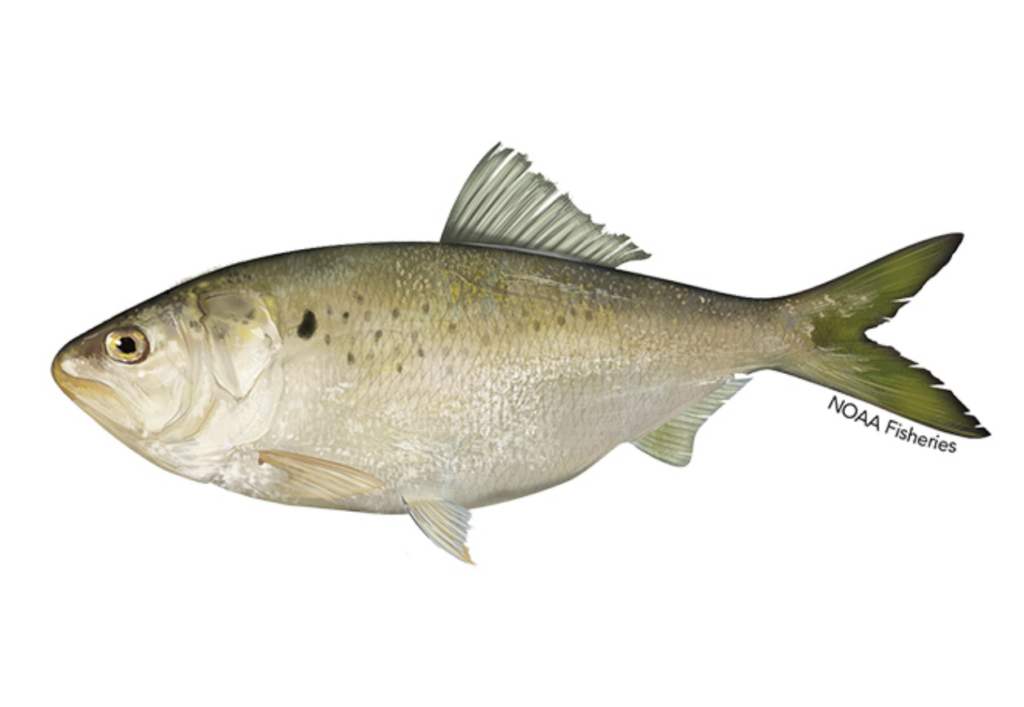
In long, impassioned, contentious sessions over two afternoons last week, the Menhaden Board of the Atlantic States Marine Fisheries Commission (ASMFC) adopted further reductions to both the coastwide total allowable catch (TAC) and the Chesapeake Bay Reduction Fishery Cap. As usual, the struggle ran between recreational angling and environmental groups arguing for a conservative TAC and commercial fishing interests, especially in New Jersey and Maine (lobster bait) and in Virginia (large-scale reduction for industrial purposes and crab bait).
Neither side was pleased by the outcome. Marty Gary, New York’s Department of Environmental Conservation’s Marine Division Director (formerly of Maryland DNR’s Fisheries Service and the Potomac River Fisheries Commission) commented, “I’m struggling like everyone else to say something meaningful…Both sides are so polarized that they’re intractable on both sides of the continuum…Somebody needs to step up, and make some concessions.”
In the end, the Board chose middle-ground TAC levels for 2027 and 2028: 170,000 metric tons (mt) and 155,000 mt, respectively, a 17% reduction from the 2026 TAC and a 34% reduction from the 2025 TAC over the next two years. Their aim was to bring fishing mortality (F) closer to the target for Menhaden Ecological Refereence Points (ERPs) while minimizing socioeconomic risk in the menhaden reduction and bait fisheries. In setting the TAC, the Board considered both the ecosystem benefits of leaving more menhaden in the water and the socioeconomic effects of further restricting harvest. They paid particular attention to potential effects on Virginia’s Northern Neck, where Omega Protein’s reduction plant and Ocean Harvesters’ fleet of purse-seine vessels provide jobs and strong support for the regional economy.
Note the distinction between managing to prevent overfishing, which keeps F above the menhaden threshold (the point where mortality rises high enough to risk stock collapse, and the Fishery Management Plan directs the Board to take action to end overfishing), and setting F at a target low enough to provide a buffer against overfishing. The Board is supposed to set regulations, including the TAC, with the goal of achieving the target, not the threshold.
In recent Menhaden Board meetings, very much including this one, the states arguing for higher harvests repeatedly pointed out that the coastal stock is not overfished (F remains above the threshold), while conservation groups argued for managing to the lower F of the target. It’s almost as if they were talking two different languages, a major factor in the polarization noted by Marty Gary in his quotation above. Basically, the harvest sector is comfortable skating closer to the edge of the overfishing ice, while the conservation sector wants a safer level, to ensure that enough menhaden remain in the water to support as well all of the non-human predators—from seabirds and fish to whales–that depend on them for food.
The Menhaden Board also approved Addendum II to Amendment 3 to the Interstate Fishery Management Plan for Atlantic Menhaden. The Addendum links the Chesapeake Bay Reduction Fishery Cap to the coastwide TAC by setting the Bay Cap as 21.8% of the TAC, instead of a fixed cap of 51,000 mt. Thus, the Bay Cap will be 37,123 mt in 2027 and 33,847 mt in 2028, with a provision for the Board to revisit it at least every 3 years.
Finally, we note that in the real world, on the water, the lower coastal TACs and the new Bay Caps are actually “paper cuts”, because in 2025, the coastwide and Bay harvests fell below even the new 2028 limits, and this season appears to have been difficult again for the Ocean Harvesters fleet. Another worrisome trend noted at last week’s meeting by Marty Gary and several others is that the size and weight of individual menhaden in the reduction catches appears to be getting smaller over the past few years.
Caution flags are obviously flying for Atlantic menhaden both along the coast and in the Chesapeake. Fortunately, there is valuable research finally getting underway by both ASMFC and the Virginia Institute of Marine Science, with preliminary results possibly available in 2028. Stay tuned.