One of the largest wastewater spills in U.S. history continues to unfold along the Potomac River just upstream from the District of Columbia, transforming the “Nation’s River” into an open sewer.
Hundreds of millions of gallons of raw sewage began gushing into the river Jan. 19 after the collapse of a 72-inch sewer line, known as the Potomac Interceptor. A massive effort got underway almost immediately to stop the spill, but the sewage poured out unabated for nearly a week until a diversion could be installed.
By then, as much as 300 million gallons of sewage had escaped from the broken pipe, according to the Maryland Department of the Environment (MDE). That’s enough to fill 400 Olympic-size swimming pools. Despite the temporary fix, the site continued to experience occasional overflows. As this issue of the Bay Journal went to press, the last overflow was reported Feb. 8 amid high wastewater usage during the Super Bowl.
The disaster triggered swimming and shellfish harvesting warnings as far as 72 miles downriver. And it sparked concerns over the possible long-term consequences that bacteria and nutrient pollution would pose to the health of the river and the Chesapeake Bay farther downstream.
Sewage could be seen and smelled at the Mason Neck area, about 30 miles downstream from the spill site, said Brookie Crawford, a Virginia Department of Health spokeswoman.
Potomac Riverkeeper Dean Naujoks said proper maintenance would have prevented the disaster, which he called “one of the largest sewage spills in U.S. history [and] one of the most disturbing things I have ever seen in 25 years as a riverkeeper.”
The Potomac Interceptor is a 54-mile-long sewer pipe extending from near Dulles Airport in northern Virginia to the Blue Plains Advanced Wastewater Treatment Plant in southeast DC. Before the collapse, plans were in the works to conduct a 10-year, $625 million upgrade to sections of the line, including the site of the rupture, to prevent such failures.
As the spill entered its fifth week, President Donald Trump weighed in with a series of social media posts, blaming Democrats in Maryland, Virginia and DC for the disaster. He directed some of his sharpest criticism at Maryland’s Democratic governor, a potential presidential candidate in 2028.
“There is a massive Ecological Disaster unfolding in the Potomac River as a result of the Gross Mismanagement of Local Democrat Leaders, particularly, Governor Wes Moore, of Maryland,” Trump posted Feb. 16. “It is clear Local Authorities cannot adequately handle this calamity.”
He added that he was directing the federal government to assume control of the response.
“The president is lying to the public,” Moore responded in a Feb. 18 post, one of several pushing back against Trump’s assertions.
While the break occurred within Maryland’s borders, Moore and state environmental officials noted, the entity responsible for maintaining the pipe is DC Water, a water authority based in the District and regulated by the U.S. Environmental Protection Agency. And the site where the rupture took place lies within the C&O Canal National Historical Park, which is federal property.
DC Water didn’t make a representative available to comment for this story. But in a Feb. 11 open letter, DC Water CEO David Gadis took responsibility for the break and acknowledged the river’s importance.
“We take seriously the calls from community members and environmental partners for accountability, transparency and long-term solutions, and we are committed to engaging constructively as this work continues,” Gadis wrote.
Asked for comment, the EPA press office pointed to a Feb. 17 social media post under Administrator Lee Zeldin’s X account in which the former New York congressman called the incident a “sewage crisis of historic proportion.”
Zeldin said that DC Water was leading the cleanup and monitoring efforts and that Maryland was providing regulatory oversight of the pollution exceedances in the Potomac. Meanwhile, the EPA has been offering support “from the onset.”
“This mess must be completely addressed as fast as humanly possible,” Zeldin added.
Authorities on both sides of the Potomac emphasized that drinking water isn’t being impacted by the spill. The region’s intake pipes are located at Great Falls upstream from the collapse site, which is just east of Interstate 495 between the river and the Clara Barton Parkway.
Emergency repairs are expected to be completed by mid- to late March. Work was delayed after the discovery of an unexpectedly large “rock dam” stretching 30 feet downstream from the rupture site, according to DC Water. In the meantime, the utility has installed a dozen large pumps to divert the sewage into and out of an ordinarily dry section of the C&O Canal, bypassing the spill site.
A permanent fix will involve accelerating the upgrade plans already on the books. Completion is expected within nine months.
Potomac Riverkeeper Network president Betsy Nicholas said she was troubled by the canal being temporarily turned into what she called an “open-top sewage conveyance.”
“I understand this is essential for the emergency need, but this is parkland,” Nicholas said. “It’s just all mush now of sewage mixed in with sediment, and it’s going to take a lot to fix that. And we’re going to make sure it is fixed.”
Her group estimates that the spill unleashed 75,000 pounds of nitrogen, a form of nutrient pollution, into the river in a matter of days. That’s the equivalent of a yearly load from one of Maryland’s largest wastewater treatment plants. She worries that the influx of pollution will lead to large algae blooms as temperatures climb later this year. The resulting “dead zones” could hamper fish spawning this spring in the river, Nicholas warned.
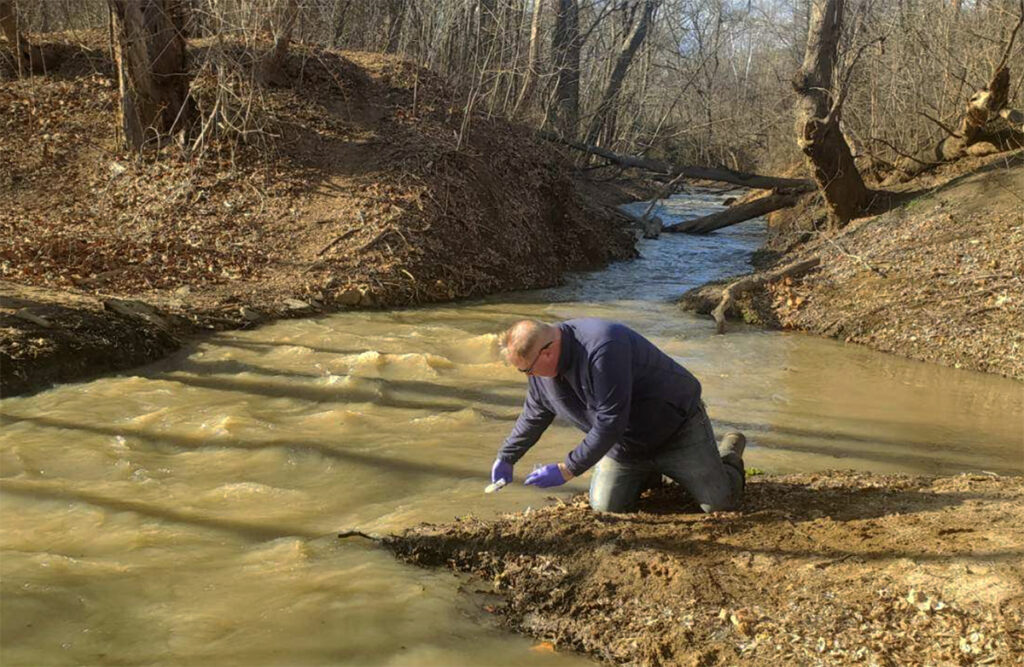
MDE water testing showed E. coli levels spiking in the river near the rupture site in the weeks after the spill, with some days exceeding 1,000 times above the safe-swimming threshold. High concentrations of the bacteria can cause gastrointestinal illnesses, skin and ear infections as well as conditions that can be life-threatening for some people.
But bacteria levels quickly tapered off downstream, suggesting that the river’s flows are diluting the pollution, said MDE deputy secretary Adam Ortiz.
“The reality is that currently the site is very stable,” Ortiz said in a Feb. 19 interview with the Bay Journal. “Overall, we’re seeing bacterial levels decreasing. As long as the material is controlled and being channeled back into the pipe, that’s what we would expect to happen.”
Hillary Harp Falk, president and CEO of the Chesapeake Bay Foundation, said the disaster should serve as a wake-up call for the federal government and states to invest in modernizing the region’s aging wastewater infrastructure. She pointed out that Trump’s 2026 budget request included a 90% cut for the federal fund that helps cities and states finance such projects.
“We can’t afford a repeat catastrophe,” she said.
This story appeared in the Bay Journal on Feb 20, 2026