
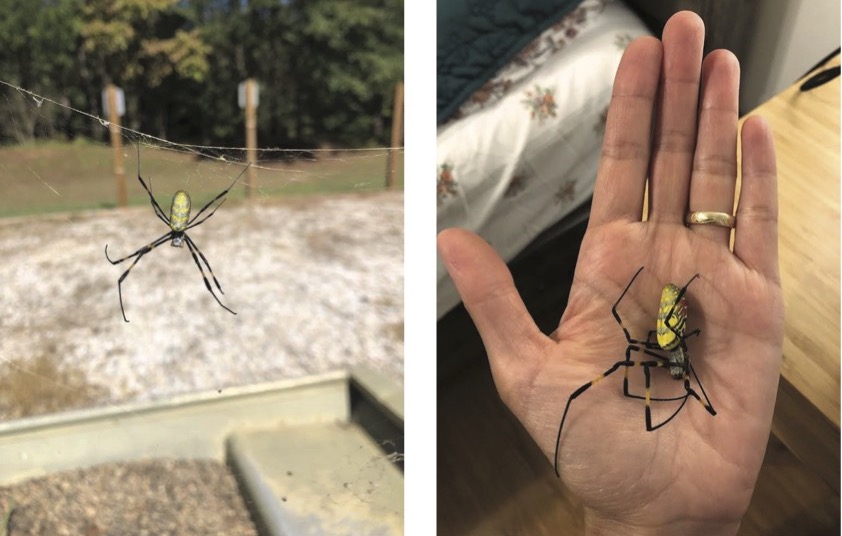
Invasive species are generally known as nasty nuisances (hello, spotted lanternflies and blue catfish). A fairly new species invading the Eastern Shore and Baltimore areas, however, is especially nasty looking. It’s a palm-sized yellow and black spider, and one Upper Eastern Shore scientist is leading the charge to track the expanding species.
The Jorō spider, native to Asia, is currently most visible as adult females reach their maximum size, often with a leg span up to four inches, in the late fall. Its brilliant yellow and black coloring can be mistaken for yellow garden spiders because of their similar size and coloring. Yellow garden spiders are native to Maryland.
Jorō spiders, however, are definitely not native to the Bay region. They had only been seen in large numbers in the U.S. in parts of Georgia, Tennessee, and South Carolina until 2022, when they were first found in Elkridge, Maryland on the upper Bay.
A professor at Washington College in Chestertown is calling for the public to help track the expansion of this spider. To her knowledge, Assistant Professor of Environmental Science and Studies and Biology Angela Chuang is the only researcher studying this “distinct, emerging population in the Northeast.”
Chuang is asking for citizen scientists to photograph and report any sightings of the Jorō spider on the widely used iNaturalist app.
“The main thing is, we would like it if people could report when they see these spiders, so we have a better understanding of how Jorō spiders are spreading around, especially because this is a distinct population from the older one,” said Chuang. “It represents an opportunity to study an invasive population at its earliest stages.”
While invasive Jorō spiders have been studied in the South, the climate difference between there and in the mid-Atlantic could change population dynamics, timing of emergence, and impact on native species.
Before you panic at the sight of this giant yellow spider, Chuang wants you to know that the spider isn’t poisonous. She studied the species as a former researcher at Clemson University and found that even when bitten by Jorō spiders, people had little or no reaction to the bites.
While the Jorō spider isn’t inherently dangerous to humans, Chuang’s chief concerns is the species’ effect on native wildlife. Are Jorō spiders having a negative impact on native spiders? “We have observed them quickly becoming the most numerous spider species within a few short years of them arriving to new sites, which is characteristic of other invasive species,” Chuang says.
To help track the Jorō spider, you can download the free iNaturalist app on your phone and create an account (we like the app for use when we see a plant or animal species we don’t recognize. The crowdsourcing feature will help identify it!) When you spot a spider with bright yellow, blue, and red coloring and a large web, in an urban areas or on the edge of a forest, open the app and select “Observe” to take a clear photo.
You can identify the photo as “Jorō Spider” or simply “Spider”. The iNaturalist community of other citizen scientists will help confirm the sighting, turning your photo into scientifically useful data that Chuang and her colleagues can use to map the species growth and expansion. Chuang encourages people to check for the spiders now, as the conspicuously large females are visible until late November or early December, depending on the weather.
Chuang is also looking for opportunities to study these spiders in the wild. Baltimore and Eastern Shore residents can email her directly at [email protected] to send photos of their findings and invite her team to come study them.