She would rise at 2:30 a.m. and pick 20 pounds of crabmeat and load it aboard the 7 a.m. ferry … cook breakfast and get the kids off to school and clean the house; cut and wrap several hundred soft crabs for market before picking some more and rustling a several course dinner for her husband and four children; and bake an eight-layer chocolate cake for a church supper, ice it and have the cooking pans and bowls washed and put away — in 20 minutes, I have timed her …
That’s how I once described a typical day for Mary Ada Marshall — an understatement, actually, of the pace that Smith Island lady kept. And even though 30 years have passed, it’s hard to write “retirement” and Mary Ada in the same space.
The kids are grown, successful and long gone from the island in the Chesapeake Bay. Dwight, the love of Mary Ada’s life since high school, died four years ago from a heart attack while crabbing in his skiff down Tyler creek. If he had to go, it’s the way he wished.
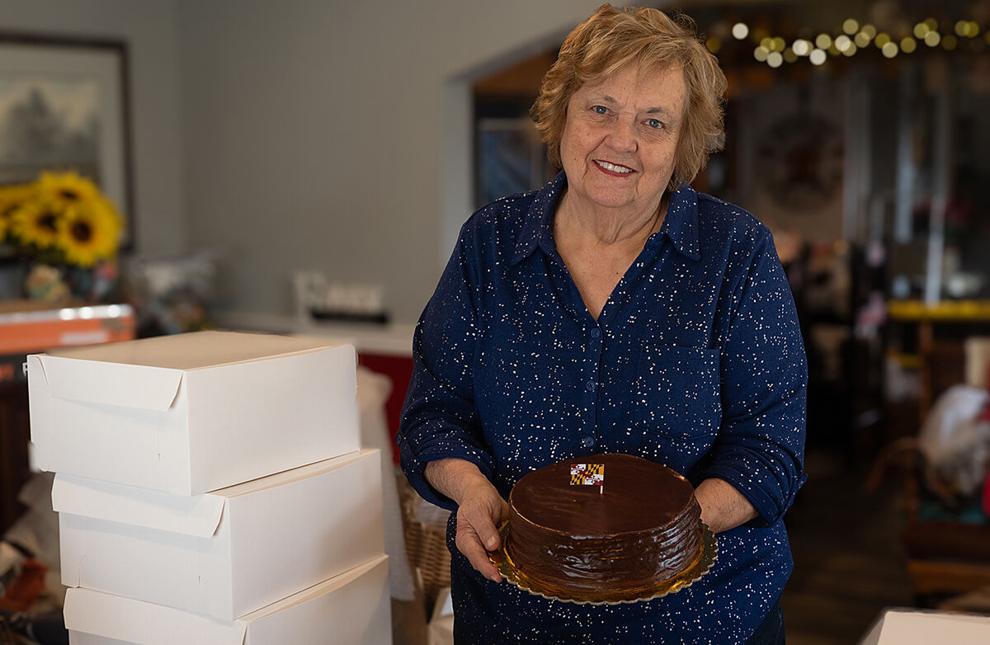
Often called the “cake lady,” Mary Ada lobbied for and popularized Maryland’s official state dessert in 2008. The Smith Island cake features eight thin layers of yellow cake, covered with a rich, satiny, fudgy icing that is also suffused between every layer. Calories? Don’t ask, she says. “It’s dessert!”
For the last two decades, it’s been six to eight cakes a day, 100 or more every month; holiday orders that can involve extra dozens of cakes; up to 1,200 slices baked special for mainland clambakes and crab festivals; more cakes for Chesapeake Bay Foundation education centers around Tangier Sound. Then there are cakes for classes visiting from colleges and schools, cakes for visiting reporters and photographers, and cakes for a 60 Minutes television special. (Two airings of that show resulted in several hundred orders.)
All of this issues from her modest home kitchen in Tylerton, MD, one of Smith Island’s three communities. On a recent December visit, the dining room was full of cake boxes, industrial size rolls of bubble wrap and dozens of miniature Maryland flags that she plants on top of each cake. Orders — three came in while we chatted, from California, New Mexico and Texas — are written down by hand while listening to her answering machine or when she answers the landline herself.
“You want chocolate, okay [she makes more than a dozen flavors]. I’m leveled off with orders [completely booked in island-speak], but I’ll do it for you … Forty dollars, plus five for the ferry.”
She reached her decision around last Thanksgiving — after December, she said, that would be it. Don’t make the Chesapeake Bay Journal a liar and go back to work, I cautioned.
“When you’ve burnt up five double ovens, it’s time to stop,” she said. Double ovens let her bake eight layers simultaneously, four in each oven, so she can “hot ice” them all at once before the fudge-like icing hardens.
“Anything I do, I like to do it right, but the phone never stops, and I’m 78,” she told me. “I just got back from a short trip to Branson [MO] and I had 72 voice mails! Shipping and ferry fees have shot up to $12-$20 a cake, and mailing from 10 miles out in the Bay can mean a cake is in transit for up to three days before it leaves Crisfield.”
I knew I was entering a crabbing culture when I moved to Smith Island in the 1980s and lived there for three years, but I hadn’t realized it was also a cake-baking culture.
Our first winter there, my family was invited to a “cake walk,” played like musical chairs on squares on the floor. Plunk down a quarter to walk, and if you stopped on the right square you won an eight-layer cake. Many of the cakes were cut and displayed in halves so you could inspect them closely before you shelled out good money to walk. My wife, who had considered bringing a modest three-layer concoction, was ever so glad she hadn’t.
Mary Ada thinks those cake walks were the origin of today’s eight-layer classic, unknown when she was growing up here. “Cakes were four layers and one day someone showed up with six and people said, ‘Who made that?’ and that’s probably how it started.”
When a state dessert was proposed in 2008, I recall thinking that it would be a hard sell to legislators. Maryland already had 21 state symbols, from skipjacks and Chesapeake Bay retrievers to jousting and Calico cats.
There were bribes aplenty — hundreds of slices of Smith Island cake delivered to legislators and whole cakes to the governor’s mansion. And Mary Ada, along with Elaine Eff, a cultural historian and cake-maven, charmed both House and Senate.
In classic political maneuvering, the Democratic General Assembly leadership held off voting until the last hours of the session, forcing the cake’s Republican sponsor, the late Page Elmore, to vote for a tax his party hated.
This historic retirement means a loss of more than cake. Mary Ada is also famous for her secret recipe crabcakes, each weighing in at around a third of a pound. Bay Journal photographer Dave Harp and I bought her last-ever dozen, and we’re not reselling them.
Excellent Smith Island cakes will not disappear, Mary Ada says. The whole premise of a state dessert rested on economic development, and a number of other islanders as well as mainland bakeries now make Smith Island cakes.
As for the cake lady, she plans some travel, seeing more of her grandchildren and some quilting (one that hangs in her living room was made from neckties donated by every waterman on the island, whose names she recites as her fingers run over the quilt).
And she is at work on a cookbook, to be as much about her stories of growing up and island culture as it will be about recipes.
Full disclosure: Every June the author of this column receives a magnificent eight-layer chocolate-fig cake from Mary Ada. If you’re gonna take bribes, you might as well go big.
Tom Horton has written about the Chesapeake Bay for more than 40 years, including eight books. He is a professor emeritus at Salisbury University and lives in Salisbury, MD.
This story originally appeared in the Bay Journal, Feb 5, 2026