Happy spring, boaters! Cruising Editor Jody here with something else for you to worry about—or at least think deeply about. As you cruise the Bay this year, remembering to keep a sharp lookout ahead and behind you, you need to look up, as well, and I’m not talking about ospreys. I’m talking about the overhead power lines that occasionally cross our waterways.
Happily, here on the Chesapeake, there are few crossings that we need to deal with, most of them up small creeks, and then usually running next to a bridge. Bear Creek off the Patapsco River is an example. The short lesson in these cases is that if you can’t get under the bridge you can’t get under the powerline. But here’s the tricky bit: Even if you can do that you can’t count on the lines maintaining their stated height all the way across the creek. In fact, often the lines slope significantly as they approach the shore.
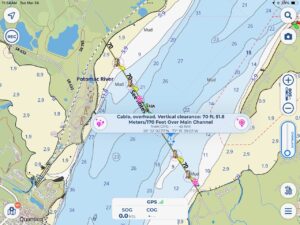
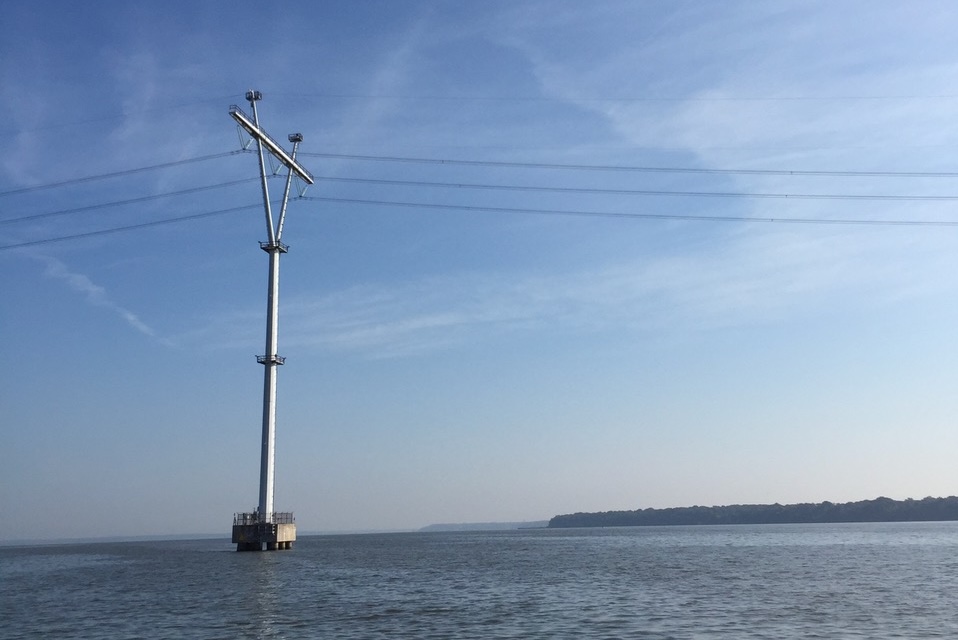
Then again, not all powerlines are accompanied by a handy bridge with its reliably charted height. For example, you’ll find an impressive set of powerlines and towers marching across the Potomac River just north of Quantico, Va. How high are they? Over the channel, they have an authorized clearance of 70 feet. Are they exactly that high? Dunno. And that brings up a crucial point: Unlike bridge clearances, which are given for Mean High High Tide, the heights of overhead lines are not given specifically, only their “authorized clearance.” The power companies do not publish the actual clearances. And, people who do math better than I, say that it is extremely difficult to judge powerline height on the fly. We know the height will change with the tide height, but we need to consider that it also changes with high temperatures, which can cause the lines to sag.
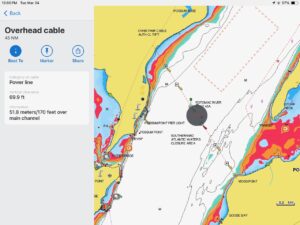
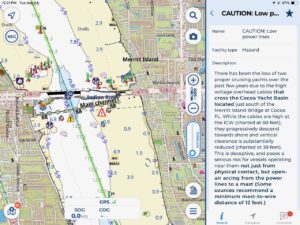
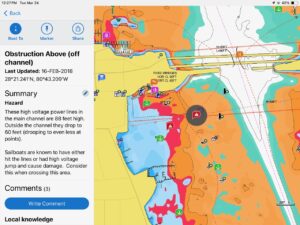
To further complicate matters, charts vary in how they mark overhead cables and how they give the height. Often they are marked as having the same “authorized clearance” all the way across the body of water. Some make it difficult to find the clearance at all. Take a look at the two sets of example charts and you’ll see what I mean. At the tricky Cocoa Beach crossing on the Florida ICW, you have to look at the notes and comments from Active Captain and Waterway Guide members to see that it is a perennial trouble area. We’ll get to that one specifically in just a moment.
First, however, we need to talk about one more very important point.Your mast can clear the lines but still get zapped by electricity arcing between the two. No?! Yes! Zapped as in everything from taking out your electronics to burning your boat to the waterline. The arc from the lines to your mast or antenna can be just as damaging as if you had run into the cable. To make matters even more, um, scary, you can have safely cleared the same lines many times until that time that high humidity, a swarm of bees, a bare line or just bad karma causes the arc to your boat and everything bad that I mentioned happens. I am not making this up. Check out this story in Triton.
So how much clearance do you need to be safe? No one knows for absolutely certain, but the guidance is generally about 12 feet of room between you and the powerlines. No one is guaranteeing that number either. The best thing you can do is go under powerlines only in the main channel and definitely not near the shoreline. Don’t be that guy coming along the Virginia Cut who strayed out of the channel and then swerved into a set of low powerlines while trying to avoid a boat that had sunk after running into the same set of powerlines. (Here’s that story in Soundings:. https://soundingsonline.com/news/power-line-sinks-boat/)
Now, as promised, here is boating safety writer Joan Wenner’s tale of her first-hand encounter with the notorious over-the-water powerlines on the ICW, near Cocoa Beach:
Overhead lines can pose a serious danger to boaters, even if their mast or antenna does not come into actual contact with them. There is the risk of arcing between the lines and the high point of the vessel. These lines pose a particular danger off the main channel, because lthough they are usually sufficiently high over the main channel, they can slope downwards as they near shore.
It’s not as rare an occurrence as many sailors may think, particularly off the popular Indian Cove anchorage on the ICW near Cocoa Beach, Florida. It happened to me and my co-captain there not long ago, and it has happened to half a dozen other over the years.
One sailing couple was crossing the lines here when their boat suddenly exploded and burst into flames, with billowing black smoke immediately visible. Luckily they were seen by two fishermen, who rushed to their rescue then ferried a shoreside fire crew to extinguish the blaze.
For us, we were just outside the main channel when the overhead powerlines arced with our mast, causing a fire within seconds, as molten globs of the melting mast struck the fiberglass deck. It was just before sunset and we had left the channel to allow an oncoming barge to pass safely.
As a longtime resident, my sailing partner knew the waterway well and was aware of the high voltage lines. On the charts, the lines are noted as having an authorized clearance of 88 feet over the channel and 38 feet near the shore. I had seen lights on a barge coming down the river and knew moving far enough from the main channel would allow proper clearance and give it a wide berth. This maneuvering however, diverted our thoughts from the presence of the sloping power cables.
A sudden jolt knocked me down into the cabin from the cockpit stairway where I stood.Stunned for a moment I recall thinking why was the front portion of the boat on fire when the engine was at the stern. As I was contemplating this odd situation, my partner grabbed my arm and pulled me up and out of the cabin away from the fire rapidly engulfing the boat.He had only a moment with a handheld radio to alert the local marine authorities before we abandoned ship,only moments before an explosion that burned the vessel to the waterline in less than 4 minutes.
We were not wearing life jackets were able to swim to a nearby sandbar near Merritt Island bridge. I still had on my denim jacket, which was pockmarked by bits of the fire and melting mast.
Marine authorities soon arrived to the scene, while two highway patrolmen on the bridge that had seen the white flash of a fireball heard the explosion. They raced to nearby Cocoa Marina and commandeered a boat to come out and look for any survivors. They later said they didn’t expect to find anyone alive, but found us on that sandbar. For one of them, it was his first day on the job.
Since that fateful day, I’ve learned a couple of valuable lessons: Either wear your PFD or keep it easily accessible (that’s the law, in fact) and always, always, remain alert to this potential danger just above you.
By the way, the sailboat’s name was Joanies Ark.