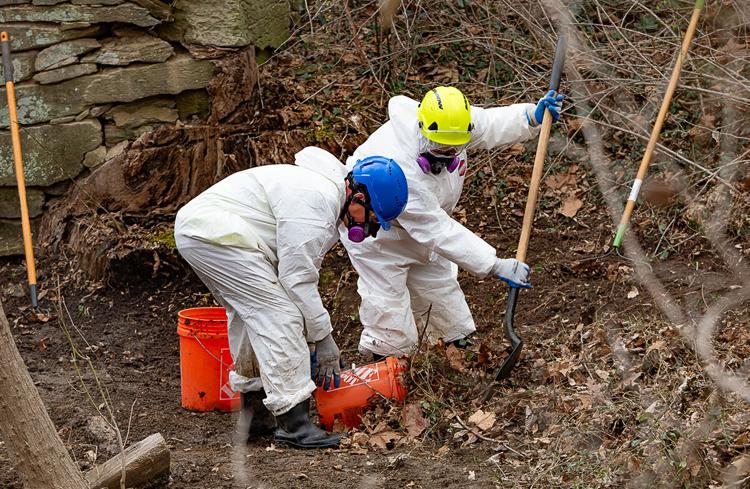
In a wooded gully a few dozen yards from the Potomac River’s north shore, workers put on white hazmat suits, thick gloves, rubber boots, hardhats and respirators. They toiled for hours, using garden hoes and rakes to scrape up the top few inches of soil — along with whatever was in it.
In this case, “whatever” means anything — human waste and toilet paper flushed down toilets, dirty dishwater, food scraps, grease and more — that surged out of a major sewage pipe after its Jan. 19 collapse.
“We’re trying to remove the impacts that were caused by the sewage overflow,” said Amanda Zander, who is overseeing the environmental remediation effort for DC Water, the public utility that owns the pipe. “The intent is to get everything up that wasn’t here before and just restore it back to what it was.”
An emergency repair was completed March 14 on what’s called the Potomac Interceptor, which ruptured just east of Interstate 495 in the Cabin John community of Maryland’s Montgomery County. For the first time in 55 days, full flows returned to the 6-foot-wide pipe. That enabled workers to drain the section of the C&O Canal that had served as an open-air bypass while the pipe was being fixed.
But the mess is far from over. DC Water officials say the historic canal, which is a unit of the National Park Service, will likely continue to reek until the remaining contaminated soils are removed, by May at the latest. A permanent repair of the pipe is slated for completion this fall.
The site’s full environmental rehabilitation, including the restoration of the impacted canal locks, isn’t expected to be done until around the end of this year.
Meanwhile, environmental advocates continue to push for a more expansive cleanup.
“Restoring the immediate damage caused by the collapse is essential, but ensuring full ecological recovery will require a broader commitment to science-based, watershed-scale restoration, as well as transparency and active community engagement,” said Katie Blackman, vice president of strategic programs and partnerships for the Potomac Conservancy. She added that the finalized remediation needs to match “the scale and scope of this unprecedented environmental disaster.”
The collapse is estimated to have discharged between 243 million and 300 million gallons of raw sewage into the Potomac River.
If there has been any silver lining, it’s that the rupture happened where it did, said Dean Naujoks, the Potomac Riverkeeper. Public drinking water hasn’t been impacted because the region’s intake pipes are located upstream from the collapse. And having the C&O Canal on hand to contain the spill was another stroke of luck, he said.
“The C&O Canal has been a huge savior of the river,” he added.
Naujoks called on DC Water and state environmental officials to continue the expanded water sampling in the river into the summer and beyond to assure the public its waters are safe.
“This right here is a popular access,” he said. “This is one of my favorite stretches of the river to float [on]. I swam right here. So, there’s a lot of people that are in the boating community that are just not comfortable taking out [their boats] here.”
Naujoks has continued conducting his own monitoring of the site. His group made public their own testing results March 9, showing extremely high E. coli levels in a ditch that passes through a stone culvert beneath the canal. The announcement suggested that waste passing through the canal was seeping into the culvert’s ceiling and dripping into the ditch below.
Two days later, when a Bay Journal reporter and photographer visited the collapse site, workers with the U.S. Army Corps of Engineers could be seen digging up muck near the culvert, and they had installed a small dam to keep the ditch’s water from continuing its path to the Potomac.
Also tromping around the site that day was a group of inspectors and other officials from the Maryland Department of the Environment. “We’re on the site every single day,” said MDE deputy secretary Adam Ortiz, wearing a hardhat. “And I do periodic check-ins just to see how the progress is coming.”
The pipe collapse began drawing intense scrutiny in mid-February after President Trump called it a “massive Ecological Disaster” on social media.
The nearby parking area off the busy Clara Barton Parkway is crowded with construction trailers, including ones belonging to DC Water, the Army Corps and the U.S. Environmental Protection Agency. The C&O Canal was still a few days away from being drained of its brownish-green torrent, and the air was tinged with a musty, earthy odor.
DC Water estimates that fixing the pipe and cleaning up after the spill will cost $20 million.
All public health advisories for the Potomac River, including a temporary ban on harvesting shellfish, have been lifted, except for the part closest to the overflow site.
The 54-mile Potomac Interceptor receives sewage from a service area of more than 500,000 people, including from Dulles Airport and portions of Northern Virginia and Maryland’s Montgomery County.
The pipe was constructed in the 1960s, and its aging condition has been no secret. A decaying portion of the sewer line just a few hundred yards west of the collapse underwent an emergency fix that was completed earlier in January. Plans were in the works before the collapse for a 10-year, $625 million rehabilitation of the entire line.
DC Water officials were still working to determine the cause of the collapse as of mid-March. But in a public letter, David Gadis, the utility’s CEO, attributed the incident to an unspecified “highly unusual event — one that could not have been reasonably predicted based on the available inspection data.”
DC Water officials in early March released years of structural inspections conducted at or near the doomed section of pipe.
Most recently, last October, a third-party inspector used a video camera to examine the inside of the pipe and found what the firm described as two holes just slightly upstream from where the break eventually happened. Using the industry’s grading standards, the firm, RedZone Robotics, classified both locations as a 5, indicating the highest urgency for repair. (The scale doesn’t prescribe a remaining useful life for each grade.)
DC Water’s engineers, though, dispute those findings, saying the alleged holes were actually dark concrete. No structural failures appeared “imminent” at that time, according to the utility.
A law firm on March 6 filed a federal class-action lawsuit against DC Water on behalf of property and vessel owners near the spill site. The suit alleges that the utility was aware of the pipe’s widespread corrosion before the incident but failed to act on it appropriately.
A DC Water spokesperson has said the utility won’t comment on ongoing litigation.
This story originally appeared in the Bay Journal